





 Markets
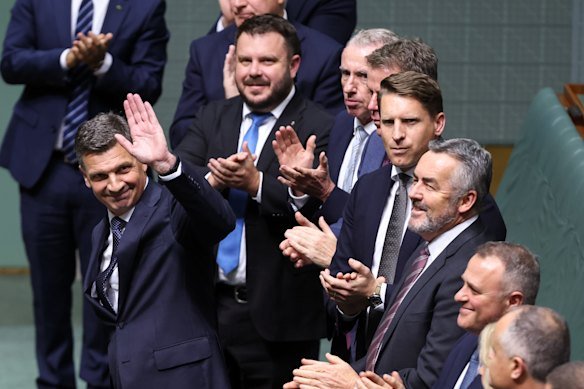
Believe. It was Angus Taylor’s key word in his budget reply speech, but it sums up the budget week that has just been. After many years of sameness, the week marked a regeneration of Australia’s two-party system, with both main parties declaring what they believe in. But it’s not just conviction that drove the bold moves. Everyone in politics right now has one eye overseas.
The weekend before the budget, British Labour had a catastrophic result in council elections, in which the populist Reform UK party made big gains. Prime Minister Keir Starmer’s leadership has been under pressure ever since. Aware of the developing issue, Prime Minister Anthony Albanese told The Australian Financial Review at the start of May that “ensuring people have a stake in the economy” is “how we hold off those surging, right-wing populists you see elsewhere in the world”.
Exposed on his left flank as well as on the populist right, Albanese prefers to frame the populist tide as purely a result of economic disenfranchisement. But Reform UK’s full message is not lost on the Coalition, which has already been overtaken in the polls by One Nation. Voters in developed countries around the world aren’t just worried about economics, they’re linking it to immigration.
Specifically, welfare immigration. In Britain, data on Universal Credit recipients has been made available for the first time, showing 1.5 million non-citizens receiving the payment. Germany is talking about the fact that migrants who have arrived since 2015 now make up nearly half of all welfare recipients. These debates are driving the rise of Reform and the Alternative für Deutschland alongside economic discontent.
On Tuesday, Treasurer Jim Chalmers delivered a budget that was very literally anti-capitalist. Income that is earned by investing capital will be taxed at a significantly increased rate. Australia will then have one of the highest capital gains tax rates in the world. Workers of the world, unite.
On Thursday, Opposition Leader Angus Taylor doubled down on the Liberal Party’s preference for individual aspiration. And he went big, with a move that shows how desperate the position of the Liberal-National alliance has become.
Taylor blew up the bipartisan lurk of pocketing the additional taxes that bracket creep levies on Australians each year, as inflation pushes taxpayers into higher tax brackets and eats away at their buying power. That’s an expensive promise financially, but also politically. Governments love nothing more than handing a fraction back with a flourish to buy your vote around election time.
Taylor also had some explosive promises around immigration. He plans to tie numbers to infrastructure completion (a policy long championed by readers in the comments of The Sun-Herald – yes, I read them). But he’s made it specific: one migrant per completed house. He’s also said he would end access to the NDIS and many other welfare programs for non-citizens living in Australia, including people on permanent residency visas. Taylor’s point is that they’re welcome to become citizens, but that citizenship requires commitment that cuts both ways. That’s why it confers special status above other kinds of participation in Australian society.
As expected, partisans on both sides are wailing about the perfidy of their opponents. How the cards fall as the electorate absorbs the information will be telling. We will discover something about who’s better at political messaging, and a lot about the soul of the nation.
The early indications are that Australians are not anti-capitalist. The response to increasing the capital gains tax has surprised Labor. Business owners are livid that the government has effectively made itself an equity partner in ventures they have built through innovation, risk and countless hours. Young Australians investing to amass a home deposit faster are among those upset that the tax will push them backwards. People who aspire to an investment portfolio that will allow them to step back from salaried work one day see their hopes of financial independence compromised. The headlines have been negative and the memes – the currency of the online world, to which Labor says it has shifted its campaigning – are pretty sour on this reform as well.
Had the government only removed the ability to negatively gear existing housing stock, without changing the CGT, that policy might have been popular. But pulling the rug on all kinds of investments denies young Australians the opportunity to build wealth the way earlier generations have. After all, so many politicians have used negative gearing to feather their nests. The grandfathering of negative gearing – which means people who’ve had it until now will not lose it on their existing properties – looks and feels like pulling the ladder out from under younger generations.
The government that won the 2022 election on “more of the same, just not Morrison” – and the 2025 election on small-target politics while Peter Dutton self-immolated – is discovering that the big Labor agenda they proposed and lost on in 2019 is still not terribly popular.
It remains to be seen if Taylor’s contribution will fare better. In some ways, the outrage from Labor will be helpful to him. As soon as Taylor’s speech was over, Housing Minister Clare O’Neil claimed that the policy to abolish bracket creep was unaffordable, which plays into the opposition’s narrative that Labor regards your money as its own.
The initial response to Taylor’s proposal to restrict social programs such as the NDIS to Australian citizens has mostly been surprise. Along with many other Australians, I had assumed citizenship was the threshold. It turns out that many of us don’t know the terms of the social contract we live under.
An argument against the restriction, most notably mounted by RedBridge commentator Kos Samaras, is that some permanent residents – he is talking about Chinese non-citizens in this case – would have to give up their first nationality to take on Australian citizenship and that would cut them off from “property, inheritance, bank accounts, pensions and business interests” in their country of birth. It’s a peculiar argument, as the logical follow-up is whether non-citizens should be entitled to the Australian social safety net if they have access to significant overseas assets.
The next two years until an election will see these arguments evolve. Not granted a formal budget reply speech was Pauline Hanson, but in reality she was a spectre in both. Australians have been asked by the main parties to back what they believe. It might turn out that they believe One Nation – because it forced the main parties out of their torpor.
Parnell Palme McGuinness is an insights and advocacy strategist. She has done work for the Liberal Party and the German Greens and is a senior fellow at the Centre for Independent Studies.
Get a weekly wrap of views that will challenge, champion and inform your own. Sign up for our Opinion newsletter.
 Parnell Palme McGuinness is an insights and advocacy strategist. She has done work for the Liberal Party and the German Greens and is a senior fellow at the Centre for Independent Studies. She is also an advisory board member of Australians For Prosperity, which is part-funded by the coal industry.
From our partners
Read the full article here