



 Markets
  Weather
Updated ,first published
Corruption-busting lawyer Geoffrey Watson SC was angry about CFMEU administrator Mark Irving’s direction to remove politically sensitive material from a report into corruption in the union’s Victorian branch, but has backed him to remain in the role.
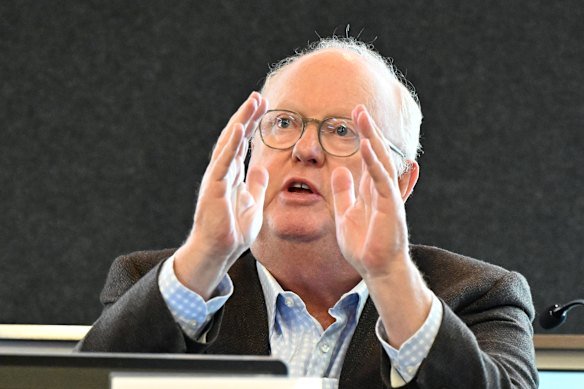
Watson revealed details of a late January phone call between the pair in evidence on Wednesday to Queensland’s royal commission-style inquiry into the CFMEU and misconduct in the construction industry.
The inquiry was shown how the original version of Watson’s report was changed – with sections on government inaction, and estimating the CFMEU cost Victorian taxpayers at least $15 billion removed – hours after the redactions were first reported by this masthead.
Launched by the Queensland government last year after reporting by this masthead and 60 Minutes into criminality, corruption and misconduct in the CFMEU and construction industry nationwide, the inquiry resumed its public work on Tuesday.
Two weeks of public hearings last year featured evidence from Watson about his report on violence in the union’s Queensland branch, and also heard from Irving and two state labour movement leaders outside the CFMEU.
But it was Watson’s since-completed probe into the Victorian branch that was the focus of the inquiry on Wednesday. Counsel assisting, Mark Costello KC, said there was a risk that similar problems could arise in Queensland if the right lessons were not learnt.
Watson’s Victorian report outlines “eight factors which wrecked the CFMEU”, including the union’s contempt for the law and takeover of civil construction sites, a rapid increase in money under the state’s “Big Build”, growing contractor fear, and government inaction.
The influence of gangland figure Mick Gatto, and ousted union figures John Setka and Joe Myles, rounded out the list.
Costello questioned Watson extensively about why Irving had asked for the changes, prompting Watson to recall the phone call in which Irving told him three key elements of the report needed to be cut.
These outlined claims that the Victorian Labor government turned a blind eye to union malpractice, an estimate that the CFMEU cost taxpayers in the state at least $15 billion, and an exploration into how delegates were appointed.
Irving was said to have argued during the conversation these were outside the terms of reference, not supported by experts, not factual, or were “speculative”.
Watson told the inquiry he felt “quite angry” and frustrated by the move, which he did not feel was justified. “It’s speculative to say the sun will come up tomorrow,” he added.
Ultimately, Watson said he accepted the directive so he remained covered by the statutory immunity granted to the administration and those working under it, “but I didn’t accept the direction was properly based”.
During a brief adjournment in proceedings, Watson appeared to have read a news story on his phone about federal opposition calls for Irving to stand down, and immediately – without any prompt from Costello – shot the calls down.
“I might have said some harsh things here today, but in my opinion … I’ve never met a more honest and decent man,” Watson said. “They’d be mad to get rid of Mark Irving.”
Irving released a statement on Wednesday paying tribute to Watson’s work in preparing his final report, saying it documented serious allegations of criminal and improper conduct.
While noting the matters had not been tested through the courts, he said the report would be referred to police, the Fair Work Commission and “other relevant law enforcement agencies and regulators”.
Victorian Attorney-General Sonya Kilkenny said her government would not respond to accusations in the report until it was made public.
That state’s opposition leader, Jess Wilson, said Victorian Premier Jacinta Allan needed to answer questions and “cannot continue to deny knowledge, or fail to take responsibility”.
Watson said there was little that worried him about details removed in the process of preparing reports into other branches of the union since this masthead’s original reporting.
For example, he had written about violence at the Queensland’s Oaky Creek coal mine because “it was the worst example in the whole of the Queensland report”, and ousted state leader Jade Ingham was present.
But, ultimately, Watson said it was reasonable that it was not included in final reports handed to Irving because it technically involved the mining division of the union – not the construction and general division under administration.
Watson said he had been always open to discussing factual inaccuracies and changing his work. But he said some concern over his draft Victorian report, alleviated by the departures of key state union figures, had returned in only the past two weeks.
“I’ve heard stories that some of the people who took redundancies walked out of the CFMEU offices and went to some of the employers and said, ‘I want a job as a delegate’,” he said.
The inquiry continues.
Start the day with a summary of the day’s most important and interesting stories, analysis and insights. Sign up for our Morning Edition newsletter.
 Matt Dennien is a reporter at Brisbane Times covering state politics and the public service. He has previously worked for newspapers in Tasmania and Brisbane community radio station 4ZZZ. Contact him securely on Signal @mattdennien.15Connect via email.
From our partners
Read the full article here