





 Markets

I expect that Pauline Hanson is merely investigating the source of all those immigrants who come here to take Australian jobs (“Hanson’s Europe vacation reveals One Nation dissent”, July 17). How very kind of Gina Rinehart to help her out. It must be quite an ordeal, having to rub shoulders with all those Brits whose “conservative” values barely reflect Hanson’s view of bludging lazy workers trying to rip off their bosses, and foreigners flooding the land. It must have been a relief to her to meet that nice Robinson man, who is so helpful in reinforcing her concerns. Pity about Farage, though; is it true he resigned from office just so he had an excuse not to meet our Aussie? Nola Tucker, Kiama
It is encouraging to learn One Nation is in disarray. Only time will tell if it can maintain the popularity status it has accrued in recent times. Barnaby Joyce is not happy with Pauline Hanson’s latest exploits in the UK. How can anyone support Hanson and her meetings with the extreme right in the UK? I look forward to the next chapter of this rocky pathway for One Nation. Robyn Lewis, Raglan
I wonder how many supporters of Princess Pauline can afford to pay $1000 a night to stay in a luxurious hotel anywhere, never mind one in Sicily? She will, no doubt, come up with her usual illiterate justification for what she does. It really is time everyone should stop listening to her. Richard Vielie, Hunters Hill
We have just returned from Sicily, where we gave Taormina a wide berth because of the swanky level of prices and a retiree’s holiday budget. It is astonishing to see how Pauline Hanson has quickly embraced the high life in Taormina. Of course, a leg up from Ms Rinehart has its benefits, at close to two-grand-plus a night. Wondering if a homely, welcoming plate of fish and chips is on the menu. How quickly, with the sniff of the luxe life, it could be for PH to lose touch with the battlers in the real world that she supposedly wants to serve. Greg Vale, Kiama
Easy to get it wrong
Pauline Hanson’s UK trip, her sojourn in a luxury resort in Italy with Gina Rinehart, the meeting with Tommy Robinson and the argy-bargy in the party over what policies, ideas and people it supports (“Top One Nation staffer breaks silence on Hanson’s UK trip as Joyce fumes back home”, smh.com.au, July 17) all highlight the complexities of politics and the weakness of populism. When a party is associated closely with one person, and its policies are based not on a set of agreed principles but on their opinions in the moment and their best guess of what potential voters might want, it’s easy to get it wrong, as Hanson has probably done both in Italy and with Robinson. When your supporters believe that you genuinely share their particular values and prejudices, they expect you to act in accordance with them. It’s a tricky path, as she is finding out. Adding to her difficulties are her numerous colleagues with few ambitions for the party other than their own leadership ambitions. They’re unreliable at best, dangerous at worst. Those of us who don’t support One Nation can only hope the complexities of the situation are too much for Hanson, and the rest of them, to negotiate with credibility, and that the cracks continue to widen. Prue Nelson, Cremorne Point
Prime omission
Waleed Aly always makes a sound argument (“Hanson’s new stuff an old turn-off”, July 17). However, this time he misses one major point: Pauline Hanson will never be prime minister. Not because she is a bigot or a fool but because she is female. Australia has not yet proven it is ready for that, and while Julia Gillard slid across the line with perfectly cut hair and intelligence, she was still labelled a witch. There is no way a grim, old, inarticulate woman is going to knock down those sexist barriers. Ironic, isn’t it? Sue Dellit, Austinmer
Worst advisers
Why is it that arguably Australia’s two worst prime ministers, Scott Morrison and Tony Abbott, keep offering gratuitous advice and opinions to the government and anyone in the media who will listen (“Morrison urges Australian military help in Gulf”, July 17)? These two private citizens’ opinions are hardly newsworthy nor helpful. Morrison’s idea to put Australian military personnel in danger in a conflict started by an unstable and erratic US president with no clear operational plan or exit strategy, personnel who would be under US command, is both ludicrous and unnecessary. The rumours of Abbott making a comeback to face off against Zali Steggall are even more ridiculous as Abbott is even less popular in Warringah than when he was defeated, and Steggall has shown a level of community involvement and representation that has resulted in her popularity and electoral support skyrocketing. Can’t these two men find some other interests to entertain them in their advancing years and the media stop giving their random utterances oxygen? Alan Marel, North Curl
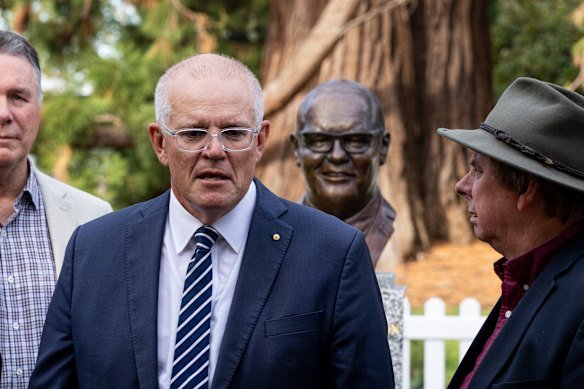
Scott Morrison made a number of less than edifying decisions when he occupied this country’s big chair and that trend seems to be continuing. Why would we shackle ourselves to the self-proclaimed “great dealmaker”, Donald Trump, whose lightbulb ideas change the international scene with predictable regularity? We have already provided the US with billions of dollars by signing up to the AUKUS agreement, the benefits of which are likely to be late, futile and more costly. Thanks for that, Scotty from Marketing. Lyn Savage, Coogee
Scott “put not thy faith in politicians” Morrison thinks Australia should send military assets to defend free shipping in the Persian Gulf. All respect but surely we don’t have the resources to pick a fight with the US. Richard Horsley, Alexandria
Trump still has his eye on winning the Nobel Peace Prize as the only world leader ever to have ended the same war 37 times (and counting). Meredith Williams, Baulkham Hills
Forgotten element
Modern slavery and child labour is too important an issue for the NSW Anti-slavery Commissioner to apparently have only one item in his sights (“Slavery builds many EVs. What if our government’s a buyer?” July 17). The EV industry is changing rapidly and the majority of new EVs sold today have batteries that contain no cobalt. I would have thought that is a critical point to make but the Commissioner didn’t mention it. The majority of cobalt is used for other things – rechargeable batteries in phones, laptops and small appliances, magnets, medical equipment and aerospace. The Commissioner did not mention those, either. And, curiously, no mention is made of the fossil fuel industry using cobalt for more than 90 years in the refining of crude oil. Brendan Jones, Annandale
Waste time
Your correspondent rightly highlights that waste-to-energy facilities are just a smokescreen hiding the sheer volume of waste we produce (Letters, July 17). These massive incinerators pose major risks to human health and the environment. The cocktail of chemicals released when plastics burn includes toxic forever chemicals that bioaccumulate in the environment. The Geelong community has been opposing a waste-to-energy proposal in Lara for six years. Why isn’t there more focus on generating less waste? We all know the three Rs: reduce, reuse, recycle.
Vicki Perrett, Indented Head (Vic)
England wasn’t robbed, just beaten
England’s elimination by Argentina has once again unleashed a familiar chorus of lamentation from sections of the British press about curses, misfortune and six decades of hurt (“Expectations crushed as fans ride wave of emotions”, July 17). One might be forgiven for thinking England had been denied an inheritance rather than defeated by a better team on the day. France, pre-tournament favourites, bowed out to Spain without comparable hand-wringing about destiny betrayed. Football’s great powers – Brazil, Germany, Argentina and France among them – know that reaching the latter stages of a World Cup is an achievement, not an entitlement. Winning it is a privilege earned over 90 minutes and, often, through resilience and tactical nous. England’s solitary World Cup triumph came in 1966, on home soil. That history deserves respect, not perpetual instalments on a debt supposedly owed by fate. Shakespeare perhaps said it best in Julius Caesar: “The fault, dear Brutus, is not in our stars, but in ourselves.” England was not cursed. It was beaten. May the better team on the day prevail, and may patriotic self-entitlement yield to sporting humility. Joseph Ting, Carina (Qld)
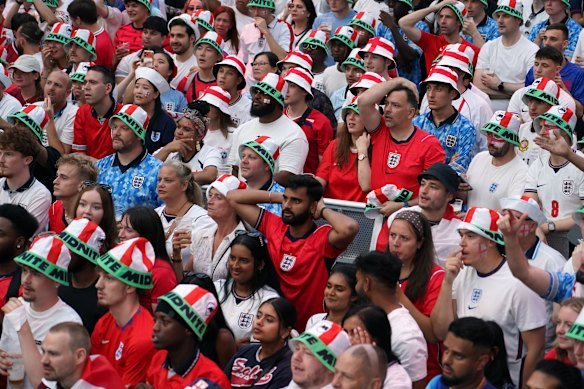
The FIFA World Cup in general and England’s loss to Argentina in particular has reinforced my view that professional sport has become as much a theatre for the expression of agony and ecstasy as an arena for the demonstration of skill and athleticism. So be it, but I am concerned that the former may further infect junior sport, where the emphasis should be on the enjoyment of participation, and encouraging a love of healthy exercise. When I was a junior soccer player and later a coach, a goal received light applause and encouragement to keep up the effort. In contrast, now a goal in my granddaughters’ soccer matches is akin to the unexpected return of a given-up-for-dead friend, with players and substitutes running from everywhere to embrace the goalscorer. Just as Queen Gertrude in Shakespeare’s Hamlet called for “more matter, with less art”, I ask for “more football, with less hysteria” in all codes at all levels. Paul Casey, Callala Bay
Whether 32, 48 or 64 teams in the Cup, qualification can be greatly improved for fans. Presently, 220 national associations play in six unequal confederations. The qualifying competition would yield better games if conducted to select an equal number of teams from the world’s four main geographic regions – Europe, Americas, Africa and the Asia-Pacific. For the sake of fans, the confederations should co-operate for such a competition. Respectively, the four regions have 55, 51, 54 and 60 national associations. In this World Cup they qualified, respectively, 16, 12, 10 and 10 teams. Equal teams from each region is not a big step. The Asia-Pacific, 59 per cent of the world’s population, grows in football strength. Australia would occasionally beat New Zealand at a sport, and the Pacific nations would compete as the sixth sub-federation in the Asia-Pacific, avoiding undue China influence. Peter Egan, Adelaide (SA)
It’s interesting that so much has been made of England’s ongoing World Cup football drought of 60 years, but the fact is that they’ve only won once, way back in 1966. Out of all FIFA member associations, there are 203 countries/territories that have never won the trophy and of the 211 current FIFA member nations, only eight have ever been successful, so let’s just keep things in perspective. George Zivkovic, Northmead
Age is immaterial
As an ageing, but by no means old, general practitioner, I would like to respond to Jo Pybus article (“On the cusp of a senior’s card, I’m rethinking my ageism”, July 17). I graduated as a doctor aged 39 years after several other health careers. I now facetiously claim the age of my medical school cohort, my medical age, of 51-52 years. I endeavour to earn this by working full-time 50 to 60 hours per week, engaging daily in continuous ongoing education and accessing the superior IT knowledge of experts, my young colleagues and adult children. I endeavour to keep an open mind but am firm about using science as the basis for management advice. Please don’t judge or be judged by age alone. Jane Hunt, Cremorne
Jo Pybus has an interesting take an ageism. I’m an octogenarian and most doctors are younger than me but, as long as you have confidence in your GP and any specialists you are referred to, age is immaterial. Change your GP if you are unhappy with the advice given but be grateful that medical science continues to improve in so many areas. Ageism is simply a word, not an untreatable condition. Denis Suttling, Newport Beach
Loyal customer
I was sorry to read about your correspondent’s experience with her local pharmacy (Letters, July 17). Our local pharmacists are tops. Not only are we on first-name terms, but one day when I arrived with a script but without my wallet, barter was suggested. I countered with an offer to recite a piece of Chaucer in Middle English. This was accepted with alacrity, and I regaled the audience with a few lines about a poor elderly widow. My script was duly supplied in exchange. I did return later with my cash. John Flint, Naremburn
AI takeover
All those businesses scrambling to get the edge on their competitors by replacing their employees with AI (“China’s economic divide widens in protectionism era”, July 17), don’t seem to have twigged to the fact that AI won’t be earning an income and therefore won’t be buying their products and services. David Atherfold, Avalon Beach

Who benefits from increased productivity if you’re out of a job? It’s a rhetorical question. Dick Clarke, Elanora Heights
During these school holidays, with less traffic, the drive to work has been great. And since AI will be doing kids’ homework from now on, they don’t need to go to school nearly as much. This could be the time to make school holidays a lot longer to keep the traffic flowing and reduce pollution at the same time. Mark Anderson, Coogee
Power in the wrong hands
In 1964, following alleged reports that North Vietnam had fired on two US ships in the Gulf of Tonkin, the US Congress gave Lyndon Johnson unlimited authority to attack North Vietnam (“US president sets his sights on Iran’s hidden nuclear fortress”, July 17). Johnson’s basic strategy for getting out of the war was to bomb North Vietnam into submission and overwhelm them on the battlefield. Neither strategy worked. Subsequently, Congress clawed back presidential authority, reasserting its sole right to declare war. Unchecked executive power and impotent congressional oversight took the US into one of its most disastrous wars, and is doing so again with Iran. John Bailey, Canterbury
Priced out
Why wouldn’t home ownership plummet when government hands over planning decisions to developers whose only criteria is profit (“Rate of ownership hits 70-year low”, July 17)? Luxury apartments and homes are being built all over Sydney in areas deemed to produce maximum profit, under the aegis of the Minns government. Take my local area of Pittwater. A development in Mona Vale proposed 30 apartments; now that development will have 81 apartments. You would think this is beneficially adding to our housing stock, except for the fact that these apartments will have $2 million-plus price tags. Yes, there are “affordable” apartments, but we have all learnt how disingenuous that is. And developers are running this scenario all over Sydney. What’s needed is housing for the less well-off and young people. The NSW labour government should be condemned for its contribution to our falling rate of home ownership. David Catchlove, Newport
Up in smoke
Sydney’s trams should adopt a new slogan: “Catch Alight Rail” (“Trams boss sorry for ‘totally unacceptable’ light rail fires”, July 17). Doug Walker, Baulkham Hills
Brewhaha
Your correspondents rightly draw attention to the quality of coffee beans for the enjoyment of a good brew (Letters, July 17). However, it pays to consider also the milk component. Towards the end of the lunch shift at one of Melbourne’s celebrated laneway cafes, the barista sat down at our table for a yarn about making good coffee. One of his tricks was to use the same kind of milk in white coffee, no matter what kind the customer ordered. He insisted no one ever protested about the milk he used. That was, of course, before the days of flavoured “milks” like almond and coconut. Megan Brock, Croydon

As a former denizen of the wonderful Bar Coluzzi from the good old days, I also agree that Australian coffee has so much to offer in comparison with many other countries. I remember arriving in America and having to resort to going to Starbucks for a coffee, it was a complete disaster. Watery, flavourless froth. And finding a cafe that was open before 8am in France was mission impossible. Nick Andrews, Bellevue Hill
There’s nearly as much garbage written about coffee as there is about wine. It’s all in the personal tastebuds of the individual drinking either. Need it be said that individuals are different in many aspects including taste? Don Leayr, Albury
- To submit a letter to the Sydney Morning Herald, email letters@smh.com.au. Click here for tips on how to submit letters.
- The Opinion newsletter is a weekly wrap of views that will challenge, champion and inform. Sign up here.
Read the full article here