




 Markets
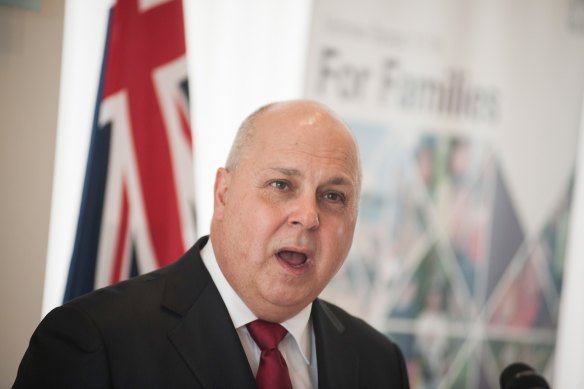
In Tim Pallas’ first budget after Labor returned to power in 2014, his message was clear: with him at the helm of the state’s coffers, Victoria would be a financially disciplined state.
“Our finances will stay strong. Our projects will proceed prudently, properly, progressively,” he said in his 2015 budget day speech.
Debt, Pallas declared, would fall below the levels inherited from the Coalition and stay there. At the time, net debt sat at $22.3 billion – about 6 per cent of gross state product (GSP) – and he promised it would shrink even further.
The then treasurer pledged to guard the state’s triple-A credit rating, avoid tax hikes and shield public sector jobs, all while maintaining a pro-business government. That inaugural budget culminated in a surplus of $2.9 billion, comfortably outstripping expectations.
Fast-forward to 2026, and Victoria’s finances are in starkly different shape.
Victoria’s net debt – now the highest of any state – is forecast to reach $175.6 billion next financial year and soar to $199 billion by the end of the decade, accounting for about 25 per cent of GSP.
That’s according to the budget delivered on Tuesday by Jaclyn Symes, Pallas’ successor, which also forecasts that Victoria’s annual interest bill will jump to $11.8 billion in 2030 – about half what the state will spend on education.
Against the backdrop of November’s state election, Opposition Leader Jess Wilson is framing the contest around the state’s escalating debt pile and the fiscal burden on generations to come.
Premier Jacinta Allan has fired back, accusing Wilson of planning “ruthless” cuts that will inevitably hit frontline jobs and services. Despite that rhetoric, Allan’s government has targeted $4 billion in savings after a review of the public service by respected bureaucrat Helen Silver.
Economists have warned that changes to government spending will be necessary one way or another, as debt repayments gobble up a growing share of available funds.
So how did Victoria get here? COVID-19 was a once-in-a-generation crisis that accelerated Victoria’s debt binge, but history shows Labor had already loosened its purse strings before the pandemic hit, as it traded off restraint to pursue a bold infrastructure agenda.
Infrastructure spending almost doubled within two years of Labor taking office, jumping from $4.6 billion in 2014-15 to $9.1 billion in 2016-17, as the government accelerated level crossing removals, road upgrades and rail projects.
But as the infrastructure agenda expanded, so too did concerns about whether the state’s ambitions were in line with reality and public need. The Suburban Rail Loop, the first stage of which is budgeted at $34.5 billion, has been championed as a transformation transport and housing project, but criticised by others as lacking a clear economic case.
Infrastructure spending again surged from $18.7 billion in 2021-22 to a peak of $24.2 billion in 2023-24. The COVID-19 pandemic landed in the middle of this generational spending spree.
Lockdowns crimped economic activity and the government spent heavily to stop the economy collapsing entirely. It has attributed $31.5 billion of debt directly to COVID-19 spending.
Crucially, the debt was taken on when interest rates were at historic lows. Like many first home buyers who took out large mortgages at ultra-low rates, Victoria is now feeling the pain of interest rate hikes.
The implied average yield (in effect, the interest rate) on Victoria’s borrowings was 2.7 per cent in 2021-22. That’s already bounced back to 4 per cent and is on track to hit 5 per cent in 2030. This explains why even though debt will increase 20 per cent over the next four years, annual interest payments will grow 50 per cent.
“Even prior to the pandemic there was a pretty widespread view that low interest rates made it a really good time to borrow and invest in infrastructure,” says Michael Brennan, chief executive of the e61 Institute and a former deputy secretary in Victoria’s Department of Treasury and Finance.
“I was always worried about that advice. Maybe it was difficult for people to perceive the likelihood that interest rates would normalise at some point. But it’s very real, and that’s happened, and that’s part of what’s driven the interest expense to rise.”
KPMG chief economist Brendan Rynne says the interest bill is the most important number in the budget for everyday Victorians. Each dollar represents money that won’t be spent delivering government services.
Rynne says there is nothing inherently wrong with governments taking on debt, so long as it’s being used to facilitate economic growth, which in turn helps pay for the initial investment. Is that what Victoria is doing?
“It’s not clear,” he says. If it were, he says, “you’d be seeing more employment growth, you’d be seeing strong gross state product relative to other jurisdictions where there’s been less capital expenditure”.
Symes and Allan maintain Victoria’s debt is sustainable. They forecast that debt will peak at 24.9 per cent of GSP next year before declining slightly to 24.4 per cent by 2030.
“I do acknowledge there is an alternative approach to cut harder and faster, but that just means cutting into schools and hospitals, and cutting into cost of living support,” Allan said this week.
Allan and Symes are heavily relying on economic growth to keep the budget under control. But current forecasts from analysts and major banks, amid the US-Israel war with Iran and rising inflation, are well below the government’s optimistic predictions.
Rynne says Victoria has limited ability to further raise taxes without businesses moving investment interstate, and has few remaining public assets to privatise. That leaves its own spending as the major lever to pull if it wants to balance its budget.
Brennan thinks Victoria should aim to get its spending growth back to about 4 to 4.5 per cent a year, in line with population growth and inflation, so it can reduce its cash deficits, which are forecast to grow from $7.7 billion to $8 billion by 2030.
Budget papers show spending grew 6.9 per cent this financial year, while forecasting 3 per cent growth next year and just 0.6 per cent the year after. Brennan says these numbers are “completely unrealistic” and imply significant spending cuts.
“That’s not going to happen,” he says. “I just don’t think the government has a policy of large-scale, real spending cuts in the next three years.”
Brennan is also sceptical about the projection that infrastructure spending will moderate, just as construction of the Suburban Rail Loop ramps up. The state government claims the project will cost $34.5 billion – but that figure has remained unchanged since 2019, despite construction costs soaring 22 per cent.
“None of this is easy, but in many areas of core government service delivery, part of what you’re on the lookout for is: are there lower cost settings in which we can try and deliver services?” says Brennan.
Brennan says the longer the state continues on its current pattern, the more likely it is that Victorians will feel the effect of debt repayments crowding out essential services and infrastructure.
“That’s how these things start to manifest. It’s the things that get crowded out, the things that can’t be done: road maintenance, school maintenance.”
Wilson tapped into one of the dominant political themes of the moment – the idea of “intergenerational equity” – this week when she accused Labor of “borrowing from our future to pay for today”.
“And it’s our children … who will be left to pick up the bill,” she said.
Economic forecasts can be unreliable, but you can count on hearing that argument plenty of times between now and November.
 Patrick Hatch is transport reporter at The Age and a former business reporter.Connect via X or email.
 Daniella White is a state political reporter for The Age. Contact her at da.white@nine.com.auConnect via X or email.
From our partners
Read the full article here