





 Markets
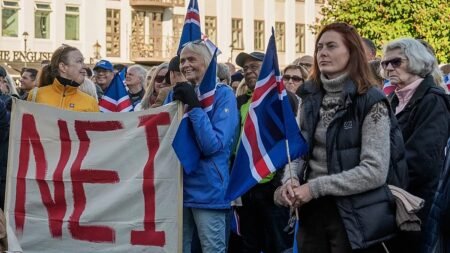
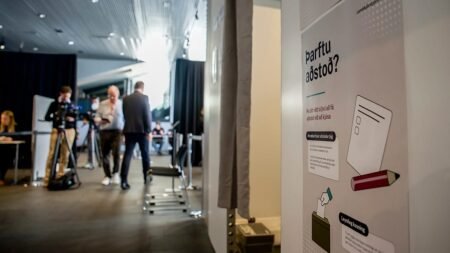
Iceland says “Nei”.
In a closely watched referendum that came down to the wire, the Nordic country rejected the reopening of accession negotiations with the European Union.
A “yes” would have restarted the process that was abandoned in 2015. Back then, Reykjavík managed to close 11 chapters of the long-winded process. The wealthy nation was all but guaranteed to become a frontrunner in the race.
But Icelanders instead chose to maintain what they have: a closely aligned partnership with the 27-strong bloc that is one step short of full-fledged membership.
Here are the four takeaways.
Fish trumps it all
For those outside Iceland, it was tempting to analyse the referendum through a geopolitical lens: Russia’s war on Ukraine, China’s unfair competition and, of course, Donald Trump and his punitive tariffs and threats to annex Greenland.
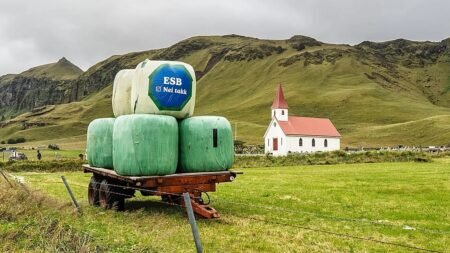
But the key driver of the vote was none other than fish.
As an island with a sprawling Exclusive Economic Zone in the North Atlantic, the fishing industry is deeply ingrained in the national consciousness. It is a major employer, accounting for about 8% of the country’s GDP and nearly 40% of its exports.
The country jealously protects its fishing rights. Between 1958 and 1976, Iceland and the United Kingdom were engaged in a series of confrontations dubbed the “Cod Wars”, concluding with Reykjavík’s victory over London.
EU membership would have brought Iceland under the Common Fisheries Policy (CFP), which dictates rules on who can fish, where and when they can fish, and how much they can catch. Most of these quotas are determined every year after negotiations. Member states are then responsible for ensuring fishers do not exceed the limits.
In the lead-up to the referendum, a Gallup poll showed that 90% of Icelandic companies linked to the fishing sector opposed joining the bloc.
The government tried to mitigate those concerns by declaring it would ask Brussels for “full authority” over the country’s fishing system. The European Commission said it was ready to explore “creative” solutions.
These statements, however, seemingly failed to convince those who feared the consequences of giving up too much control.
A stark urban-rural divide
The urban-rural divide in the referendum was unmistakable.
Out of the six constituencies in the country, only two voted “yes”. And those two happen to be in the capital, Reykjavík, the centre of power.
In Reykjavík south, 54.5% of voters chose “yes”. In Reykjavík north, the share was even higher, at 57.5%, matching a pattern seen elsewhere in Europe showing larger support for political and economic integration in the big cities.
By contrast, the Northwest, Northeast and Southern constituencies all voted “no” with margins exceeding the 60% threshold. In these rural communities, the fishing industry plays a larger role in employment compared to the capital, where it is marginal.
In the Southwest constituency, which surrounds Reykjavík and was the last to report the final results, 47% voted “yes” and 53% voted “no”.
Turnout in the referendum (82.5%) was higher than in the previous parliamentary election in Iceland (80.18%), reflecting widespread interest in the matter.
In total, 225,031 votes were cast: 118,040 chose “no” (52.8%) and 105,399 chose “yes” (47.2%). Meanwhile, 1,652 were blank or invalid.
The status quo stands strong
By rejecting accession talks, Icelanders stand by the tailor-made status quo they have forged across decades of engagement with Brussels.
Iceland already enjoys broad, unfettered access to the single market under the European Economic Area agreement together with Norway and Liechtenstein. (Fisheries and agriculture are notably excluded from this scheme.)
The Nordic island is part of the Schengen Area, the Emissions Trading System (ETS) and flagship programmes like Erasmus and Horizon. This level of access has required Iceland to adoptnearly 9,000 pieces of EU legislation, without having a vote in Brussels.
The country is also closely aligned with the bloc’s foreign policy and is a member of NATO, the Council of Europe and the “Coalition of the Willing” for Ukraine.
When voters were asked whether they wanted to take this partnership all the way to the finish line, they seemed to have concluded that “so far, so good” was enough.
Prime Minister Kristrún Frostadóttir recounted how, during the campaign, she had seen “people are very satisfied with the EEA agreement and with the arrangements we currently have with the European Union”.
“This may show that we need to do an even better job of defending that agreement, and I hope the entire parliament will rally behind that,” she said.
No accession for the wealthy
Should Iceland have chosen to resume accession talks, it would have become an immediate frontrunner in the race.
Officials and diplomats in Brussels privately admitted that the Nordic country, with its enviable €84,000 GDP per capita, highly developed economy and nearly 100% renewable electricity mix, would have jumped to the front of the queue overnight.
But they were also mindful of the awkward optics of Iceland leapfrogging the other candidates, particularly those in the Western Balkans, who have been waiting more than a decade to join the bloc. Coupling Iceland and Montenegro was floated as a potential solution to avoid the blowback from the region.
This will not come to pass, and the accession race will remain as it is.
Still, one question is now inevitable: Can enlargement attract wealthy countries?
The current list of candidates (Albania, Bosnia and Herzegovina, Georgia, Moldova, Montenegro, North Macedonia, Serbia, Turkey and Ukraine) present economic indicators and democratic standards that are miles behind Iceland’s.
For these candidates, the EU represents a source of growth, prosperity and equality. The remarkable trajectory of the Central and Eastern countries that joined in 2004 shows the promise of what a European future might bring them. Membership is also a geopolitical necessity for them as an aggressive Russia ploughs on to reassert its sphere of influence.
The referendum proves that Iceland, from its comparably privileged position, had quite a different calculus of what EU membership entails and how urgently it is needed.
This is not the first time that a rich country has rebuffed the bloc. Norway, another Nordic, rejected joining the EU not once but twice, in 1972 and again in 1994. And the United Kingdom, a G7 economy, famously voted to leave in 2016.
Interestingly, the Brexit margin (51.89% for Leave to 48.11% for Remain) is almost identical to the outcome of the Icelandic vote.
Read the full article here