




 Markets
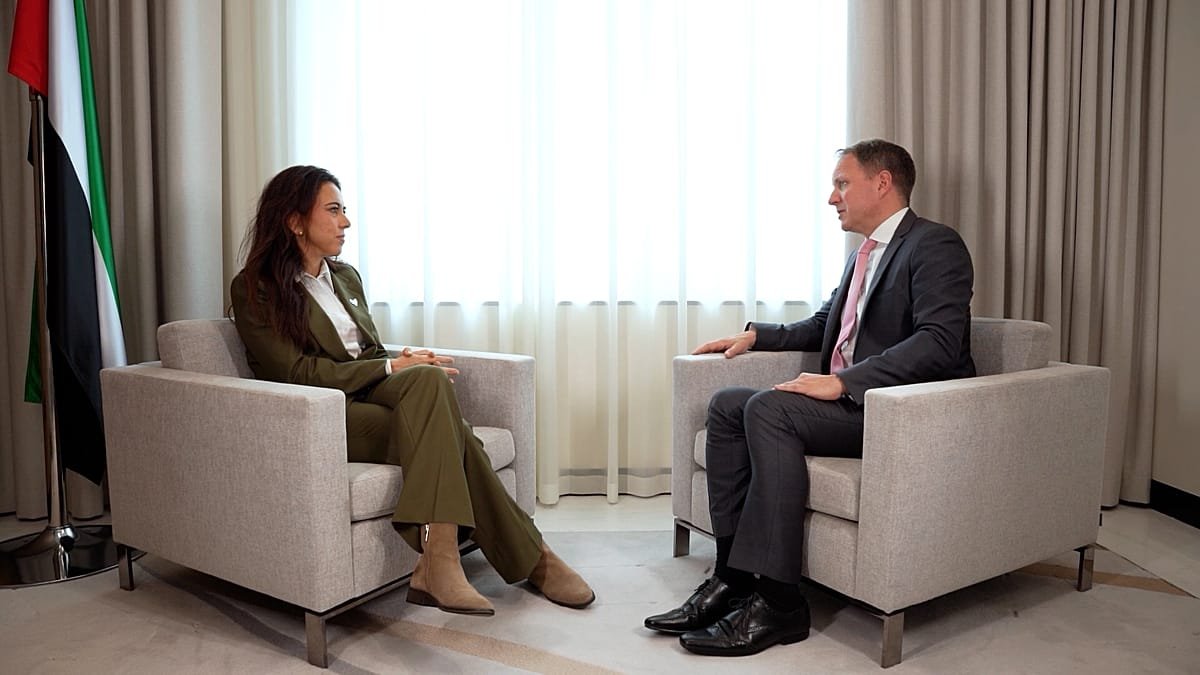
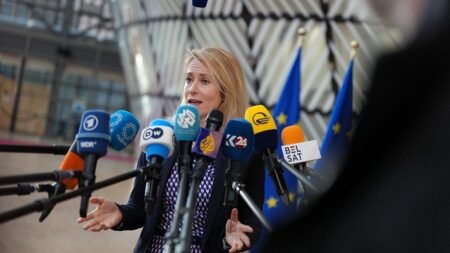
The United Arab Emirates Minister of State Lana Nusseibeh launched an appeal to the world to force Tehran to lift its stranglehold on the vital shipping waterway, the Strait of Hormuz, and hailed the support provided by the European Union since the start of the Iran war.
In a wide-ranging interview with Euronews in Abu Dhabi, Nusseibeh said, “Iran must not be allowed to hold the global economy hostage by its rogue state behaviour.”
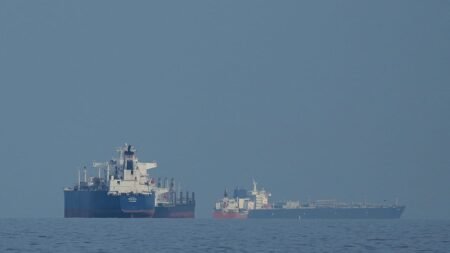
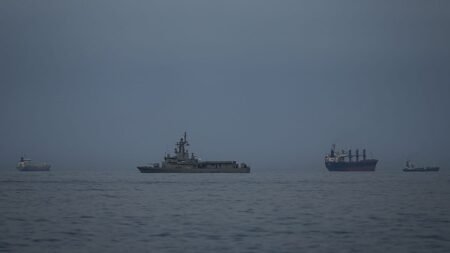
In the interview, Nusseibeh warned that the consequences of the disruption of the narrow waterway between Iran and Oman extend far beyond the region, emphasising that “globally, about 20% of the world’s energy supplies travel through that narrow waterway.”
“If that is disrupted, it has an impact on not only global energy prices but global food security and food supplies, and that will impact bills in grocery stores, bills in petrol stations, and the price of food,” the UAE minister said on Euronews’ interview programme 12 Minutes With.
Nusseibeh added that the UAE continues its sustained efforts to respond to the developing global energy crisis, emphasising the country’s commitment to global energy markets.
“In terms of energy supply, we are a responsible and committed supplier to the global energy market, and we will continue to do what we can,” the minister said.
The Gulf has long been a critical partner for Europe when it comes to energy, trade and global shipping routes. With tensions rising around the Strait of Hormuz and Iran’s missile and drone attacks targeting the region, officials in Abu Dhabi say cooperation with European partners has become even more important.
The minister said European governments have been among the most engaged international partners since the crisis began. “We’ve been in frequent contact with different governments around the world since this has started, but I would say the Europeans have been incredibly supportive,” she said.
According to Nusseibeh, that support reflects long-standing political and economic relationships between the UAE and Europe. “Our trade ties with Europe at €65 billion a year are a robust signal that we are also open for investment.”
Those ties are not only related to trade. More than half a million Europeans live and work in the UAE, making the crisis particularly relevant for European audiences. “We take the safety and security of the 500,000 European residents who reside here incredibly seriously,” Nusseibeh said.
Diplomatic contacts have taken place at multiple levels, reflecting concern in European capitals about the broader implications of instability in the Gulf. The region’s critical role in global energy flows and maritime trade makes disruption likely to have far-reaching consequences for European economies.
Nusseibeh said the UAE views its partnership with Europe as central to maintaining stability. “We are definitely doubling down on our engagement with Europe.”
‘Defending model of peace’
The minister framed the conflict as something larger than a bilateral relationship. “What you are defending here is not only the UAE. What you are defending here is a model (…) of coexistence, tolerance, of peace for the wider region.”
She argued that those who oppose these principles are “in the camp of Iran and these rogue state actors that are trying to export nihilism to the whole international system.”
As the war enters its third week, the United Arab Emirates says its response is focused on a difficult balancing act: defending its territory while preventing the crisis from spiralling into a broader regional war.
Nusseibeh highlighted the role of the country’s defence systems. “They’re honed over decades of investment, practice in real battles around the world as part of coalitions. The UAE Armed Forces have kept our communities and our residents safe.”
She added that the “red lines are the security, the prosperity, the well-being of our Emirati community and our expatriate community here. We consider all of them part of this country, and they deserve our protection.”
For Gulf governments, the strategic calculation is complex. A forceful military response risks widening the confrontation with Iran, potentially drawing multiple regional and international actors into the conflict.
At the same time, failing to respond decisively could leave critical infrastructure and civilian populations vulnerable. Minister Nusseibeh underlined the scale of the challenge facing the country, as the UAE absorbed the highest number of Iranian missile and drone attacks across the whole Middle East since the war started.
“We’ve had an incredibly challenging 14 days (…) but life has pretty much gone back to near-normal in the UAE.”
The country’s ability to maintain stability reflects decades of preparation for geopolitical uncertainty in the Gulf, the minister said. “We have been preparing for various scenarios in a very turbulent region for decades, so these are not new plans.”
Those preparations extend beyond military readiness. The country has invested heavily in economic resilience, logistics networks and supply chain security.
According to Nusseibeh, who was the UAE’s ambassador to the UN until recently, the conflict erupted despite massive diplomatic efforts to avoid escalation. “We were very engaged in diplomatic efforts before this escalation to try to avoid a conflict in the region.”
Moving forward, the minister said the UAE’s government’s long-term strategy remains focused on economic transformation and future industries and that the country’s development model is built to withstand such geopolitical shocks.
According to Nusseibeh, the UAE’s development over the past half-century has fundamentally reshaped its economic structure, saying that “we have had, since our founding, a number of shocks.”
“Even as we were formed as a federation, there were a lot of naysayers who said the federation would not last. We didn’t just last. We grew from a pearl-diving economy into a global exporter, not only of hydrocarbons, but of commodities, of foreign direct investment, of clean energy, of AI.”
Instead of depending solely on oil revenues, the country has spent decades diversifying into sectors such as finance, logistics, and advanced technology.
She pointed to major technology investments aimed at positioning the UAE as a global hub for artificial intelligence infrastructure, with a $1.5 trillion investment with the US in AI data centres and “similar investments in Europe, in Italy, in France, in AI data centres that we are building here.”
Nusseibeh stressed that the UAE is an “economy of the future,” adding that the focus on emerging industries is intended to ensure that the UAE remains competitive in a rapidly changing global economy.
Yet she acknowledged that no government can fully control the geopolitical environment surrounding it. “We don’t promise that the regional environment can be entirely controlled,” she said. “I think that’s a false promise,” she concluded.
Read the full article here