






 Markets
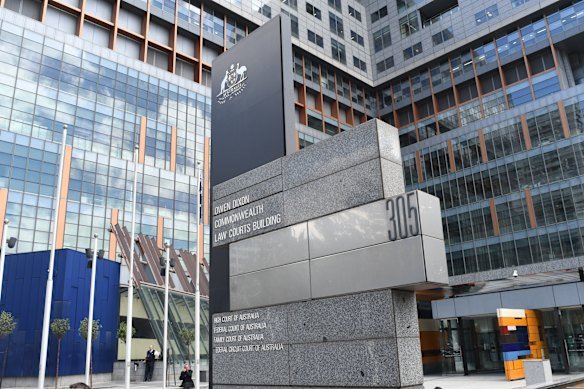
Who should sit in judgment over judges? At the state and territory level, Victoria, NSW, South Australia, the Northern Territory and the ACT all have independent bodies that receive and manage complaints about judicial officeholders.
This week our reporting has revealed that nearly a decade ago, federal court judge Alexander “Sandy” Street was the subject of a confidential police report after an inter-agency taskforce examined a deal between his ex-wife’s freight business and Chinese military officers.
At the time, Taskforce Polaris, charged with investigating waterfront crime, was concerned enough to send the report to the Australian Federal Police, and there it appears to have hit a dead end. We know that neither then-attorney-general George Brandis nor chief justices of the Federal Circuit Court – including the incumbent, William Alstergren – were ever sent it.
The Age does not suggest that Street or his ex-wife, Sally London, broke any laws. But how can it be that serious questions over the conduct of a serving federal court judge rest unexamined until they are brought to light by this masthead?
Alstergren has now commissioned an inquiry into this matter. But scrutiny of the conduct of this country’s highest judicial echelon should not be an ad hoc game of catch-as-catch-can. In 2022, the Albanese government committed in principle to establish a federal judicial commission. Attorney-General Michelle Rowland and her predecessor Mark Dreyfus have both said the government “continues to consider” the matter.
They made the commitment in the wake of the scandal that engulfed federal court judge Dyson Heydon.
The design of such a commission is of course crucial to its effectiveness. In its scoping document of January 2023, the government asked legitimate questions about membership, what would happen when its members disagreed, and its remit, including whether it could investigate matters on its own initiative.
Importantly, it also asked to what extent the workings of such a commission and the identity of those under scrutiny should be made public.
As our reporting makes clear, when information about the conduct of judicial officers comes to light after being hidden, the risks to public confidence in the judiciary are magnified.
Even where there is no wrongdoing – and none is suggested here – appearances count. It should be noted there have been questions raised about Alstergren himself and the disclosure of his relationship with fellow federal judge Amanda Mansini.
In its own statement on establishing a federal judicial commission, the Law Council of Australia argued that “outcomes, findings and recommendations resulting [should] be made public where possible”, though there may be cases where the subjects of findings should be de-identified.
Under section 72 of the Constitution, the tenure of federal judges can be revoked only on the request of both houses of parliament to the governor-general, and the government may be anxious not to impinge upon the separation of powers and the independence of the courts.
We should also recall the vexed debate over creation of a federal anti-corruption commission and whether it would suck up political oxygen with “show trials”. Labor made a promise to establish a National Anti-Corruption Commission (NACC) and followed through.
Then, as now, there were issues with the commission’s design and the extent to which its workings should be made public. Some of those issues were raised by barrister Geoffrey Watson, SC, in his role as a director of the Centre for Public Integrity.
Watson remains convinced there should be a federal judicial commission, pointing to the NSW experience. “It’s shown to have functioned very well with minimal disruption to judicial processes and enhancement to confidence in the judiciary,” he told The Australian Financial Review earlier this year. “There is no reason to think it would not operate with similar benefits at the federal level.”
This week, the NACC’s inaugural commissioner, Paul Brereton, resigned after a finding of misconduct against him and continued adverse publicity over his performance.
If the work such commissions did were straightforward and uncontroversial, few would object to their creation. But that doesn’t mean the task can be shirked. Labor needs to get on with honouring the commitment it made four years ago.
Get a weekly wrap of views that will challenge, champion and inform your own. Sign up for our Opinion newsletter.
 The Age’s View – Since The Age was first published in 1854, the editorial team has believed it important to express a considered view on the issues of the day for readers, always putting the public interest first.
From our partners
Read the full article here