





 Markets
A frenzy of attacks on Melbourne nightspots with no clear motive has left police scrambling for answers, and one theory being considered implicates the backbone of late-night hospitality: alcohol.
Federal and state police are investigating whether the recent spate of violence is linked to the trade in tax-free booze which is causing concern at a national level.
Specifically, according to law enforcement sources unable to speak publicly, they are considering whether some new opaque entrants to the distilling industry are exploiting a $180 million-a-year tax break meant to encourage craft spirit makers but which critics say is distorting the market with excise-free liquor.
While the link to recent hospitality attacks is still uncertain, Detective Superintendent Jason Kelly, of Victoria Police’s anti-gangs division, said “everything is on the table” as a new taskforce was announced on Tuesday to figure out the cause of recent violence.
“We will look at anything that may assist us to understand if organised crime have infiltrated this industry and why they’re doing this,” he said. “If [tax] is one of the drivers, then we’ll certainly provide that advice back to the relevant governments.”
Police have said none of the targeted venues have indicated a demand for money has been made, and all owners were co-operative and did not know why they had been attacked.
Specialist officers from Victoria Police’s liquor unit are included in the new Operation Eclipse, which will also investigate the torching of a liquor warehouse late last week.
This masthead has reported previously on police concerns about black-market liquor operations that blend dangerous industrial alcohol into whisky, vodka and other top-shelf spirits. The Australian Taxation Office (ATO) estimated in 2024 that the bootleggers avoid more than $700 million in alcohol excise a year.
Whatever factors are behind the recent attacks, the market for the supply of spirits across Australia has been upended by federal government tax changes that critics say pose an “existential threat” to some businesses while leading to a boom for new players.
The alcohol manufacturers’ remission scheme launched in 2021 enables spirit makers to pocket the first $350,000 in excise they would normally pay on gin, vodka and other spirits. The automatic refund was intended to help boutique and artisan producers grow.
But industry advocates complain the tax settings have had unintended consequences as established operators are undercut by a burgeoning industry of tiny distilleries, now under scrutiny for feeding on a tax break that is costing taxpayers tens of millions of dollars more than expected.
In contrast to those smuggling illicit tobacco, the spread of excise-free liquor has been partly powered by the perfectly lawful use of the remission tax break – introduced by the Morrison government and set to be expanded in Labor’s upcoming budget.
Quite apart from the violence that is now focusing police attention, industry groups are calling for tighter integrity measures as they say networks of start-ups have unfairly taken advantage of the scheme.
The rapid growth of small alcohol businesses has now caused it to cost $225 million more in its first four years than Treasury initially predicted.
Steven Fanner, director of industry lobby group Spirits & Cocktails Australia, said the tax break was also encouraging new entrants to buy and resell booze – with a fresh label – to claim the remission.
The unlikely new band of brewers
Some of the new entrants look very little like the boutique gin, vodka and whisky makers the scheme was intended to support.
The case of one small company – providing a house spirit in several Melbourne venues – gives a taste for the freewheeling nature of the bottom end of the system.
The labels on some of the company’s bottles say it is, in fact, only distributing booze under its brand that is produced by two other businesses. One of those businesses said it had no association with the company; the other wouldn’t comment.
The company, which this masthead is not naming for legal reasons, told this masthead the tax break for distillers was an attraction.
“It’s just been a cruisy sort of thing,” its director said, insisting the company distilled its own spirits in an inner-Melbourne warehouse.
The facility does not have a producer’s licence. Rather, in an indicator it is one of a new breed of legal but backyard players, the company has a pre-retail licence registered to a Docklands apartment.
In response to repeated questions, the company insisted it had all necessary permits, saying the business was a “side hustle for everyone”.
“We operate strictly within the ATO’s legal framework and do not exploit the remission scheme,” an emailed statement said. “We actually share the frustration of established distillers on this topic.
“There are many bad actors who abuse the scheme by running multiple distilleries that do not abide by the framework set out by the ATO and make it difficult for all of us.”
The ‘existential threat’ to mid-sized spirit makers
Established spirit makers still support the scheme, but say it needs tightening as the benefits are going to unintended recipients.
It was initially spruiked as helping craft spirit producers employ new workers, expand cellar doors or explore export markets.
“Increasingly, the benefit is being claimed by ‘aggregator’ businesses which purchase excise-free spirits in bulk from multiple small distillers each claiming the remission,” Spirits & Cocktails Australia’s pre-budget submission said.
“The aggregator then operates as a wholesaler, on-selling the product to the market (often hospitality venues) at heavily discounted prices, thus transferring the benefit of the remission from the small distilleries to the wholesaler.”
Another industry submission to a 2024 parliamentary inquiry warned the spread of start-ups spruiking “excise-free” spirits was an “existential threat” to mid-tier distillers that were slugged up to $30 in excise for every unit above the roughly 12,000 bottles that qualified for tax remission.
“The ease with which businesses are able to access the full remission of $350,000 in tax is incentivising people to enter the industry for the wrong reasons,” the submission said.
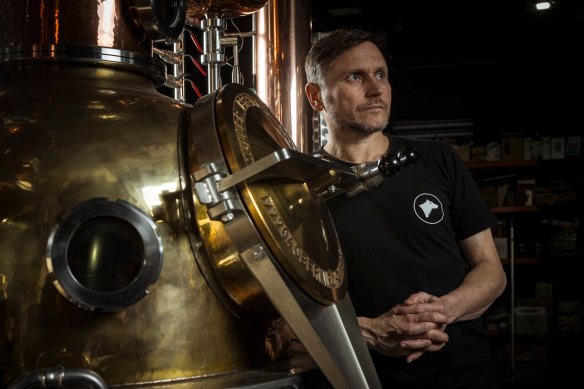
To access the remission, the tax office requires companies to hold a manufacturer licence and meet several other criteria, but Patient Wolf Distilling Co. founder Dave Irwin said the bar was too low.
“You don’t technically need to own a production facility,” he said. “The requirements are that a certain percentage [of a beverage] needs to be going through an actual still, but you can start a company and then rent a still and then claim excise [remission].”
“I’ve been approached to essentially distil on behalf of other companies, as a contract distiller, then they’re just claiming the remission on it.
“Some people are basically maxing out their remission cap and using these third parties.”
When the Morrison government expanded the excise refund scheme for brewers and distillers in the 2021/22 budget, Treasury estimated it would cost $415 million over four years. But the latest tax expenditure and insights statement revealed it would cost $640 million over four years instead – a 54 per cent increase.
The Albanese government has moved to increase the excise remission cap to $400,000 per financial year from July, blowing out the scheme’s cost further.
Fanner argued eligibility criteria could be reformed, as they were for the Wine Equalisation Tax rebate in 2016.
This could include requiring direct-to-consumer sales, or a distillery door open to the public, so remission scheme users were genuine distillery attractions.
“The tax benefit to support craft distillers should be going to distillers only, not to wholesalers and middlemen,” Fanner said.
The spread of excise-free spirits
One small distiller, speaking anonymously due to fear of being targeted in Melbourne’s current arson wave, said their company was created partly as a way to source cheaper alcohol for their bar business, but also sold to others.
They said not paying the first $350,000 in alcohol excise via the remission scheme was a key incentive.
“It was definitely a big factor,” they said. “We probably would have done it anyway. However, we definitely wouldn’t have grown as fast. Our goal is to get hundreds of customers.”
“I know there are a few dodgy ones … Some bloke owns a wine bar, then [they will] distil stuff and just sell it to themselves, and that’s their only customer. That’s basically a scam. We’re trying to grow a legitimate business. We’re kind of inspired by Four Pillars.”
A spokesperson for Treasurer Jim Chalmers said the tax break supported Australian distillers and the government took integrity “very seriously”.
“The ATO is responsible for compliance, and we expect them to crack down on anyone who is doing the wrong thing,” the spokesperson said.
The ATO said in a statement it was reviewing arrangements that saw some businesses contracting smaller distillers to produce beverages on their behalf.
It would also “actively challenge arrangements that seek to multiply or manipulate the cap through artificial structures or economic control”, the statement said.
On Monday, Victorian Premier Jacinta Allan was asked whether the Commonwealth alcohol tax regime could be contributing to the recent spate of arson. In response, she brought up tobacco excise increases that many experts have blamed for kick-starting the illicit cigarette industry and its associated firebombings.
“We have seen through some changes in recent years in the treatment of illegal tobacco, some of the challenges that has brought to the states in terms of the enforcement of what has been a growth in the illegal tobacco trade,” she said.
Start the day with a summary of the day’s most important and interesting stories, analysis and insights. Sign up for our Morning Edition newsletter.
Read the full article here