






 Markets
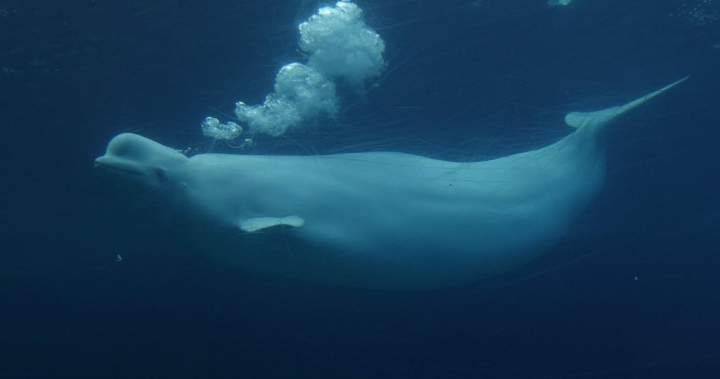
A new study suggests beluga whales may be capable of recognizing themselves in mirrors, a trait linked to self-awareness and once thought to be uniquely human.
Researchers with the New York Aquarium of the Wildlife Conservation Society observed two belugas, Natasha and her daughter Maris, at the New York Aquarium where a two-way mirror was installed to better understand the species’ cognitive abilities.
According to the study published May 20, the whales appeared to study their reflections closely, blowing bubbles, performing barrel rolls and examining features such as their faces and teeth — behaviours scientists say are consistent with self-recognition.
“And that’s where the light bulb seems to go on when they figure it out that’s me,” said Diana Reiss, a marine mammal scientist and cognitive psychologist based in New York.
Reiss said scientists do not fully understand what drives this ability, but it appears to be linked to traits such as having a large brain relative to body size.

Get breaking National news
Get breaking Canada news delivered to your inbox as it happens so you won’t miss a trending story.
Self-recognition has been observed in only a select group of animals, including bottlenose dolphins, Asian elephants, magpies and great apes.
Scientists say the ability is typically found in species that are highly intelligent, social and capable of empathy, including humans.
The findings come as no surprise to Valeria Vergara, a British Columbia-based whale biologist with the Raincoast Conservation Foundation.
“Every time we sort of uncover a new dimension of beluga cognition or social complexity, it raises the stakes for what we stand to lose if we don’t protect them,” she told Global News.
Canada is home to some of the largest beluga populations, including in the St. Lawrence River, where they are endangered.
Vergara said threats such as ocean noise pollution can interfere with the whales’ communication systems, which are key to their complex social structures.
Researchers say a better understanding of animal cognition could encourage greater efforts to protect vulnerable species.
Read the full article here