






 Markets
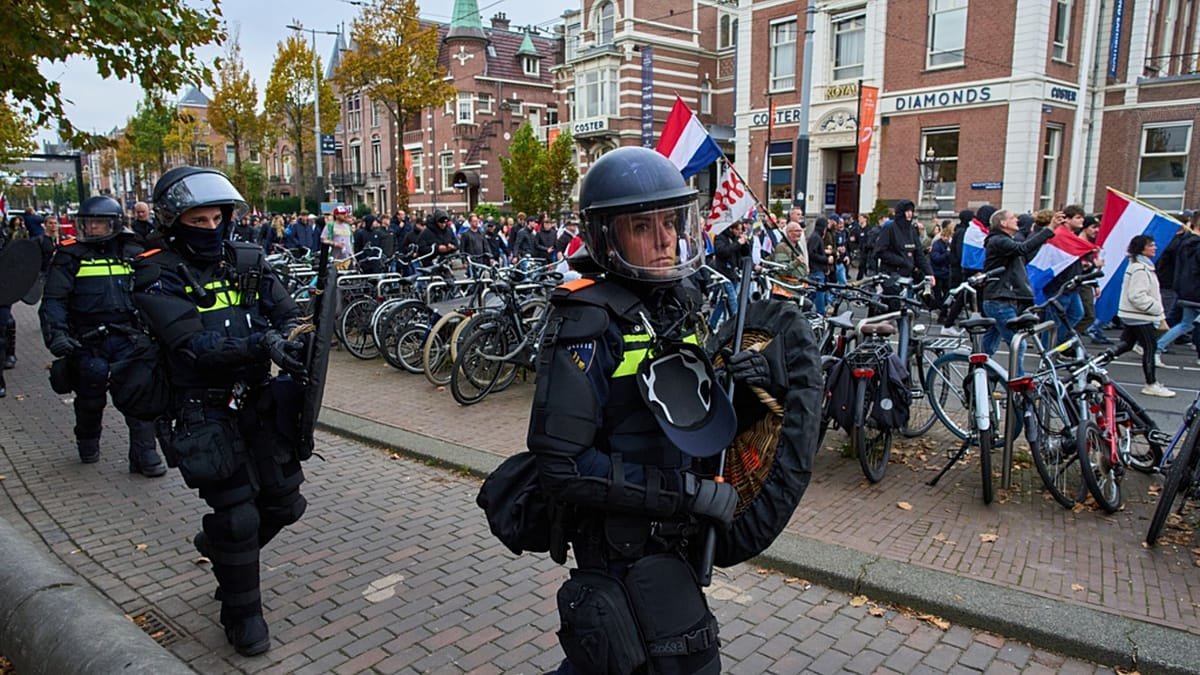
Dutch social media users and activists claim that the country’s Senate has rejected a law that would have made residing in the Netherlands irregularly “illegal”.
The Senate did recently throw out a bill, designed by the far-right populist PVV party, to take a harder line on illegal immigration.
The controversial bill, dubbed the Asylum Emergency Measures Act, was devised during the previous government in a bid to tighten Dutch asylum policy before the broader EU Migration Pact fully comes into force in June.
But online narratives suggest that striking down the bill would entail a major legal reversal that would severely weaken the Netherlands’ asylum measures, rather than harden them.
The Cube, Euronews’ fact-checking team, spoke to experts who said that framing the bill in such a way was wrong and that the devil is in the details.
Is it ‘criminal’ to be an irregular migrant?
Living in the Netherlands without a valid permit has long been classified as illegal or irregular under administrative migration law.
Asylum seekers and undocumented individuals in the Netherlands are primarily processed under the Aliens Act 2000, a piece of administrative legislation that treats infractions as a violation of status rather than a crime.
The proposal devised by PVV and rejected by the Senate would have criminalised illegal residence, moving it into the realm of criminal law.
“They [the Senate] haven’t voted against making illegal migrants ‘illegal’, if you want to call them that,” Betty de Hart, professor of transnational families and migration law at Vrije Universiteit Amsterdam, told The Cube. “They’ve already been ‘illegal’ for many years.”
“They just voted against the criminality and being able to arrest them on the basis of being undocumented,” she explained.
Voting down the bill doesn’t mean that irregular migrants are suddenly “legal” either. They still face consequences such as detention and deportation, but under administrative law, as they did before, rather than being given a criminal record for being in the country without papers.
“People can be put in detention to expel them later, and can be in detention for quite a long time,” de Hart said. “But this is administrative, not criminal detention. So this kind of thing is already possible, you don’t need criminal law for that.”
“Making them criminal actually makes it more difficult to remove them, as they need to serve a sentence first,” she added. “Under administrative and migration law, they can be removed the next day, basically.”
‘A cup of soup’: Charitable acts at risk of criminalisation
Critics of the bill celebrated its rejection, after advisory bodies, including the Dutch Council of State, said that, if made law, the bill would have also made it a criminal offence to help or support any undocumented immigrants.
While the proposed law didn’t explicitly ban acts of charity, legal experts and human rights groups warned that by criminalising illegal residence, acts of humanitarian aid, such as providing irregular migrants with meals, would naturally fall under the legal definition of complicity in a crime.
This sparked the famous “cup of soup” debate in the Netherlands, with churches and NGOs rallying against the provision, warning that volunteers in soup kitchens could face prosecution for helping people without papers.
“There was a lot of protest against this bill and in particular against this part on ‘illegal stay’ as it is called in short,” Carolus Grütters, research fellow at Radboud University’s Centre for Migration Law, told The Cube.
“The problem as such with this is that illegal stay is not an action but an administrative code; one does not have the right papers,” he added.
Amid the backlash, Justice Minister David van Weel, of the centre-right VVD party, attempted to amend the law to include a “humanitarian” clause, which said that acts of charity would not be punishable.
However, the motion to include the amendment was defeated by a single vote, triggering the legislation’s total collapse.
The PVV party, which originally drafted the law, ended up voting against the final bill, accusing the government of trying to water it down into a toothless measure.
Meanwhile, centrist and religious parties, such as the CDA and the SGP, withdrew their support because it lacked explicit protections for aid and humanitarian workers.
In the end, the law didn’t fail because the Senate wanted to be soft on illegal immigration, but because politicians couldn’t agree on where the line between a border policy and a bowl of soup should be drawn.
In fact, the Senate showed its desire to toughen immigration measures at the same time, voting through the Two-Status System Act for asylum seekers as it threw out the Asylum Emergency Measures Act.
This law allows Dutch authorities to distinguish between people fleeing persecution due to their sexual orientation or religion, for example, and those fleeing from war and the consequences of climate change. It marks a return to a similar two-status system that was removed in the early 2000s.
Those in the first category will have more rights than those in the latter, who will only receive a limited residency permit and restricted family reunification rights.
The country’s independent Advisory Council on Migration has been critical of the Two-Status System, warning that it won’t deter immigration and will lead to backlogs.
Is asylum a problem in the Netherlands?
As in much of Europe, the debate over immigration and asylum in the Netherlands is highly polarised.
Critics say that the biggest challenge stems from a severe housing shortage for both residents and refugees, often resulting in significant bottlenecks for suitable accommodation.
Voices from the PVV point to perceived difficulties that immigrants and asylum seekers have in integrating with the local culture. Some in the party suggest that immigrants pose a threat to Dutch values.
Others cast doubt on the claim that the number of asylum seekers is a critical problem in the Netherlands, especially when comparing it to other European countries.
“If one looks at the numbers, there is no problem at all,” Grütters said. “The percentage of asylum seekers that files an asylum request in the Netherlands, compared to Europe as a whole, i.e. EU and EFTA countries, is around 3% of the European total and descending.”
Some figures do indeed support this: Eurostat said in March that in 2025, 669,365 first-time asylum applicants from non-EU countries applied for international protection in EU countries, down by 27% compared with 2024.
Grütters agreed that the main crisis in the Netherlands is a lack of housing, with skyrocketing prices making it difficult for everyone to get affordable accommodation. However, he warned against blaming immigrants for this.
“And given the situation of a shortage of housing in the Netherlands, the populist parties blame the migrants and refugees in particular for this,” he said. “A far bigger problem is the fact that labour migrants are underpaid and housed with too many people in a room.”
Concentrated in sectors like greenhouses and slaughterhouses, these workers often receive housing as ‘payment in kind’ from their employers.
This creates a precarious dependency: the moment a contract ends, their housing vanishes.
“In practice, ending employment also means ending housing. And one can find those people sleeping under the bridge,” Grütters said. “But populist parties do not want to do something about that, as this affects a substantial part of the Dutch economy.”
Read the full article here