Markets

“My name is Claudine, I live in Montigny; I was born there in 1884; I shall probably not die there” is how French author Colette began her eponymous Claudine series. But in Haberfield, plenty of us do end up dying here.
Our next-door neighbour Norma was born in our street before it had an electricity substation and lived long enough to see the first Uber Eats delivery cyclists cruise down it. My sister and I joke that we’ll be 90 years old and living in our childhood bedrooms, neither of us having been able to afford a house of our own.
I was born during Haberfield’s turn-of-the-century demographic transition, as the suburb’s postwar Italian community was making way for clucky couples like my parents who wanted the big backyards and leafy streets of suburbia, all while remaining close to the inner city.
It is a great place to be a glutton too. Unlike Leichhardt’s Norton Street, with its eerie, empty Italian Forum, or Five Dock’s Great North Road, littered with far-from-great chain restaurants, Haberfield’s Ramsay Street boasts delicious Italian food.
Like many Anglo-Celtic Australians, our family lived large on the culinary legacy installed by the migrant community before us. Weeknight dinners of freshly made ravioli from Peppe’s Pasta smothered in olive oil and parmesan, or a thin-crust pizza from La Disfida that would hold its own in Naples.
There were antipasti from the deli counters at Lamonica IGA or Zanetti’s, both of whom took orders in Italian as frequently as they did in English. Raffael’s Bakery served up a solid mix of lunchbox delights, from perfectly greasy pumpkin arancini to chewy sourdough dinner rolls. My first taste of independence was being allowed to take my scooter up to Haberfield shops to buy bocconcini from Paesanella.
Special occasions would be celebrated at Dolcissimo, an institution that at its height spanned two shopfronts and – in a fitting twist for Sydney – the entanglement of its owners in defamation proceedings.
On one birthday, a waiter predicted that I wouldn’t be able to finish my entire margherita pizza. I proved him wrong, but at an extraordinary personal cost: I was too full for a slice of ricotta cake from Pasticceria Papa (known locally as Papa’s) afterwards.
Of course, the Italian community has brought Haberfield far more than good food. They have given us history, community and stories. In year 7, I was loaned a copy of Melina Marchetta’s Looking for Alibrandi by a family friend’s daughter who was also raised in Haberfield. I haven’t returned it.
It seemed incredible that the feelings and experiences I couldn’t articulate for myself (at age 13, that’s most of them) could be found lurking in the pages of a book set in and around my home in the inner west’s Italian enclave. By all accounts, that feeling is redoubled for the children of migrants who identify with the story of the book’s heroine, Josie Alibrandi.
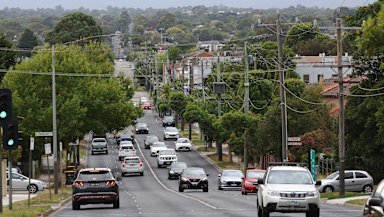
There’s a scene in the 2000 film adaptation of the book where Josie and her nonna walk down Ramsay Street, the major road dissecting Haberfield.
Seeing the Federation shopfronts and the recessed balconies of the apartments above evokes a twinkling nostalgia, like catching another’s gaze in a mirror.
It’s been a quarter of a century since my parents bought their house in Haberfield, and the suburb is more than due for another demographic shift. Not that one is coming anytime soon. Skyrocketing house prices have prevented all but the most affluent young families from moving in, and kept plenty of overgrown bambini from flying the nest.
Haberfield has not been a mere bystander to Sydney’s housing crisis. While it benefits from a light rail stop, many city-bound bus routes and large swaths of green space, it has steadfastly held out on higher density development.
Founded during Federation as a “slumless, laneless and publess” refuge from the inner city, Haberfield has notoriously changed very little since. While even the suburb’s most ardent NIMBY accepts that Haberfield contains barely any “outstanding architectural masterpieces”, its streets of single-storey homes are precluded from meaningful redevelopment, with the Inner West Council designating the entire suburb a Heritage Conservation Area.
But Haberfield is modernising in other ways. Ramsay Street now has a Japanese restaurant, a Chinese restaurant and a bakery selling banh mis. There’s a McDonald’s on our southern border and Papa’s sells Dubai chocolate-flavoured gelato.
Best known of all is the cheery North-American themed diner Happyfield, which was named Cafe of the Year in the Good Food Guide 2024. At Happyfield, waiters take orders on tablets and don’t raise an eyebrow if you ask for an alternative milk (Caffe Bianchi and Bar Italia in neighbouring Leichhardt still only serve full cream).
Most astonishingly, Happyfield has overtaken next-door neighbour Dolcissimo as Haberfield’s premier restaurant by slowly starving the latter of foot traffic and floor space.
The victory has been so comprehensive that Dolcissimo recently converted part of its shop into a pop-up convenience store. It’s as if the House of Medici has been deposed by Mickey Mouse.
Cafes such as Happyfield routinely attract a younger and more diverse crowd, consisting of parents spoon-feeding toddlers pancakes and young couples collecting take-away matchas before setting out for the nearby Bay Run.
But these customers, for the most part, call other parts of Sydney home. Haberfield’s median age rose again last census to 46, eight years above the national average. It’s a reminder that its refusal to change physically risks its ability to evolve demographically, a sad fate for a suburb practically engineered for children.
I left Haberfield for an inner-city share house at the start of the year. I’ll most certainly be back – either when the rent gets put up or my hankering for on-demand ricotta takes over. It’s a wonderful suburb to live in, and one simply wishes more people could. After all, there’s room for plenty more.
Grace Lagan is a Sydney journalist.
From our partners
Read the full article here