





 Markets
When the Ford government first unveiled its controversial changes to Ontario’s freedom of information laws, the province promised that 95 per cent of the work at Queen’s Park would still be accessible and transparent.
The province’s vast complement of civil servants, the government argued, would be looped into major government files — allowing the public, journalists and opposition parties to request and receive key documents related to government decisions.
“I want to make it very clear that 95 per cent of what is accessible now — actually, greater than that — will still be accessible through freedom of information,” Stephen Crawford, Minister of Public Business and Service Delivery, stated repeatedly in the Ontario Legislature.
“Any direction from ministerial offices to the public service is still open to freedom of information. Anything within the public service is open to freedom of information so that people will be able to access that information.”
But freedom of information disclosures from Ontario’s top civil servant are shedding new light on just how little information is actually released on government discussion and decisions.

Get daily National news
Get daily Canada news delivered to your inbox so you’ll never miss the day’s top stories.
Global News requested copies of notes kept by Secretary of Cabinet Michelle Di Emmanuel on the province’s decision to mandate the civil service’s full time return to office.
“This is a request for documents held by Michelle Di Emmanuel. Please disclose any handwritten notes relating to the return to the office for all civil servants. In addition, please disclose any emails from Michelle Di Emmanuel to anyone in the premier’s office regarding the mandate,” the request by Global News read.
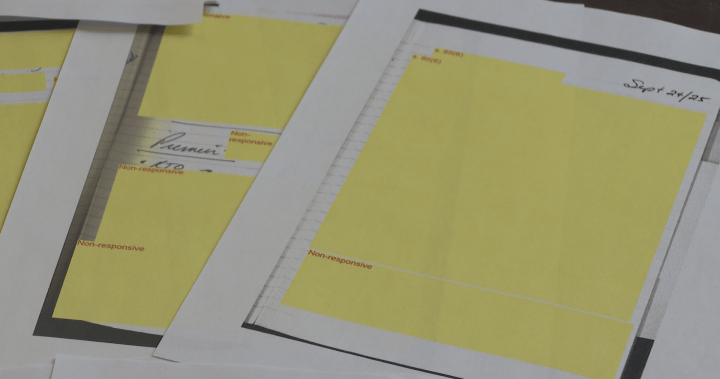
While Di Emmanuel offered up a black notebook with handwritten notes on the topic, the majority of the information was redacted before being released.
Of the 15 pages from Di Emmanuel’s notebook, the government only allowed roughly 25 words, phrases or dates to be released.
- Among the words:
“Pat” – a reference to Premier Doug Ford’s former chief of staff, Patrick Sackville - “RTO” – a reference to return to office
- “Premier”
- “Weekly meeting”
- “Appointed week” — a phrase that didn’t include context
- “Sept 24/25, Aug. 26/25” — dates that didn’t include context.
A drawing of two square brackets and a rectangle also made it into public disclosure.
“That’s not acceptable at all,” Ontario Liberal interim leader John Fraser told Global News. “The reason we have freedom of information is so that people have access to how decisions are being made in the government.”
Crawford’s office did not respond to requests for comment.
While Crawford introduced the changes, they will be passed as part of the province’s budget, which is currently rushing through the legislature and bypassing public hearings.
Finance Minister Peter Bethlanfalvy, who was shown the redacted documents during a scrum on Wednesday, would not comment on the specifics, but defended the freedom of information overhaul.
“I think that the public service, who are doing an outstanding job, they’re following the rules,” he said. “We’re lining up with other jurisdictions; our Westminster model is based on this.”
Pressed on the redactions, he added: “I can’t speak to the documents you’re flashing in front of me. I’m not going to speak to those.”
The changes to freedom of information rules, which will remove the premier, his cabinet and all their staff from having to disclose records or communications, could pass this week.
Read the full article here