



 Markets
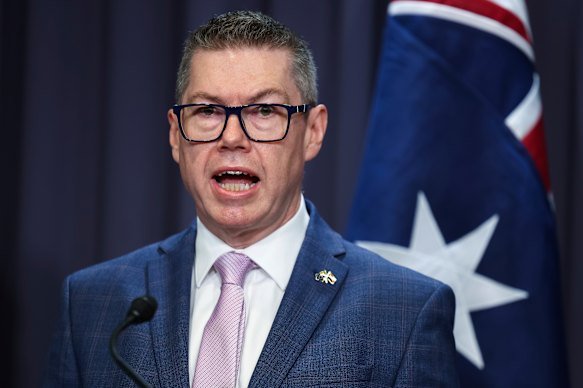
Washington/Sydney: Defence Industry Minister Pat Conroy has walked back his declaration of a time limit on the presence of US nuclear-powered submarines at HMS Stirling in Perth, saying he expected the Americans to maintain some form of submarine presence there indefinitely.
A day after telling the ABC the US submarine rotation would “come to an end” once Australia’s own Virginia-class submarines began arriving from the US under AUKUS – due in 2032 – Conroy told this masthead the agreement could easily be renewed or expanded.
“There’s an agreement around force posture that governs how they’ll operate for a certain length of time. As we approach the end of that term, then the governments will talk about what makes sense,” he said in an interview during a visit to Washington.
“We’ve had a presence of US and UK nuclear submarines before Surf West – we expect to have a presence afterwards. The force posture agreement has a nominal period, but there’s absolutely no reason why governments won’t continue it if they want to.”
Conroy added: “I would expect the US to have an ongoing submarine presence in HMS Stirling, it just might not be exactly the same way as Surf West is constructed.”
He said that did not constitute a permanent US base because the presence could take the form of visits. “Ongoing visits is a construct that a future government might choose to work with the US on.”
Opposition defence spokesman James Paterson said: “It’s frankly bizarre that Pat Conroy used an interview with ABC 7.30 to serve an eviction notice to the US Navy from HMAS Stirling before they have even arrived.
“It’s even weirder he’s now walking these comments back.
“For the sake of the alliance and the deterrence posture we need for our own security, his boss Richard Marles should urgently clarify: are US submarines welcome in WA beyond 2032 or not?”
The Pentagon did not immediately respond to a request for comment.
Former defence minister Christopher Pyne said earlier this month that “for the Americans, being able to have a submarine base in the Indian Ocean is a massive strategic advantage”.
Pyne said that HMAS Sterling navy base near Perth “will effectively be a US, UK, Australia submarine base”.
“Now, many people might not think that’s a good thing, but … it is a very important part of AUKUS for the United States because they want a submarine base in the Indian Ocean for obvious strategic purposes,” he told a crowd-funded inquiry into AUKUS.
Former Home Affairs department head Michael Pezzullo said the claim that the US rotational force will terminate in 2032 “will have come as a surprise to American ears”.
Pezzullo, the author of the 2009 defence white paper, said the US understood Australian sensitivities about foreign bases.
“However, if one peels back the diplomatic framing, from a raw US military power perspective, the submarines that will be rotated through HMAS Stirling will constitute a combat squadron that will be able to be tasked in times of war to undertake combat missions,” he said.
“Better that the Australian people be told that truth now.”
Conroy’s remarks followed meetings with acting US Navy secretary Hung Cao and US Army secretary Daniel Driscoll. He also visited a US shipyard where Virginia-class submarines – the type Australia is to acquire under AUKUS – are being built.
This masthead reported last week that senior Pentagon official Austin Dahmer told an inquiry the production rate of the submarines was still 1.1 to 1.2 a year – lower than the 2.33 required to fulfil the US’ AUKUS commitments – and that $US20 billion in additional funding had not changed the production rate.
That included $US3 billion from Australia, $US2 billion of which has already been paid into the US defence industrial base.
Conroy said he was satisfied there had been significant improvements, but the completion rate was being slowed down by delays on a few parts.
“We’re seeing advances. We’re not seeing them universally across the entire industrial base … You can’t finish a submarine with a part missing,” he said.
Cao was appointed acting navy secretary in April after his predecessor John Phelan was ousted by Defence Secretary Pete Hegseth.
During Prime Minister Anthony Albanese’s meeting with US President Donald Trump last October, Phelan said some “ambiguities” about AUKUS still remained.
“To be honest, it was a statement that perplexed me at the time,” Conroy told this masthead on Wednesday. “I did not understand what those ambiguities were.”
Asked whether the Australian government investigated what those ambiguities were, he said: “We were comforted by President Trump saying [AUKUS] was ‘full steam ahead’.”
Conroy maintained the Australian government has never given any commitment to the US, even in private, to use its AUKUS submarines in any particular conflict.
Cut through the noise of federal politics with news, views and expert analysis. Subscribers can sign up to our weekly Inside Politics newsletter.
 Michael Koziol is the North America correspondent for The Age and Sydney Morning Herald. He is a former Sydney editor, Sun-Herald deputy editor and a federal political reporter in Canberra.Connect via X or email.
 Matthew Knott is the foreign affairs and national security correspondent for The Sydney Morning Herald and The Age.Connect via X, Facebook or email.
From our partners
Read the full article here