





 Markets

John* was an 18-year-old student who had just moved out of home and was eager to please the first time he was strangled during sex.
“I got a shock the first time I was choked and slapped in the face,” he said. “But then I thought, ‘maybe I’m the prude here’.
“A lot of my friends were doing it so we had this weird kind of Stockholm Syndrome effect where everyone is talking about it and saying ‘oh that’s so hot’.”
Asphyxiation was supposed to give you an extra high during sex, John said, although this never happened for him.
“We were conditioned to think it was part of being sexually liberated. And god forbid you be seen as vanilla, conservative or boring in bed.”
The issue of choking has come into focus after a 16-year-old girl died in the northern beaches area on Tuesday in a suspected case of strangulation during what is believed to be consensual sex. NSW Police are investigating.
More than half of Australians aged 18 to 35 say they have been strangled during sex at least once, with the figure highest among women and gender-diverse people.
But the health risks are serious, ranging from pain and headaches to brain injury, memory loss, stroke and death.
Experts and violence prevention advocates have been increasingly sounding the alarm in recent years in line with a rise in easily accessible, violent pornography.
Maree Crabbe, director of Australian violence prevention project It’s Time We Talked, says choking or strangulation wasn’t an issue for the first decade after she began interviewing young people about their experiences of pornography in 2009.
But that has changed radically. “In recent years, we’ve been hearing it’s become normal to young people of all backgrounds, socioeconomic groups, cultures, sexual orientations,” she said.
Inevitable parallels have been drawn to the Scots College case of three teenage boys being charged this week with the rape of a 14-year-old girl.
Crabbe says while there’s an important difference in cases in which partners seek permission as opposed to assault, the dangers of strangulation are the same.
“You can’t consent to something that causes grievous bodily harm,” she said.
“Consent needs to be informed and people generally don’t know how easy it is to harm someone, not just at the time but in the hours, days, weeks, months and years that follow.”
CEO and founder of Teach Us Consent Chanel Contos points out that strangulation has become so normalised many young people don’t recognise a need to discuss it in the first place.
“They’ve been conditioned by porn so they don’t think it’s needed because it’s part and parcel of the act,” she said. “And if you don’t engage in this act, you are considered boring or vanilla. Violence during sex is seen as standard.
“For young women, I think a lot is about doing what’s expected of them. So many boys I’ve heard from used to engage in this when they were younger because it’s what they thought they had to do. Then they grow up and they are mortified by their behaviour. The boys are victims, too.”
In NSW courts, there’s been a surge in the number of choking and strangulation incidents.
In 2021, there were just over 1300 charges finalised in the courts of domestic violence-related choking and strangulation. By the end of 2025, that had shot up to nearly 2000.
Recent cases have included Mohammad Siddique Haidar, who in March was convicted of choking a sex worker. While on bail for raping a “sugar baby”, Haidar hired an erotic masseuse, whom he choked so hard she lost her vision and felt like she was going to die. He was sentenced to 10 years in prison for the two attacks, with three years for the offence of choking.
In June last year, an unnamed man was sentenced to 10 years in prison for raping and choking his newly pregnant girlfriend. The pair had engaged in a “light pressing of the neck” previously with the woman’s consent and ongoing nodding; however, she had clearly told him she didn’t consent to anything harder. During the offending, the woman asked the man to stop after he became rough. Instead, the man grabbed her neck until she blacked out and continued to have sex with her.
NSW law was amended in 2018 to make it easier to obtain a choking conviction, removing a requirement for the prosecution to prove the defendant meant to render someone unconscious or incapable of resisting.
Many believe this doesn’t go far enough. There’s a push to follow Britain, where active campaigning and reforms have driven policy to make strangulation a standalone criminal offence with penalty of up to five years in prison.
A previous “rough sex” defence has been eliminated and legislation has been introduced to make it a criminal offence to create, possess, publish or distribute pornography depicting non-fatal strangulation or suffocation.
Anna Coutts-Trotter, co-founder and director of The Survivor Hub and a survivor of an abusive relationship, supports stricter regulation and penalties but says that’s not the full solution.
“I’m focused on the idea of teaching young people to be critical about pornography, social media and what they are being sold,” she said.
“Most of my peers would say they’ve experienced strangulation during sex at least once – most would say with consent.”
The pornography industry has “blood on its hands” for propagating violent content, according to Contos.
“They are profiting from this,” she said. “There are generations of kids who have had their sexual desires distorted.”
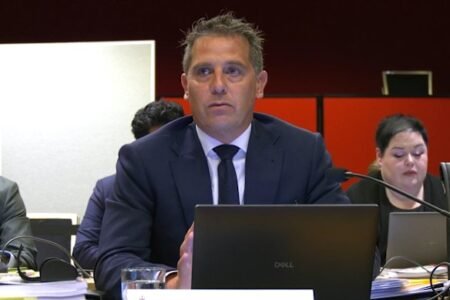
NSW Minister for Women Jodie Harrison said there was a growing concern about “the way that our boys and our men are growing up”.
During budget estimates on Thursday, Harrison was asked by Greens MP Abigail Boyd about a string of recent high-profile sexual assault and domestic violence cases.
Though she did not refer specifically to the suspected choking death, Boyd said there had been “some very troubling accounts of young people who are perhaps being influenced by social media and other things in the context of relationships”.
Harrison said she was concerned about the impact of social media on young people.
“The fear is that we are at the moment seeing an entire generation of young people who are seeing a really twisted worldview of artificial intelligence and algorithms that normalise sexual violence and hate speech, and anxiety as well as that.
While the NSW government has invested considerable resources into domestic violence prevention, Boyd said it was not enough.
“Yes, we’re doing a little bit more, but we’re never doing enough … like objectively nothing is getting better,” she said.
Contos isn’t convinced the death of the 16-year-old girl on the northern beaches will be a wake-up call for young Australians.
“I don’t think they’ll be scared by this because they know how often it happens,” she said. “They’ll see it as a freak accident and think it’s not going to happen to them.”
Start the day with a summary of the day’s most important and interesting stories, analysis and insights. Sign up for our Morning Edition newsletter.
 Amber Schultz is a crime and justice reporter with The Sydney Morning Herald.Connect via X or email.
From our partners
Read the full article here