



 Markets
Principals have warned a pay deal that would cut teachers’ meeting hours in half would backfire, as the state’s new premier continues to urge educators against more strikes.
Australian Education Union members narrowly rejected the government’s most recent offer of a 28.3 per cent pay rise over the next four years, with an increase of 12.75 per cent by October this year.
The latest deal would have also seen meeting hours halved from 80 to 40 hours a year, and government teachers at the top of the pay scale be given an annual lump-sum payment.
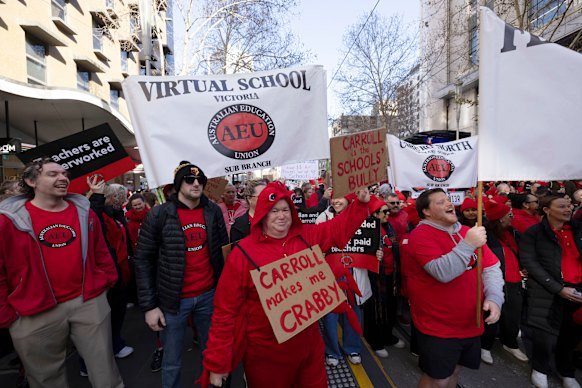
However, the offer was narrowly rejected and led to 20,000 teachers, principals and educators from government schools taking to the streets in Melbourne to call for better conditions as part of any deal.
The rejected cut to meeting hours frustrated principals, who sent a letter to Premier Ben Carroll, who is still serving as the minister for education, over the issue this week.
In a separate letter to its members, the Australian Principals Federation said it was concerned about the consequences of the proposed meeting changes.
“While the intent to reduce teacher workload is acknowledged, we believe the implementation will have several unintended consequences for school leaders and school operations,” it said.
“The APF supports genuine workload reduction for all school staff. However, workload solutions must not simply shift responsibility onto principals and assistant principals.”
Federation president Andrew Cock pointed out the organisation was not consulted before the announcement of the plan to cut meeting hours.
“There was limited opportunity to provide feedback and regrettably, not even the courtesy of a phone call advising us that such a significant announcement was imminent,” the letter reads.
Cock told The Age the unintended outcome of the proposal reduced the ability for schools to work collaboratively and for school leaders to support teaching staff.
“Some of it could be shifted to be completed in teachers’ other work hours, and some of it will be shifted to the responsibility of principals and assistant principals,” he said.
The AEU’s Victorian branch was contacted for comment.
Carroll said on Thursday morning he had pulled “every lever” when negotiating with the teachers’ union, and believed a deal was within reach.
“We are close, and I continue to have an open-door policy with both business and the union movement to get this resolved,” he said.
The premier also addressed calls for a strike on August 4, proposed by the left faction of the AEU, urging teachers not to take part as it would inconvenience families and harm vulnerable children.
“This is the biggest public sector agreement in Victorian history,” Carroll said.
“This is $5 billion over four years in wages and conditions to make our teachers and our education support staff the highest paid in the nation with the best conditions. I’m urging anyone considering going on strike not to.”
Carroll, whose role as education minister has been complicated by his sudden ascension to premier this week, said he would have more to say on the future of the portfolio – and a broader cabinet reshuffle – in the coming days.
“I’ve always said education is close to my heart … I value this portfolio.”
About 70 members of the union’s left faction met on Wednesday night and have called for more industrial action, including another strike.
They are sticking to a demand of a 35 per cent pay increase over three years, backdated to January, a cap of 25 students per class, a reduction in teaching time and improved conditions for education support staff.
Department of Education deputy secretary David Howes sent a letter to public school teachers warning them that any potential strike on August 4 would fall outside the protected action window.
“The Australian Education Union must provide the department five working days’ notice before any protected stop work action can take place,” he said in the letter addressed to principals on Wednesday.
“Stop work action that is taken without formal notification is considered unprotected industrial action,” Howes wrote.
According to the letter, the department has not received any notification from the AEU about planned action.
The union is set to meet on Friday, where it will decide upon the next campaign steps and any future industrial action.
Victorian president Justin Mullaly last week warned of further industrial action if the government failed to budge on funding state schools and education staff.
“We will escalate our campaign if we need to,” he told thousands of applauding educators.
Start the day with a summary of the day’s most important and interesting stories, analysis and insights. Sign up for our Morning Edition newsletter.
 Caroline Schelle is an education reporter, and joined The Age in 2022. She previously covered courts at AAP.Connect via X or email.
 Angus Delaney is a reporter at The Age. Email him at angus.delaney@theage.com.au or contact him securely on Signal at angusdelaney.31Connect via email.
From our partners
Read the full article here