





 Markets
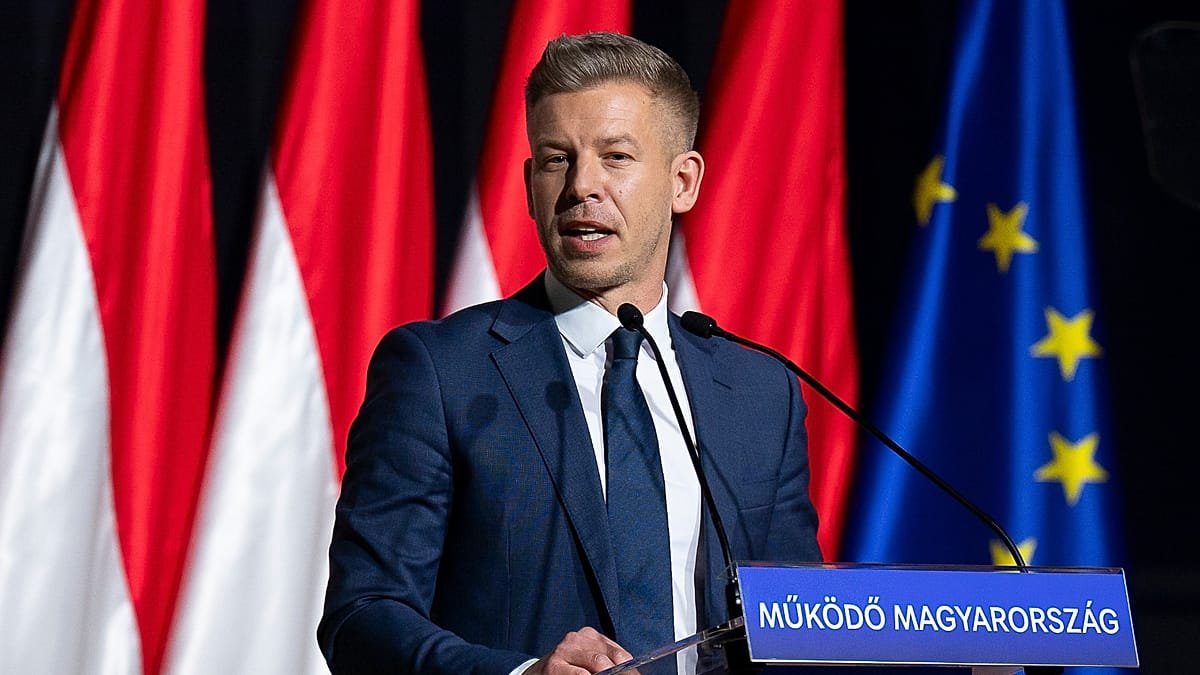
A false claim that Hungarian opposition leader Péter Magyar plans to bring back military conscription in Hungary has spread online and been linked by researchers to a widespread Russian disinformation campaign.
The allegation, shared on X and Facebook alongside an image mimicking a news broadcast, claims that Magyar told voters at a campaign rally that “Hungary needs conscription to get ready for war.”
One post on X claimed that “Magyar thinks forcing 90,000 young men into army boots will solve Hungary’s problems.”
However, there is no evidence that Magyar and his pro-European Tisza party plan to introduce mandatory military conscription.
In fact, his party’s manifesto explicitly rules this out, stating that, if elected, a Tisza government “will not reintroduce conscription” either after the election or any time in the future.
The manifesto also rules out sending Hungarian troops to Ukraine or other conflicts, while calling for increased military spending and strengthened national defence. It also advocates for scaling back foreign missions that do not serve Hungary’s interests.
Prime Minister Viktor Orbán’s Fidesz party has echoed the claim that Magyar is pushing for forced conscription, with candidates campaigning on the premise that Tisza will embroil Hungary in the war in Ukraine, re-direct pension funds to support Kyiv and impose conscription.
There is no evidence, however, that Fidesz is behind this social media campaign.
Researchers at the Gnida Project, an open-source investigative unit which tracks Russian disinformation, have linked the theory to Storm-1516, a Russian propagandist group that spreads false claims online to further the interests of the government in Moscow.
The group was first recognised in 2023 by a group of researchers at Clemson University in South Carolina, and has since been identified in multiple election campaigns, including in the US and Germany.
Microsoft’s Threat Analysis Centre, a specialised team that detects foreign state influence operations, said in a 2024 report that the group formed part of a network of “Russian influence actors” that use synchronised techniques to try and discredit Democratic candidates in the final weeks of three US presidential campaigns.
In December 2025, the German government summoned the Russian ambassador over allegations that the group had interfered in the country’s federal elections.
Storm-1516 uses a range of tactics, including creating accounts posing as citizen journalists on YouTube and X, as well as setting up fake news websites to spread false narratives.
These well-established tactic can be seen in Hungary: in this election, Storm-1516 impersonated Euronews by creating a fake report and accompanying website that falsely claimed Magyar insulted Donald Trump at a campaign rally.
A report from the Institute of Strategic Dialogue, an independent non-profit think tank based in London, found that pro-Kremlin information operations, including Storm-1516 have increased their activity in Hungary over the past few weeks, focusing their efforts on discrediting Magyar and his party.
It found that the fake website impersonating Euronews was one of six newly created websites linked to Storm-1516 that were all registered in two weeks and spread false claims about the Hungarian opposition.
The sites shared content in both English and Hungarian, suggesting an intent to target both audiences.
Storm-1516 uses misleading Facebook ads for reach
The false claim that Magyar is planning to introduce compulsory military service also ran as two Facebook advertisements, allowing it to reach a targeted audience in Hungary beyond a regular social media post, the Gnida Project found.
One advert, featuring a photo of Magyar and a link to Tisza’s party website, carried the caption “Every 18-year-old should know: conscription is coming back.”
Together, these ads reached more than 20,000 people combined in Hungary, the majority over the age of 50.
Meta, which owns Facebook, allows advertisers to target users in specific areas or age groups for a fee. In 2025, the tech giant banned political advertisements, defined as those created by political candidates, parties or content promoting or opposing election outcomes, in response to the EU updating its political advertising rules.
The ads promoting the false claim were posted by a page listed as a beauty salon, which has since been removed. No evidence of a salon operating in Hungary under the same name could be found.
According to the Gnida Project, Facebook ads are not a common tactic for Storm-1516, but the campaign has used them in the past.
They said that Storm-1516 often relies on contractors with regional and linguistic knowledge to carry out campaigns on its behalf.
“One of the clearest examples is how almost every campaign targeting Armenia is connected to the Russian propagandist of Turkish origin, Okay Deprem, and the campaign materials are executed in a certain way unique to the targeted region,” the Gnida Project said.
“We are observing the same phenomenon with Hungary, for example, most of the video materials are executed in vertical format with relatively unusual dimensions,” it added.
From conscription to conspiracy theories
Storm-1516’s theories have ranged from implicating members of Tisza to the Epstein files and accusing Magyar of funnelling financial aid from the EU to Ukraine.
One campaign identified by the Gnida Project used a vertical video with a false investigation from the “European Centre for Investigative Journalism” — a non-existent organisation.
The video falsely claimed that Magyar was involved in a scheme to funnel $16.7 million (€14.3 million) in EU aid funds to Ukraine and alleged that a trip Magyar made to Ukraine in 2024 to visit a hospital damaged by a Russian strike was a ruse to deliver the money.
Elsewhere, Lakmusz, a Hungarian fact-checking website, reported that posts linked to Storm 1516 were attempting to discredit Ágnes Forsthoffer, Tisza’s vice president, by alleging she was implicated in sex offender Jeffrey Epstein’s sex trafficking ring.
According to the Gnida Project, Storm-1516’s campaign has taken different forms in targeting international and domestic audiences.
“We are seeing that they are using different fake websites to target the Hungarian audience and the international audience to proliferate the same narrative,” the Gnida Project said. “This is a tactical shift.”
For example, after JD Vance’s visit to Hungary, in which he endorsed Orban, an English-language campaign appeared claiming that Magyar had withdrawn from the election, mimicking a Sky News report. The report and the claim are, however, baseless.
Read the full article here