






 Markets
  Weather
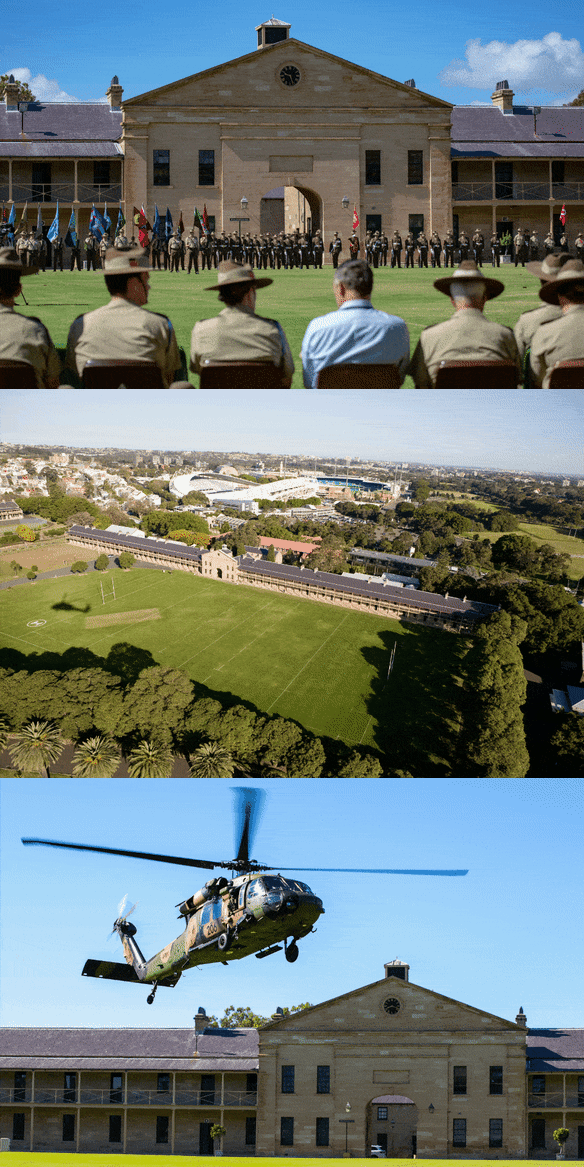
The decision to sell Victoria Barracks in Sydney, Melbourne and Brisbane is being presented by the Albanese government as a necessary act of fiscal discipline. The stated justifications are high maintenance costs, underutilised land and the prospect of raising $1.8 billion to $3 billion to reinvest in defence capability – and support the budget bottom line.
On paper, it appears pragmatic. In reality, it represents a familiar and costly failure of long-term thinking in Australian public administration. These barracks are not surplus sheds or anonymous office blocks. They are among the most significant pieces of Commonwealth real estate in the country – heritage precincts deeply embedded in the civic and military history of their cities.
Once sold, they will never be reassembled. At best, fragments will be preserved as heritage veneers around high-value development. The public interest embodied in these sites will be permanently diminished. Australia has been down this road before, and the results are not encouraging. Over several decades, successive federal governments have sold diplomatic residences overseas, landmark Commonwealth buildings in Canberra, and Defence properties around the country, often only to lease back equivalent space later at market rates.
Notable examples include the sale of the prestigious Australian embassy residence in Tokyo in the 1990s. The subsequent escalation in property values, and the sale and leaseback of Defence and other Commonwealth buildings in Canberra and other capitals during the 1990s and early 2000s locked government into long-term escalating rental commitments.
The logic is always the same: convert a capital asset into immediate cash and let “the market” carry the burden of ownership. The outcome is also depressingly consistent: higher long-term costs and a permanent transfer of value from public to private balance sheets. Sale-and-leaseback arrangements are particularly revealing. They are presented as financially neutral or even beneficial, yet they are attractive to investors precisely because they lock governments into long, inflation-linked rental obligations backed by sovereign credit. What is sold as a saving is a deferred liability – one that future taxpayers must service long after the proceeds have been spent.
While there is no current proposal to lease back the Victoria Barracks, experience demonstrates how relinquishing strategic public property can create expensive constraints when future governments discover they again need comparable facilities. In this case, the more immediate risk is the permanent surrender of rare, centrally located real estate that could serve future defence or broader public purposes.
Parts of the barracks could house Defence education and training functions, veterans’ services, emergency co-ordination centres, public museums or civic spaces. Carefully structured long-term leases, partnerships with states or universities, or partial redevelopment that funds restoration without surrendering control are all viable options. None require the permanent loss of the asset.
Although Defence argues the sites are not configured for contemporary operational use, large heritage precincts around the world have been successfully adapted for modern military, security and public service functions. The barracks could accommodate reserve and training units, cyber and intelligence support centres, joint emergency management headquarters, or integrated veteran and community service hubs. Adaptive reuse is often cheaper than acquiring and securing equivalent new inner-city sites in the future.
Once these sites are sold, those options disappear. Renting space back at market rates in perpetuity is not strategy; it is surrender.
The financial argument is weaker still when viewed in the context of overall Defence spending. Australia is prepared to commit up to $368 billion over the lifetime of the AUKUS submarine program. Whether or not one supports that investment, it places claims about the unaffordability of maintaining heritage barracks in perspective. That cost is marginal within the Defence budget.
If fiscal discipline is genuinely the objective, there are far more credible places to look. Defence has become increasingly top-heavy over the past two decades, with expanding headquarters layers, proliferating managerial roles and heavy reliance on consultants and contractors. These costs recur every year and increase over time. Addressing them is politically and bureaucratically difficult, which is precisely why governments prefer to sell land instead. Property sales produce an immediate headline figure; structural reform produces resistance.
The deeper issue is cultural. Governments increasingly treat public assets as if they were disposable items on a balance sheet rather than strategic holdings accumulated over generations.
The decision to sell the barracks may make the next budget look marginally better. It will not make Defence stronger, the public richer or the nation wiser. Already, veterans’ groups, the RSL, the federal opposition and community leaders are warning of long-term costs, a decade-long sell-off process, and the irreversible loss of irreplaceable heritage and strategic assets. It will simply repeat a pattern Australians have seen too often: the quiet liquidation of irreplaceable public assets for short-term gain, followed by decades of rent, regret and reduced sovereignty.
Professor Clive Williams is a former army and Defence officer and is director of the Terrorism Research Centre in Canberra.
The Opinion newsletter is a weekly wrap of views that will challenge, champion and inform. Sign up here.
 Professor Clive Williams is a former army and Defence officer and is director of the Terrorism Research Centre in Canberra.
From our partners
Read the full article here