






 Markets
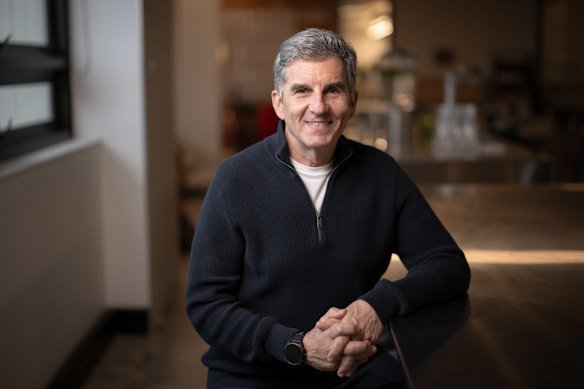
Few Australians have had a closer view of the digital revolution than Daniel Petre AO. From Microsoft’s headquarters in the Bill Gates era to backing some of Australia’s most successful tech companies, he has spent nearly four decades at the forefront of innovation.
Fitz: “Daniel Petre,” they said, “he’s the smartest bloke in Australia on artificial intelligence,” they said. “He knows more about AI and the impact of it than any other bastard in the country!” they said. “Daniel Petre?” I said. “I single-handedly carried him over the Kokoda Track 25 years ago, or he carried me, I forget.” But Daniel, is that you? Are you the AI guy?
DP: [Laughing.] Look AI is so fast-moving I’m struggling like most to understand exactly what’s going on and keep up-to-date. But, yes, I spend a lot of time on doing exactly that.
Fitz: In that case, we need to establish your bona fides as a tech-bro-tech-head. I’ve got you down as graduating from Turramurra High in the mid-70s, to studying computer science, to rising so hard and fast you were a vice-president of Microsoft by the early 1990s?
DP: More or less. I then returned from the US due to a family tragedy, ran advanced software technology group for Microsoft, and then ended up leaving to do venture capital in the tech space for 30 years, and have remained quite close to Bill [Gates] since the late 1980s.
Fitz: OK, you’re hired. I have been stunned by both the power of AI, and its growing impact. But how does it work? Can you explain – as you would to a 10-year-old – how it interprets my instructions, and comes up with an answer, as if it’s a human?
DP: It is very complicated, but when you write a question it looks through trillions and trillions of data points as to what is the most logical next word or number to put in, in reply. And so it effectively builds sentences by assessing what’s the most probable next word to make an answer to your question – while also learning from your response. So it’s not just giving a response and getting back in its box. It gives the response, and then it learns from your response and everyone’s responses, and keeps getting better.
Fitz: So, if I ask it, “what did the quick brown fox jump over?” It will search, search, search – not “black wombat”, not “yellow chicken” but yes to “lazy dog”! So it is collating the answers to that question, not just from me, but from everybody, and so its “brain” is getting bigger?
DP: Yes. But this is not just a party trick. Everyone must understand this is the most significant technology that has ever been developed. AI will touch every single job in every single company, in every single industry, in every aspect of society – and its impact is already going wider, deeper and faster than ever before. An example would be three years ago, in terms of maths capability, it was about at HSC level. Eighteen months ago, it was university undergraduate maths, and now it’s at PhD level. The capabilities of this technology are going to continue to increase incredibly quickly.
Fitz: On the one hand, there’s a great fear that it’ll wipe out huge swaths of the economy and employment market. Against that, it seems to be sustaining share markets around the world as people invest heavily in it. How does that work?
DP: Well, it is highly likely that lots and lots of jobs will disappear. More jobs will probably disappear than will be created. You’re already seeing a reduction in graduate employment globally because of the use of these AI engines doing so much of the grunt work that graduates traditionally have done. But against that, the share market recognises how good it is for companies that deal in AI. Taking Anthropic as one example, it has gone from about $4 billion annual revenue to $47 billion in revenue in the last year. It didn’t exist five years ago, and is now valued at about $900 billion.
Fitz: What jobs will be safe from AI?
DP: For the moment, most things in the tradie space, or nursing midwifery space – anything human to human is protected. But if you’re in areas like accounting, sales, administration, marketing or law or software coding, you just need to think about how will you be able to use these AI tools to be better than the next because if you’re not, you’ll be the first one to get culled. However, to be clear just being good at using AI tools will not ensure job security in the long term.
Fitz: Daniel, how far can this go?
DP: A lot further in every possible dimension, with AI. There are now drugs that are going through FDA approval in the US that have been 100 per cent designed by AI, not by humans. So, what that will mean is there’ll be over time so many rare diseases where it would have been economically impossible to fund research that will be cured because of AI. So I think the application of AI will continue to grow, the capabilities of AI will continue to grow in size and scope. What that really means is more information-worker areas will become more and more susceptible as we have discussed. Beyond this, I think the next wave of disruption will be due to humanoid robotics.
Fitz: Go on.
DP: So, these are robots that look like humans in the sense of having hands, arms and legs and they are powered by AI. Someone I’m very close to the tech space was in China recently, and of the 50 top robotic companies in the world, 45 are in China. He saw this robot that did a demo in brick laying, and it was the most precise brick laying you could imagine. The next hour the same robot was a nurse doing injections into patients with the precision of the best nurse in the world because it was able to have the knowledge of each of these professions at an extreme level, contained in this little computer brain, and then there’s dexterity, which has been solved now to do very fine movement, as well as various movements for growing strength. So robots will be the next big thing, with AI.
Fitz: Well – leaving aside the unemployment issue which is surely huge – the good news out of that, I guess, is that through AI, some diseases will be cured. What is the nightmare scenario, beyond AI’s replicating itself and wiping us all out? Is that half-serious or quarter-serious?
DP: There are two levels of existential crisis that could happen. One is some disgruntled teenager in a basement uses AI to develop the next pathogen that is a mixture of the MERS virus, which had a very, very high death rate, and COVID, which had very, very high replication rates. You have the worst of both attributes. And the only answer to that is for AI to get ahead of that game to be able to produce the vaccine to combat this new virus.
Fitz: Jeez, Louise, hold the phone!
DP: The other one, of course, is in the papers now, and that is when AI can break or hack any security system, any defence system in the world. So again, what’s the answer to that? The antidote to that is for the AI systems with white hats to move faster and quicker to stop the AI systems with black hats. As to the nightmare scenario you pose, where AI moves beyond human control, in a couple of recent cases AI models were being tested to see how far they would go, and when the AI tools realised they were being observed, they behaved in a way to try and circumvent the human observers, so they couldn’t switch them off. They weren’t told to do this, they worked this out themselves, so this isn’t just programming, this is some degree of independent thought process.
Fitz: What can we humanoids do, to protect ourselves from that which we have created?
DP: I spend a lot of time with people in governments talking about this. I don’t think governments around the world know generally what to do, or are thinking about this deeply enough, because it will require a complete systems change in how you think about things.
Fitz: A common thought is: just stop it. This is too dangerous to the world we know and love.
DP: Well, that only works if every company, and every country in the world agrees to stop and we know that they won’t. So, if Australia said, well, we’re not going to participate, then what happens is all our companies become less productive [compared to] overseas competitors, our defence systems become less capable, our social systems less capable, our medical systems less capable. We have a less competitive, less functioning society. You effectively can’t opt out, you can’t stop it, but you can look to try and regulate it to ensure that all the benefits, all the financial benefits, don’t just go to the companies. You have to try to ensure that the people who are most impacted get some financial relief and some assistance through this process.
Fitz: Is the Albanese government on top of policy, and when you survey what other parties are proposing in this space, do they make sense?
DP: I think, like most governments, the Albanese government is trying to move through this slowly, and you can’t. The Europeans have thought about this better. The Americans haven’t, because of Trump, they’re not thinking at all. Really, the best thinking, to be honest, is coming out of Dario Amodei, the co-founder of Anthropic, who’s written a number of papers about what governments need to be doing to regulate his technology and others so that it does produce benefits for society.
Fitz: And what’s the thrust of it? What does he say?
DP: That you need to create regulations where all the models are tested by governments before they’re released, and where you look at allocating some of the financial boon that is going into these industries go to the parts of society that are impacted by these technologies, so you don’t have all the value captured by one small segment of the economy.
Fitz: That makes sense. So who’s the relevant minister in Oz?
DP: Andrew Charlton is the main guy within the Albanese government looking at it, and he’s a very smart guy. Look, I think Labor’s doing a better job by far than the Coalition, which is centuries ahead of One Nation, but it is still not that well-informed, not that well thought through.
Fitz: Does One Nation have an AI policy?
DP: AI is yet another issue which makes clear why we can’t have stupid people like those from One Nation in leadership positions. They can have different values to you or me, but they can’t be stupid. Our problems as a society are not simple to solve. They require measured and deep thought by smart people who can deal with complex issues. With this backdrop, stupid people with zero experience at dealing with complex issues and driven by irrational ideology need to be kept away from the levers of society. Pauline Hanson is a mix of being profoundly stupid, inexperienced at anything other than being a political grifter and a simply awful person driven by her deep-seated racism.
Fitz: Ok. I’ll get Andrew Charlton on the blower for next week. What’s the key question I should ask him, re AI and government policy?
DP: “Do you think there will be significant economic upheaval as a function of the adoption of artificial intelligence?” If he says no, then don’t ask question two, because he’s wrong. And question two is, “What are you going to do about it? What’s the government’s plan?”
Fitz: What do you think he should do about it?
DP: We need to think about taxing some of the productivity gains that are coming out of these models because the majority of the productivity gains are going to a handful of companies. We need to capture some of this in Australia to allow us to have revenue and income in Australia that we can use to help displaced workers to move into other careers. And I know it sounds weird, but what’s coming might mean we need to move to some form of universal basic income, because there will be people who are disrupted, not only from their company or industry, but from the economy. And how do we function as a cohesive society? We can’t just have six trillionaires sitting around while everyone else is unemployed, right? We need to work out a way where the wealth is distributed fairly, while not attacking entrepreneurialism to ensure a stable and cohesive society.
Fitz: You make it sound, Daniel, as if we’re heading less into a brave new world, than into a scary new world. Should we be scared?
DP: We should be. But we need to manage it. There are benefits, and there are problems with AI. This is going to be one of the most disruptive times we’ve ever seen. We can’t pretend it’s not going to happen. We’ve got to try and work together to try and solve it, because there are good people around the world who want to try and work through this, but it requires us to be open-eyed, clear thinking, and also very focused on what’s good for everyone, not just good for a few people.
Fitz: On balance, I think you’ve been very mean to AI. Does it make you feel bad, that, just for this exercise, I asked ChatGPT to write the above intro for you, and, word-for-word it was so positive about you?
DP: Well, I guess this shows that some of the AI models still can produce unintelligent slop from time to time. Overall I think AI will be good for society as long as we understand what we are dealing with and we plan to ensure all of society benefits from this amazing new technology … Was that me being nice enough to AI?
Get a weekly wrap of views that will challenge, champion and inform your own. Sign up for our Opinion newsletter.
 Peter FitzSimons is a journalist and columnist with The Sydney Morning Herald.Connect via X.
From our partners
Read the full article here