



 Markets

Updated ,first published
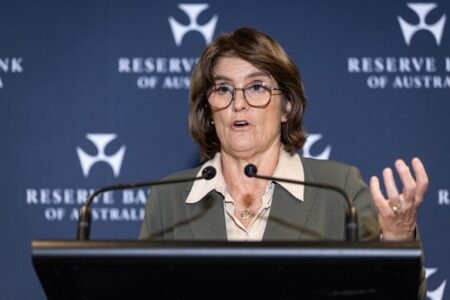
Reserve Bank governor Michele Bullock has joined economists in warning that government stimulus will only add pressure to keep hiking rates, as Liberal leader Angus Taylor flags support for proposed tax relief in next week’s budget but accused Labor of lying about investor taxes.
Chalmers was forced to defend Labor’s near-record spending on Tuesday after the Reserve Bank lifted rates for the third consecutive time, wiping out last year’s trio of rate cuts and placing more scrutiny on the level of spending in the budget.
The treasurer tried to play down speculation that he would put forward a tax offset of between $200 and $300 for wage earners next week as a way of softening the blow from changes to negative gearing, capital gains tax discount and family trusts.
This masthead reported on Tuesday that households could score tax relief to offset revenue-raising tweaks to negative gearing, the capital gains tax discount and family trusts, whose distributions are likely to be taxed at a minimum rate of 30 per cent.
Asked in an interview with this masthead if he would support a one-off tax credit, Taylor said that “we believe in lower taxes”, paving the way for the opposition to support any offset unless Labor wedges the Coalition by tying the relief to legislation that includes its broader tax hikes on asset owners.
Taylor was shadow treasurer when the Peter Dutton-led opposition infamously opposed a small tax cut announced by Labor before the last election, denting the opposition’s reputation for supporting lower taxes and contributing to its crushing election loss.
On those broader measures, which largely re-adopt Bill Shorten’s 2019 tax agenda, Taylor was resolute that the opposition would not support higher taxes that Labor said it would not pursue at the last election.
“They lie without any sense of remorse now, they break their promises without any sense of remorse,” Taylor said on Tuesday in Canberra. “This is a Labor Party that has clearly lost any respect for the Australian people and thinks that it’s all just a political game.”
“They are incompetent, they are fraudulent, and they are liars.”
The opposition is flirting with bold policies on slashing company tax for small businesses or using the GST or other means to pressure states to wean themselves off stamp duty.
Bullock, who has been reluctant to weigh into the debate on whether government spending is fuelling inflation, said on Tuesday that the bank was trying to reduce demand in the economy because supply-side constraints meant it did not take much additional demand to set off inflation.
Her comments underline the dilemma facing Labor in next week’s budget, which Prime Minister Anthony Albanese has framed as his most ambitious to date. On the one hand, the government is facing pressure to shield households from the global oil crisis and rising fuel prices. It is also trying to rein in spending to take heat out of the economy and make the budget sustainable.
The tax offset, first reported in The Australian, may not kick in until next year, in which case the government may argue it would not add to inflation in the near-term.
The bank’s statement did not specifically mention government spending but she said in her subsequent remarks that providing more money to households would inflame demand. Higher business investment, a sign of a rebounding economy, helped drive up inflation last year.
“Whether it’s direct expenditure or giving money to households to spend on goods and services in the private sector, that adds to demand,” she said.
“When governments are spending a lot of money and we’re running up against capacity constraints, then they do need to think about whether or not there’s ways they can help the inflation problem.
“I personally think that the treasurer, privately and publicly, is focusing on that. But it’s not just the federal government. It’s the state governments as well.”
Deloitte Access Economics’ economist Stephen Smith said that the government’s fiscal stance should align with the Reserve Bank’s aim to tame inflation.
“The government will need to demonstrate a genuine commitment to fiscal discipline and structural reform, rather than relying on broad-based, short-term cost-of-living measures that may provide temporary relief while adding to medium-term inflation persistence,” he said.
Chalmers said: “The Australian economy is getting absolutely pummeled by this war in the Middle East, and Australians are paying the price for that.”
“We’re seeing that again today with this interest rate decision.”
The government has already announced major savings, including in the NDIS, and has pledged to bank most of the savings rather than spend it.
Albanese is planning to revive almost all the tax pledges Bill Shorten took to the 2019 election, which Scott Morrison won in a fight over Labor’s plans to levy asset owners more heavily to reduce inequality.
Before the last election, Albanese explicitly ruled out future changes to negative gearing, which allows investors to deduct rental property losses from their taxable income. Labor is planning to pare back the concession but allow it to be used for new homes to spur housing supply, as it gambles on a younger electorate backing major changes to make the housing market fairer.
Asked if he had broken trust with voters, Albanese told reporters in Brisbane that Australians would judge his budget policies on their merit.
“People will see the budget there, and people will make their own mind up about the decisions that we have made,” Albanese said on Tuesday.
Separately, the government will announce a $74 million will be spent over two years to create a new online terrorism centre, led by ASIO and the federal police, to target terrorists who are using the internet to recruit young people.
 Paul Sakkal is Chief Political Correspondent. He previously covered Victorian politics and won a Walkley award and the 2025 Press Gallery Journalist of the Year. Contact him securely on Signal @paulsakkal.14.Connect via X or email.
From our partners
Read the full article here