




 Markets

Opinion
We were told that it was impossible, insane even, to attempt. But it’s actually working. In a world of woe, Australia can be quietly pleased with progress on an important reform.
The electricity grid is moving towards renewables at a rate faster than experts predicted. For two quarters in a row now, solar and wind have supplied about half of the nation’s electricity. Coal’s share is shrinking to all-time lows.
The grid has remained stable. The price of wholesale electricity has come down. Carbon emissions have fallen. And the price of a lamb roast is yet to hit $100. Far from it.
Is this because demand for electricity has fallen? On the contrary, demand has reached record highs, thanks to heatwaves.
“Not long ago, that would have sent energy ministers out to ask people to not turn on their dishwashers,” says federal Energy Minister Chris Bowen. “No need. The grid coped fine. This is a turning point.”
What’s going on? Like Hemingway’s famous description of how bankruptcy happens, the electricity transition has proceeded “gradually, then suddenly”.
“The story is that there’s a big shift to a lot more battery storage, and that’s changing the market in interesting ways,” says Grattan Institute energy and climate change program director Alison Reeve. “All the batteries are starting to mop up daytime solar energy and then people are using it at the evening peak. That’s flattening demand peaks. If it continues, it’s a great sign.”
How so?
“The lower you make your peak, the smaller the overall grid needs to be,” Reeve says. “And that saves everyone a lot of money.”
Another change: “We used to have gas peakers turning on at 5pm,” she says, referring to the gas-fired power plants that switch on to supply the extra electricity needed at the time of peak demand. “That’s very expensive.” But the surge in new batteries is making gas peakers redundant and that cuts the cost.
“The story of the last 20 years has been coal leaving the grid. Now we are starting to see gas leaving the grid,” Reeve says.
That doesn’t make gas obsolete. Heavy industry depends on gas, and 5 million homes use it too. But it does make it a little less central; we have a glimpse of the future. Better yet, the change is giving Australia’s electricity market some insulation from the world energy crisis.
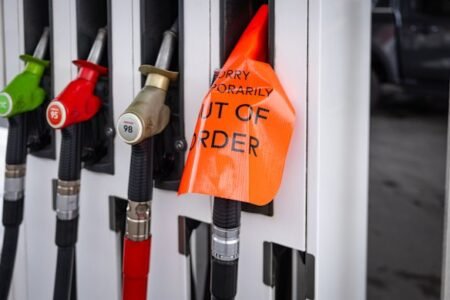
The last time there was a global oil shock was in 2022, when Vladimir Putin invaded Ukraine. Oil prices leapt by about 60 per cent. The Australian wholesale electricity price leapt yet higher in response, by some 200 per cent. But this time, while the global price is up by about 70 per cent due to the Iran war, Australia’s wholesale electricity price remained “relatively subdued” in the words of energy analysis firm Wood Mackenzie.
In fact, wholesale power in Australia is cheaper now than it was in January, before the war broke out. The bottom line: “The country’s power sector is steadily decoupling from global fossil fuel market volatility,” says Wood Mackenzie analyst Natalie Thompson.
In the midst of a fuel crisis, this is very welcome news. Perhaps not for some Coalition politicians who’ve staked their careers on opposing the shift to renewables, however.
Australia has expanded its renewables to the point that they supplied the majority – 51 per cent – of electricity in the last quarter of last year. It was the first time. In Western Australia, which operates separately, the comparable statistic was even higher, at 52.4 per cent renewables.
Of all the batteries being installed worldwide today, one in 10 is in Australia.
The Coalition, allergic to electoral majorities, intensified its phobia to electric majorities in exactly the same quarter. It renounced its policy of net zero in November. So the Coalition hardened its hostility to renewables at just the moment they became dominant in the electricity grid.
Once an ungrateful electorate had rejected the Coalition’s brilliant plan to build seven nuclear power plants over the next 20 years, entirely at taxpayer expense, it needed to find new ways to express its renewables rejectionism.
Pauline Hanson goes even further. Renewable energy “has all been a scam” and Australians had been “brainwashed”, the One Nation leader says. If so, it’s been effective. Renewables are partly a people’s movement. Families have led installations of solar panels for decades now. The total number of households with rooftop systems is 4.3 million. That’s rapidly approaching half the country.
Altogether, the capacity of the people’s panels movement “now exceeds the total capacity of existing coal-fired power plants”, Wood Mackenzie reports.
And the battery boom is partly a people’s movement. About 360,000 households have installed a home battery over the past 10 months under a federal scheme. The demand outstripped government expectations and also budgets; federal subsidies for those batteries ran to a total of about $3.3 billion.
Big batteries have boomed, too. Remember the fuss when Tesla installed its “big battery” of 100 megawatts in South Australia? In the eight years since, Australia has hooked up batteries with a combined capacity 45 times this size. In the last year alone, the installed capacity of batteries, home-scale and grid-scale, in Australia has more than doubled. Of all the batteries being installed worldwide today, one in 10 is in Australia.
Donald Trump’s war has galvanised a boom in EV demand in Australia, too. Sales of EVs grew by 42 per cent in March compared with February. Polestar Australia’s Scott Maynard told the ABC that sales in the first quarter had doubled year-on-year: “It’s almost been like a sale weekend every weekend, which is not normal for a March trading period.”
Renewables, backed by batteries, have developed serious popular support and major marketplace momentum.
The fight over energy and climate change has been one of the dominant themes in Australian politics since 2007. It was a big asset for Labor in the election of that year, but the Coalition turned it to its advantage in the four elections to follow. So it’s not going to put down the climate cudgel any time soon. But the Coalition needs to cast its thinking two years ahead to the time of the next federal election. Will renewables rejectionism and climate churlishness still be a political asset for the Coalition in 2028?
Labor recaptured the edge on the issue in the 2022 and 2025 elections. Now that the grid transition is working, power prices are falling, at last. The draft electricity prices proposed for the year beginning July 1 offer cuts across the board.
According to the Australian Energy Regulator, the default price for households in NSW, south-east Queensland and South Australia will be between 4 and 10 per cent cheaper than in the preceding year. On current developments, the price cuts are likely to gather pace the year after. This will give Labor an easier sell for its energy policy.
And the climate will continue to change. As Caitlin Fitzsimmons reported for this masthead earlier this month, Sydney summers are seven weeks longer than they were in 1990, according to University of British Columbia researchers: “If trends continue, summer will last half the year within a few decades.”
Is the Coalition’s war on renewables a busted flush? It can take heart from the many problems that remain with the energy transition. “The electricity transition is making good progress,” says Reeve. “The rest of the transition is not so good. There’s no signal from governments to say ‘this needs to happen’.”
Climate change high priest Ross Garnaut agrees: “Compared to other developed countries, Australia is well advanced in the electricity transition, but for the economy as a whole we are way, way back.”
After the electricity system, the biggest carbon emitters are transport, heavy industry and agriculture, and progress in all three is slow to stalled. Garnaut says the federal government’s renewable energy target (RET) “was the main driver of renewables investment, but it ran out of steam a couple of years ago. The first-best policy choice now is not an extension of the RET but an economy-wide carbon price to drive private investment into big-scale wind and solar”.
“And the reason it’s so much better is that it also fixes up the budget problem” by raising revenue for the Treasury, Garnaut says. It would also boost productivity while lifting living standards and meeting the country’s emissions targets, he adds.
The reaction of Labor ministers to the idea of a carbon price is, however, like a vampire to a crucifix. It will not happen. Instead of a single, efficient price mechanism, the Albanese government intends to muddle through with its patchwork approach.
Garnaut still holds to his vision of Australia as a renewables superpower, eventually. “Australia’s advantages are so great that we are making progress despite the headwinds from policy.”
Opportunity remains, and so do the obstacles.
Peter Hartcher is political and international editor. He writes a world column each Tuesday.
Get a weekly wrap of views that will challenge, champion and inform your own. Sign up for our Opinion newsletter.
 Peter Hartcher is political editor and international editor of The Sydney Morning Herald and The Age.Connect via email.
From our partners
Read the full article here