






 Markets
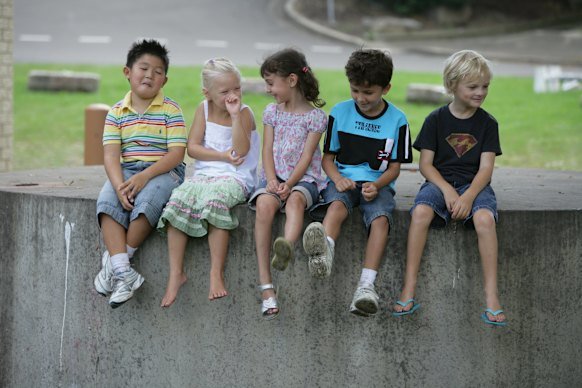
Picture this: Middle Park Bowls Club on a sultry Saturday afternoon in February. Sausages sizzle and pop on the barbecue. Crowds in bare feet wobble bowls down the length of the green.
Here I am with my wife and our son, 11, and daughter, 14, to celebrate the wedding anniversary of a couple we befriended just a few years ago.
Our group was about a dozen or so couples and families. Our children, most of whom had not previously met, ranged from infants to early teens.
It only took a few moments before they formed little packs, and we parents faced away from our progeny so we could talk and drink together. Occasionally, I would turn around to see the kids hoarding bowls and creating their own games that had little to do with actually bowling. They climbed trees. Fell down. Scraped their hands and shins.
Dinner was sausages in a blanket. The kids could help themselves or keep playing.
They mostly resolved their own petty squabbles. When necessary, we sent in one of the bigger kids to mediate the teasing. Parents only got involved briefly, when violence escalated to a slapped face or pulled hair.
No phones or screens. It felt like the 1980s or 1990s when, as children, we seemed to play for hours on end beyond the view of our parents, who were locked in lengthy conversations which held little interest for us.
I looked at the circle of parents drinking and laughing in the summer dusk, and I thought about my life outside this gathering. These simple, carefree social moments were all too rare.
On the way home I started wondering: when did this parenting thing become so damn complicated?
Excluding historical crises like war or natural disasters, it feels like contemporary pressures have created unprecedented complexities in family life.
For those in my generation fortunate enough, we gratefully accepted the advice and financial help of our parents to buy into the property market. But when we did get our own bricks and mortar, rising interest rates and a spiralling cost-of-living crisis stole the joy from home ownership and the freedom it was supposed to deliver.
When I was a child, my parents sent me to school down the road. Now, school choice has become a time-consuming and stressful ordeal for many families. Whether public or private, none of it seems straightforward any more.
For many parents, like me, who had children just before or during the 2010s, the pandemic felt like an inflection point shunting us into a more complicated life that could not be unwound simply when all the lockdowns ended.
Long hours of screen time were foisted on us before we were ready. Our kids then missed social development opportunities, including school camps and sleepovers that had long helped build independence.
All the while social media bombards us with advice and lectures about what we’re doing wrong. Not to mention the effect of social media on our kids. The federal government’s age limit of 16 was not the end of the matter for teens too young to have their own accounts. Rather, it was the start of another argument with them.
Despite these real and new complications, Raising Children Network director Derek McCormack has some relatively good news: the fundamentals of parenting have changed little over time.
The love and support of at least one adult, a nutritious diet and physical safety remain core elements of a good childhood.
“These are like scaffolding or building blocks for healthy development,” McCormack says.
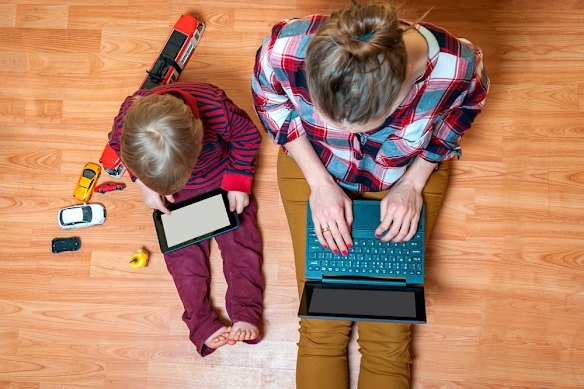
But he agrees parenting in modern Australia is undeniably more complex than even just a decade ago. McCormack says parents often might be battling for their children’s attention against big tech companies that “come for your attention and then take up your time”.
He says parents cannot constantly monitor their adolescents’ screen and social media use. But we can model the kind of behaviour we want to see in our children. And we can be available with a non-judgmental ear when things go wrong.
“You can have open, curious, positive, respectful communication,” McCormack says.
I have been trying to cut my screen time at home. And yet so often I find myself absorbed in that rectangular screen.
I try to justify it by reasoning that so many life necessities must now be done on phone: banking, weather checks, social arrangements. But I fear what my children see is just me on the phone all the time.
Screens are among myriad pressures affecting parents’ emotional wellbeing. A survey by the Parenting Research Centre of 10,000 Australian parents revealed high levels of psychological distress had almost tripled between 2016 and 2025, increasing from 4 per cent to 11 per cent.
The centre’s report found the growing weight of social pressures, from the cost-of-living strain to eroded informal support networks, were increasing the load on caregivers.
Parents reported increasing levels of self-doubt, which may be a response to unrealistic parenting ideals conveyed on social media.
Emily Alston is becoming well acquainted with the challenges of navigating screen use and the online world with her teenage daughters Alayna, 14, and Lily, 13. She has another daughter, three-year-old Harriet.
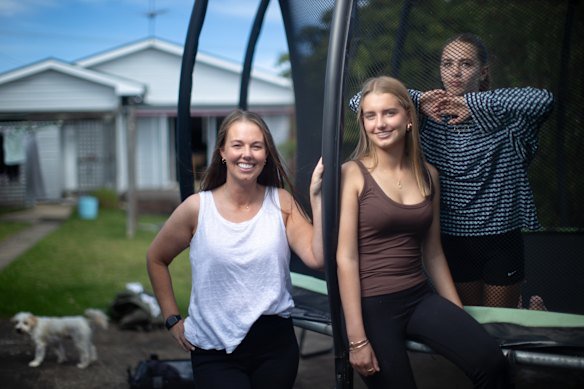
When her elder girls were little, Alston longed for the day when they could put on their own shoes and use the toilet themselves. Now they’re teenagers, she realises every stage comes with unique challenges.
“I’ve just come to think all the stages are bloody hard,” Alston laughs.
Alston, who lives 150 kilometres south-west of Melbourne in Colac, relishes the conversations some parents might find tricky. Her work in health promotion focuses on vaping and its related harms, which helps for discussions with her daughters.
“Having those conversations and picking things apart – I do enjoy that with them.”
Even though regional Victoria’s lockdowns were less severe than those in Melbourne, Alston says Alayna in particular missed valuable experiences, including school camps.
Some children maintained relationships via social media during lockdowns, so friendship groups changed once they returned to school.
“I wonder if she had been a more confident person had that not been the case.”
Alston decided her daughters could have mobile phones at 13. But Alayna, whose birthday is in October, started year seven when she was 12. So her mother found herself constantly fielding messages and calls from Alayna’s friends trying to reach her.
By Easter of that year, Alston relented and gave Alayna a phone six months earlier than they originally agreed.
Alayna’s phone was connected to the family account, so Alston could control it from her phone. No social media. Not long afterwards, Alayna successfully argued she needed messaging app Snapchat to communicate with friends.
However, Alston has not compromised on phone downtime, which she enforces every night at 9pm.
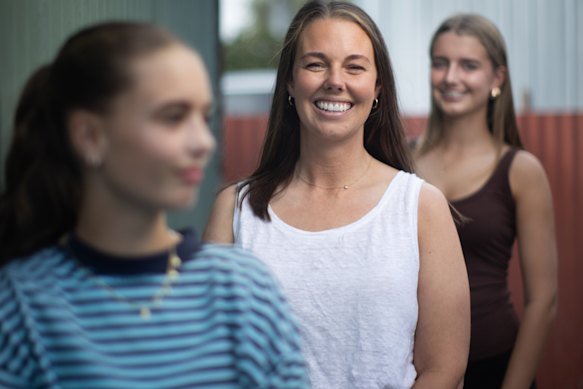
Then comes the inevitable conflict after Alston rebuffs her daughters’ demands for more screen time. As she recounts these experiences in her Colac home, I nod along at the similarity of our parenting struggles and the seemingly daily conflicts about screen use.
Alston worries about the corrosive effect of social media on her girls’ perception of the world. But the reality is, they’re worried too.
I ask Alayna if she would rather have a world with or without mobile phones. Her response is emphatic.
“Without,” she says.
Alayna agrees social media sets unrealistic expectations of the real world. And Lily feels the same, even though she is three years away from legally having a social media account.
“It does influence me because friends have social media,” Lily says. “I feel like I want to do the same thing as my friends.”
Social media not only influences their fashion choices and concepts of beauty, it plants the seed of holiday choices too. Alayna wants a trip to the Maldives after seeing posts by influencers.
But when I ask about some of their favourite family holidays, both girls mention camping. Lily believes she will always want to go camping with her parents.
“If we did it without them, then it wouldn’t be the same,” she says.
Alston’s sister-in-law Laura lives on a sprawling sheep farm in Beeac, near Colac, with her husband and their primary school-aged children George, 5, Willow, 10, and Heidi, 11.
The farm is the children’s backyard where they can ride dirt bikes, run around with their puppy Daisy and explore until it gets dark. I imagine an idyllic and wholesome country existence untouched by digital technology.
Yet, even at her children’s tender age, devices and algorithms have successfully sunk hooks into their lives.
The children do not yet have phones but iPads and other screens have proven unavoidable.
“We talk about it pretty openly, but I feel like I’m the police all the time. ‘Don’t watch this. Don’t look at that’,” Laura says.
When I visited the family farm, Laura’s children were welcoming, polite and chatty. Like any family, though, sibling conflicts often bubble over.
One weekend Laura banned television altogether and sent the children outside after their squabbling pushed her patience to its limits.
“It was so nice,” she says. “Being in the city would be so much harder.”
My city-dwelling offspring are experiencing a vastly different upbringing to Laura’s children, yet we share many of the same frustrations about the online world’s encroachment in our lives.
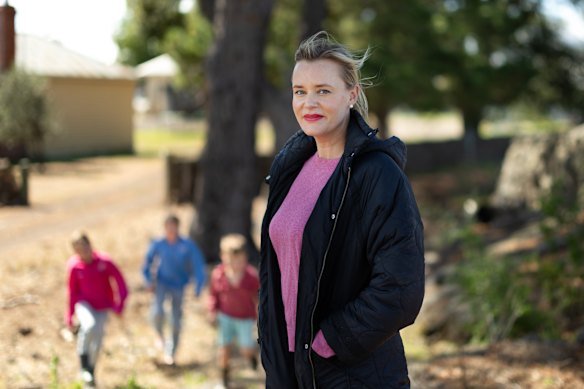
Laura is trying to manage these challenges while studying medicine full-time. She tries to be present for her children but often feels life is sliding by amid the hustle of work and parenting.
There is always so much to manage.
Laura talks with her children about safe online conduct, which includes never sending photos of themselves. There have already been cautionary tales in her community, including a friend who learned a photograph of their child was taken from a newspaper and manipulated into a pornographic image.
“It’s just scary. I don’t know how we’ll protect them from that,” she says.
All of this makes for an often bewildering experience as parents. I don’t mind being called “bruh” by my kids, but snapping angrily at me when I ask them to put away the devices? Well, I never spoke to my parents like that.
But I don’t want to be a grumpy, authoritarian dad – a trap I fall into far too often. I want to counter teenage and childish rudeness with calm positivity rather than matching my children’s anger.
Mostly, I fail at that. But not always.
The other night I felt my frustration simmering again after hollering at my daughter to brush her teeth. Repeatedly. Pick the shoes up from the kitchen floor. Clothes too. Go to bed.
I’m about to yell again over the music drifting out from behind her bedroom door.
I stop for a beat, realising I like this record. It’s Currents by Tame Impala.
We have tickets to see them together in October, and we’re both excited. Then I wonder if she still wants to go with me. She is 14 after all. So, I knock on her door and ask whether she would rather take a friend instead.
“Nah Dad, it’s OK,” she says, barely looking up from her book. “I’ll still go with you.”
My daughter still wants to hang out with me. My wife and I must have done something right in this crazy parenting caper. For all our frustrations, our daughter is savvy, fun and empathetic with a strong moral compass. So is our son. I know many other young people like them too.
Just maybe, the kids are gonna be alright.
Start the day with a summary of the day’s most important and interesting stories, analysis and insights. Sign up for our Morning Edition newsletter.
Read the full article here