




 Markets
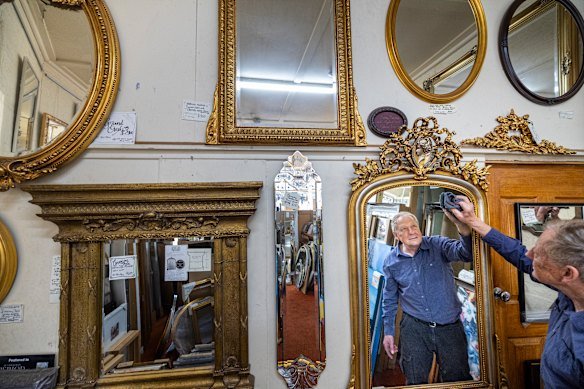
Denis Kosnar is wrangling a 2.6-metre python skin, unfurling the great rolled-up beast and flattening it with clamps and weights.
Applying snake oil to one side (or, more accurately, glycerin) and rubbing alcohol to the other, he’s been meticulously working to preserve the skin, some weeks after a woman walked into his shop and pulled it out of her bag.
Her relative shot and killed it in Sri Lanka 20 years ago, she said.
Kosnar has been a framer for 61 years – but this is a first.
“See, there are the creases there,” he says, tracing a finger over the snake’s scales through his phone screen, “we’re starting to get rid of them.”
Seventy-three years ago, his father, John (Jan) Kosnar, started the family framing business, working out of a small shed at Ferny Creek in the Dandenong Ranges.
A Czechoslovakian migrant, he brought over picture framing and gilding skills. Soon enough, 14-year-old Denis was apprenticed in their new shop in Moonee Ponds in Melbourne’s north-west – the family’s first major commercial move.
At one time, Kosnar’s supplied most picture framers in Australia and New Zealand, and John was formally recognised as the founder of Australia’s industry for picture frame mouldings (individual frame pieces that are cut to size).
A factory and dozens of employees (85, at its height) came and went – before financial troubles in the 1990s forced the business to scale back. What’s left today are two workshops, and a quaint storefront in Ascot Vale, a suburb over from where Kosnar, 75, started.
Ye olde signage covers the corner shop’s exterior, proudly declaring “Kosnar’s” from all angles. The bell chimes when you pull on the door’s great, golden handle, and inside, Julie – who has worked for the business a decade – uses a ruler and a cardboard pricing chart (dated 1993) to calculate quotes.
There’s no computerising of customer orders here (Kosnar reasons that paper records can go back longer, as computer programs change and documents are lost). Thick record books are instead stuffed into shelving in a back room cluttered with hangers, screws, brackets, glues, tools and a small workbench.
“When I first came to work here, it was like walking into Dickens,” Julie says, speaking over soft classical music. She waves off a request to publish her surname, insisting she stays “under the radar”.
Hand-constructed ornate frames and mirrors, many gilded by Denis, take up most of the shop’s surfaces, except for a sliver of red carpet.
“We frame an awful lot of things,” Julie says. “You’d be surprised.”
There was the wedding dress – a big tulle gown with a beaded bodice and empire waist – and last year, a woman came in with a full-face medical mask, with holes cut into it for the eyes. She was in remission after wearing it during cancer treatment.
Julie defers to Kosnar, who brings up those golden underpants they put in a showcase frame a few years ago – but he quickly recovers.
“It was a prize for doing something,” he says, “but it’s probably best not to be known what it was for.”
For all Kosnar’s years, he can’t choose a favourite project (to do so would be like “choosing a favourite child”) – and Kosnar’s are still not Melbourne’s oldest framers.
That title belongs to Jarman, the cavernous counterpart to Kosnar’s curiosity, acquired by artists’ services company Chapman and Bailey in 2014. Founded in 1879 by John Thallon and his brother Thomas, the combined business today operates out of a Willy Wonka-style, multistorey building in Abbotsford in Melbourne’s inner north.
The showroom and gallery is merely the taster before the gilding room, the ornamental room, the mounting room, and the spraying room, where a metres-high curtain of water filters out excess paint.
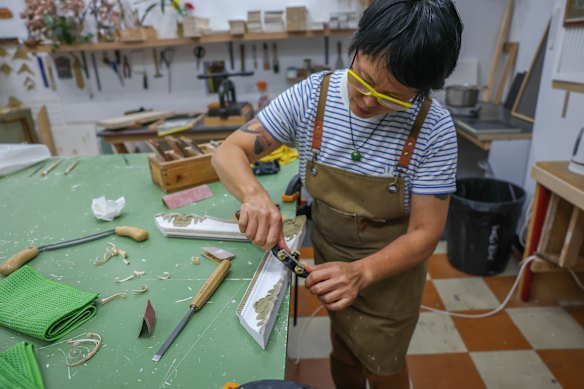
The Jarmans are long gone from the business, but the framers’ legacy remains, particularly in ornamental specialist Ying Huang.
Beneath hodgepodge plants and old window mounts hung from the ceiling, she cooks up composite in heavy metal pots, before pressing the material into hand-cast ornamental moulds – the main attraction for owner Mark Chapman, who bought Jarman to keep the practice alive.
Huang trained under Tom Whitfield, the last of Jarman Framing’s original ornamental specialists, before he retired in 2020. Nowadays, Jarman stocks a frame dubbed the “Tom special”. “One day I’ll have a frame in my name,” Huang says.
On the showroom floor, clientele clearly see the value in Jarman’s craft. Two consultants – one, in a tweed vest with thick, black-rimmed glasses – cling to the side of a suited gentleman, who is weighing up framing options for an oil painting on a video call to his wife.
The priciest frames here – all of which are museum-quality – can cost up to $30,000. At Kosnar’s, the maximum price is more like $8000. But when I ask Kosnar what the most valuable item they’ve framed is, his answer isn’t monetary.
Read the full article here