






 Markets
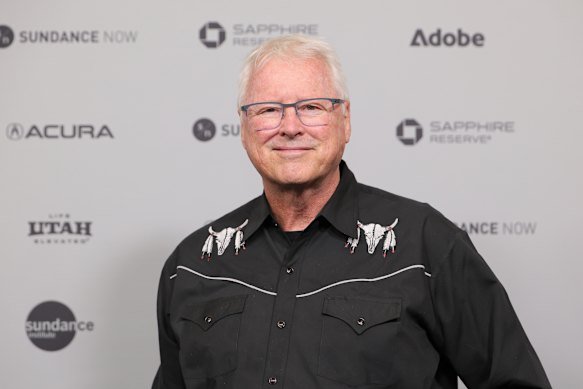
Ihad an admission to blurt out to Tony Jones as we kick off our conversation about Sentient, his new documentary about the use of monkeys in the testing of pharmaceuticals.
“You made me cry!”
“If I knew you were going to watch the film I would have warned you,” the former ABC Landline and Q&A host laughs in response.
“We knew we had made an emotional film, but it was after the world premiere of Sentient at Sundance, when audiences were left like stunned mullets, that the power of the film became clear to us.”
Jones makes no apology for leaving audiences grief-stricken. One of the aims of Sentient is to elicit empathy for the primates who for decades have been locked up in cages and subjected to an array of shockingly painful, trauma-inducing tests that invariably lead to their early deaths.
“It’s not an easy watch, but it is an important one.
“In a world where there is very little evidence of empathy, we think this film is very much about empathy — not just for the monkeys, who are the subject of the film, but the people who work with them for what they believe is the good of humanity.”
The empathy for both animals and for their handlers who believe they are doing important work is one of the reasons why Sentient has been getting rave reviews out of the international festival circuit.
It is also why it has been selected as one of the centrepiece sessions at this year’s Revelation Film Festival, which started this week.
Instead of another activist diatribe that has become fashionable since the impact of Michael Moore’s Roger and Me in the late in 1980s, Jones has leant into his four decades of journalism to allow both sides to present their cases.
Jones has now turned to his journalistic skills to longer form examinations of subjects that that pique his interest.
In one corner is Dr Lisa Jones-Engel, a highly decorated scientist who for decades worked with chimps at the famed Washington Primate Research Centre until she had a Road to Damascus moment and came to see her life’s work was profoundly wrong.
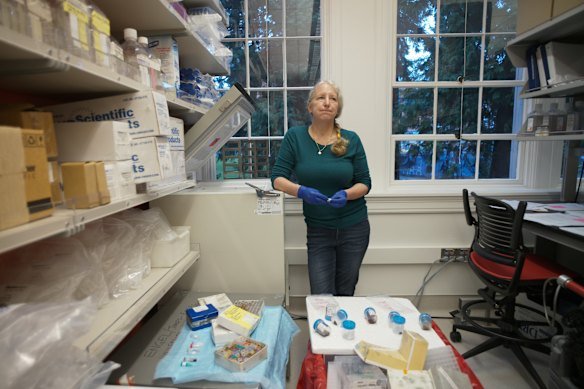
In the other is Sally Thompson-Iritani, who works in the area of animal care in the same centre and, despite the criticism from organisations such as PETA – for whom Jones-Engel now works – still hangs on to her belief in the importance of the work she is doing.
“When we found these two women on opposite sides of the equation we knew we had the kind of narrative that would be the basis of a compelling feature film,” Jones says.
Sentient didn’t begin as an examination of animal testing. Rather, Jones’ interest in the subject can be traced back to an episode of Q&A, when he found himself sitting next to Peter Singer, the man Jones says wrote the Urtext on the animal liberation movement.
“Peter said that one day we will look back at the way we treated animals in the same way that we treated humans during the period of slavery,” Jones says.
“Our initial intention was to make a series about sentience in animals and cover the whole spectrum of human relationship with animals with a focus on animals in captivity and those that end up on farms and in abattoirs.
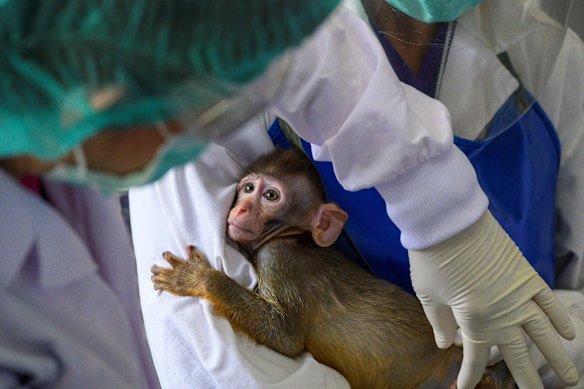
“Then during our research we got access to graphic undercover footage of the monkeys undergoing testing, which became the final act of our film.
“That footage and access to the primate research facility in Seattle pushed us to a more pressing subject.”
That access allowed the team to follow the animals from their arrival to their final moments, which Jones says is “incredibly powerful”.
The documentary’s even-handedness extends to the trauma of those who have spent their working lives in animal testing centres, understanding the benefits of such research to humankind but shattered on a daily basis at having to put animals through such awful procedures.
“I suffer type 2 diabetes and I know that without the research carried out in these centres I would be living a less good life,” Jones says.
“So my approach was that of an ABC journalist and not an activist. It is a complex situation, with powerful arguments on either side.
“My job is to present those arguments as clearly as possible to allow the viewers to come to their own conclusions about what is happening to the animals.”
While Sentient is extremely confronting it, has something of a happy ending and coming from the unlikeliest of sources: Donald Trump’s eccentric US Health and Human Services Secretary, Robert F Kennedy Jr.
Kennedy has a declared his intention of ending the of animals for testing, paying particular attention to defunding reaching centre using monkeys (there are more than 100,000 monkeys in primate testing labs around the US and more than 20,000 more being imported every year).
And it is coming to a natural end through the use of artificial intelligence to help sort through and organise decades worth of data, and other new methods of testing medicines that don’t involve the mistreatment of monkeys.
While Jones is pleased that animal testing is winding down, he is not convinced it will happen quickly or completely disappear.
“There is a massive investment in using animals for this purpose,” he explains.
“There are many people involved in the capturing of monkeys, there are massive breeding facilities for monkeys in South-East Asias, as we show in the film, and they are feeding laboratories around the world.
“It’s very hard to change direction once you have gone down this path.”
Sentient is screening at July 11 at 2.40pm at the Luna Leederville. It will be followed by a Q & A with director Tony Jones. There will be a second screening on July 14 at the Luna Leederville on July 14.
Read the full article here