





 Markets
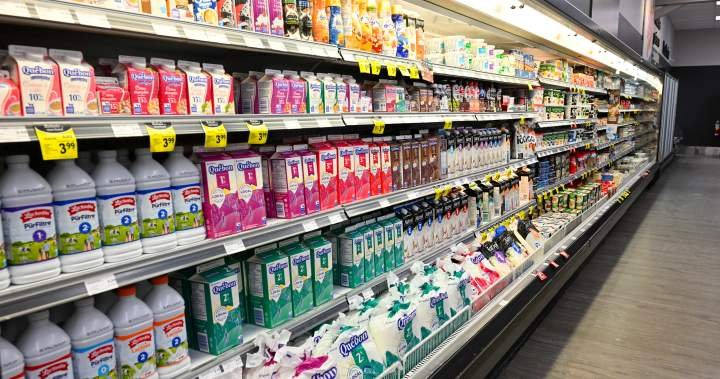
Astute dairy shoppers may have noticed a fresh new option in some Ontario grocery stores — with nearly twice as much fat as consumers are used to seeing in whole milk.
Sealtest’s new six per cent fat product comes at a time when many people are rethinking long-held dietary practices, with the nutritional benefits of meat and dairy frequently debated.
Followers of U.S. Health Secretary Robert F. Kennedy Jr.’s “Make America Healthy Again” agenda have rallied around full-fat milk, with President Donald Trump promising to reintroduce it into the school lunch program.
Health Canada takes a different approach, recommending whole milk — which is at least 3.25 per cent — for babies under 24 months old but otherwise suggesting lower-fat options.
The government agency says it stands by that, after reviewing the latest evidence last year.
Still, Guillaume Bérubé, the public relations director at Sealtest parent company Agropur, says there’s been growing interest in higher fat options.
The six per cent fat product came to market in Ontario late last month, and Bérubé said the company will monitor its performance and consider expanding its availability.
Agropur’s customers had been asking for a higher-fat milk product, Bérubé said, noting it was of particular interest to the South Asian community.
The Indian dairy company Amul has long offered a six per cent milk option. The company has expanded into the North American market in recent years, and its product is available in some Canadian stores.

Get breaking National news
Get breaking Canada news delivered to your inbox as it happens so you won’t miss a trending story.
“Being an Indian person, we are the milk people. We love milk,” said Anika Dhalla, a Hamilton-based registered dietitian. “I definitely have patients who love milk as well just because I do work with a lot of South Asians. It’s a big part of the diet.”
Richer milk products tend to make for tastier yogurt and ricotta cheese, she said, noting those are also staples. It can also be used to make paneer and korma.
But she said the MAHA movement and its popularity on social media has prompted a wave of interest in higher fat products.
Not really, Dhalla said.
“It’s about preference,” she said. “If someone’s choosing higher fat, I usually question why.”
If people really want that creamier taste, they can work it into their diet, but she said she’d steer them away from drinking it for health reasons.
Drinking higher fat milk means potentially consuming more saturated fat, she said.
Lowering your saturated fat intake can reduce your risk of high blood pressure, which in turn reduces your risk of heart disease, she said.
“Heart disease is the number one thing in Canada that kills people,” Dhalla said. “It’s the number one thing that kills women, it’s the number of one thing that kills men, the number one thing that kills all people. So why go for something that has higher saturated fat?”
But for kids, a higher fat milk might make more sense because their growing bodies need lots of energy.
Lower fat options can also have more protein per serving than their high fat counterparts, Bérubé said, which is another health trend among consumers.
“In the past two years we’re seeing this stronger demand for the true 3.25 per cent milk, but on the other hand in the dairy industry we’re talking a lot about the enriched product with protein. There is a strong demand for protein on the market.”
Milk comes out of the udder at roughly four per cent fat, said Douglas Goff, a professor emeritus of food science at the University of Guelph, who is best known for teaching an annual course on ice cream technology.
Once the milk reaches a processing plant, it’s separated into different dairy products. The separator spins the milk at an ultra-high-speed to separate the milk in two: fat-free skim milk and cream, which has roughly 40 per cent fat.
The fatty cream rises to the top of the separator and the skim milk is left at the bottom. To make milk with a fat content between those two extremes, the machine adjusts how much cream is added back into the skim and mixes it together.
“By far most people buy two per cent milk, so there is an excess of cream in a dairy plant, which goes into 10 per cent fat or 18 per cent fat or 35 per cent fat creams, or sold for butter making,” Goff said in an email.
“Making this six per cent fat milk is not much different than making 10 per cent fat cream (except that creams have some thickeners and emulsifiers added), it’s just a blend of whole milk with some additional 40 per cent fat cream added to it.”
This is also how high-protein milks are made — but instead of adding in more fat, the protein is isolated and added back into the milk at a higher concentration.
Bérubé said there’s a limit to how much protein can exist in a single serving of high-fat milk, so customers may have to choose what matters most to them while they’re in the dairy aisle: more fat or more protein.
Read the full article here