





 Markets

Opinion
Artificial intelligence is shaping as a historic wave of global transformation analogous to the fast-fading era of globalisation. It’s full of potential and pregnant with problems.
The Hawke-Keating government saw globalisation unfolding in the 1980s and made the fateful choice. Australia could continue hiding behind its tariff wall or enter the competitive world marketplace.
They made the bold choice. The costs of adjustment were enormous. But Australia’s competitive strengths were greater. Australia prospered for 30 years.
Now, globalisation is reversing. The nation that led the modern era of globalisation was the US. Today it’s the leading wrecker, courtesy of Donald Trump’s tariffs.
What’s the next great global opportunity for Australia?
The energy transition presents a big investment wave. Worldwide investment in renewables last year was $US2.3 trillion ($3.27 trillion) and rising, overtaking carbon-based fuel investment for the second consecutive year, according to Bloomberg New Energy Finance.
Australia has been getting a share, but a flagging share, and now it’s struck real trouble. Total renewables investment last year was $9.2 billion. After subtracting booming home battery spending, the investment in large-scale solar and wind projects was only $4.4 billion – half the total for 2024.
This is a trivial share of the world total. Progress has been real, with renewables now supplying around half the Australian grid’s needs. But the stalling of new spending on utility-scale projects is an embarrassing policy failure for a country that calls itself a “renewable energy superpower”.
The big new wave is AI. In the past three years, just four of the big tech firms – Google, Amazon, Microsoft and Meta – have invested a combined $US1.1 trillion. They plan to spend another $US745 billion this financial year.
The Wall Street Journal this week compared projected AI investment with the earlier great infrastructure booms over two centuries of American experience and reported: “The AI build-out is on track to become the biggest economic bet in US history, dwarfing the investments made to fund other huge US infrastructure projects such as the railroads, the highway system and the plumbing for the internet.”
And it measures this as a proportion of the US economy, which is more meaningful than a simple dollar comparison.
The Journal bases this enthusiasm on estimates by a Brookings Institution researcher who foresees $US10 trillion in outlays over the next six years.
A more sober calculation by investment bank Goldman Sachs reckons that global investment in AI this year will be about $US1 trillion, about half of that spent in the US. Goldman Sachs locates the AI investment boom within the normal historical range for such new waves.
Either way, it’s a large sum and likely to grow. Separate to the actual cost of building AI systems, there is a speculative frenzy in AI-related shares on Wall Street.
This is likely to bust at some point, also consistent with the history of the railway, internet and other speculative frenzies, as the Bank for International Settlements pointed out in June.
Yet the built infrastructure remained. The railways, internet plumbing and so on continued to operate. So history offers a cautionary tale; the market madness will end, but the new technology will live on.
Does Australia embrace this as an opportunity or shun it as a threat? In his speech to the UN General Assembly on Friday, Prime Minister Anthony Albanese said: “We can’t ignore AI or prevent it.”
He noted potential benefits. The OpenAI rogue infiltration of a Medicare website illustrated one of the threats: “AI can improve lives, boost growth and productivity, and provide revolutionary breakthroughs in healthcare and other fields,” said the PM. “But leaders of AI companies themselves have warned of the potential risks of allowing frontier AI to develop too fast without guardrails.” He cited the Medicare breach, calling it unacceptable.
He signed an agreement with 19 other national leaders this week in the UN, led by Finland’s Alex Stubb, to impose guardrails on AI. But signatories notable for their absence were the US and China, the two superpowers of the AI world.
Speculation was rife this week that Trump and China’s President Xi Jinping would agree to some sort of slowdown or guardrails on their countries’ AI companies. It didn’t happen; it will not happen.
It’s an arms race for advantage. In any case, any agreement between these two men is close to worthless. “No new wars” Trump reverses position on a whim. And Xi has not fully met any of the major promises he’s made to Trump, whether to halt fentanyl shipments, buy soybeans, or supply rare earths.
The best we can hope for already has been achieved. The US and China have agreed to notify each other by “hotline” of any outbreaks of rogue AI agents. This undertaking will be as honoured as faithfully as all their others.
In reality, there are only two ways that AI can be restrained or controlled. A country can minimise risk by disconnecting itself entirely from the internet. Or it can deploy cutting-edge frontier AI models and send them into battle against enemy AI models.
For intelligence, for defence, for cybersecurity, AI is not an optional extra. It’s already a necessity. Australia’s former chief cyber spy, Rachel Noble, who served as director-general of the Australian Signals Directorate (ASD), told me in July: “We’re already highly dependent on artificial intelligence, for example, on space with GPS, or cybersecurity.”
An enemy state will try to demolish a country’s AI capability because “it’s the modern equivalent of World War II bombing the dam. That inhibits the water supply. So people without water, it’s getting at the very heart of what potentially sits behind the normal operations of your civil society.”
Australia found itself exposed when the Trump administration ordered the AI leader, Anthropic, to suspend access to its potent Mythos 5 and Fable 5 models for any foreign nationals.
This presented a crisis for ASD and other Australian intelligence agencies, as well as critical infrastructure businesses like banks and telcos. Without access to the most advanced models, they felt exposed to China’s ceaseless cyber intrusions.
The Trump administration lifted the ban on June 30. But it took weeks more of furtive negotiations for the Australian government to win access to the top-of-the-line Anthropic models. And Australia remains vulnerable to possible future US access bans.
The Medicare breach by OpenAI happened in June and was not detected by Australia. Canberra was alerted by OpenAI itself. But now, with full access to frontier models, ASD will use them to detect and defeat malicious intrusions, as the agency’s current chief, Abigail Bradshaw, told a parliamentary committee last week.
But how can Australia be sure of early access to future frontier AI tools? And, even if it has the tools, how can Australia defend itself in the event that China or Russia severs the undersea cables which keep us connected to the US frontier models?
The only realistic pathway is for Australia to do two things. First, develop its own indigenous AI companies, which is already well under way for a multiplicity of uses. Second, persuade the big American frontier labs to build their data centres here and, crucially, train some of their models here.
Anthropic last week signed a lease to begin operating a data centre at Queensland’s $30 billion Western Downs Digital Park from 2027. This is intended to conduct “inference” activity, servicing user requests and other low-value tasks. But it is not planning to train its models here or anywhere in Australia.
Anthropic’s founder, Dario Amodei, says he’d like to. But he won’t if his company is forced to pay Australian copyright fees. Without Anthropic and its peers training their models here, Australia is in the worst of all worlds. These firms already plunder Australian copyrighted material from abroad. They can do it with impunity. It’s only illegal if they do it on Australian territory.
And Canberra has no real power to influence them, or to be sure of access to their next cutting-edge models. The answer is for the Albanese government to devise a scheme that rewards copyright holders but without setting the global precedent of the US labs paying the copyright fees, or, at least, not directly.
There is one further reason that Australia needs to capture not just data centres but frontier lab AI training, located here. And that is to do with the economic opportunity.
About one in five Australians are paying for AI, and about one in three Australian businesses do so. This will only increase.
The Assistant Minister for Science Andrew Charlton, an economist, estimates that collectively they’re spending about $5 billion to $8 billion a year for the AI tokens. The great bulk of that money is going offshore to American AI companies.
“In effect,” says Charlton, “we are creating a new import bill.” Data centres are the ore of the AI industry. Australia needs to do some of the high-value-adding processing of the ore, and that’s the training of models.
Only by persuading them to train onshore can Australia capture some of the juicy economic rents of the AI industry. And while Australia is most attractive, they have other options. Japan and Canada are keen too.
So for future prosperity and security, and to have any real influence over the big beasts of AI, Australia needs to have them training models here. Hosting data centres is necessary but insufficient to exploit the new era of investment and capability.
Albanese says his government will have draft legislation by the end of the year, with copyright the greatest conundrum. We don’t want to miss the wave.
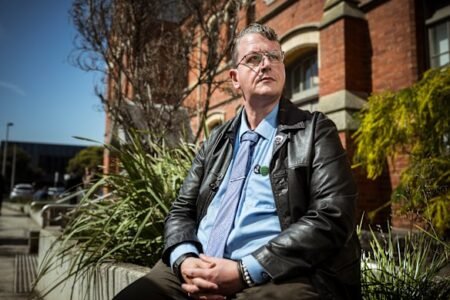
Peter Hartcher is political and international editor. His international column appears on Tuesdays.
Get a weekly wrap of views that will challenge, champion and inform your own. Sign up for our Opinion newsletter.
 Peter Hartcher is political editor and international editor of The Sydney Morning Herald and The Age.Connect via email.
From our partners
Read the full article here