






 Markets
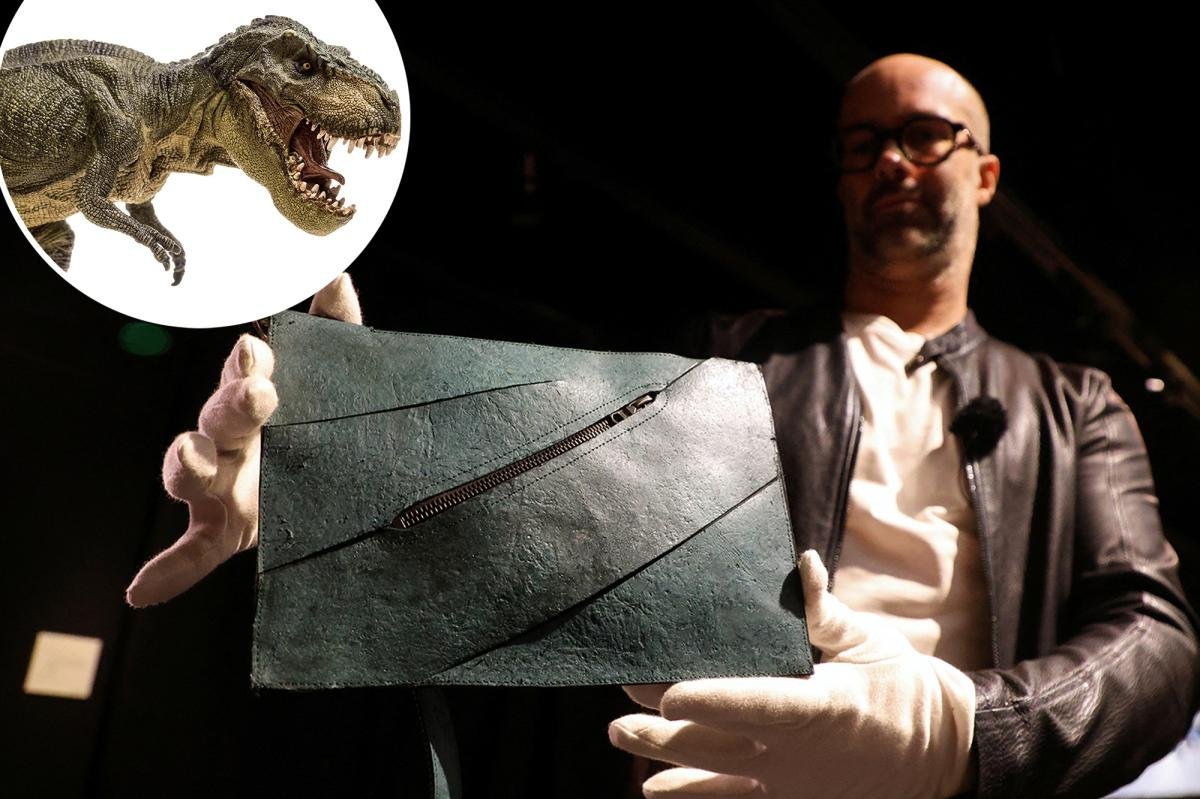
It’s a sale of Jurass-chic proportions.
Birkins are beautiful. Chanel bags, très magnifique. But a purse derived from 66-million-year-old purse dinosaur DNA simply cannot be beat, per the Parisian auction house hawking the prehistoric must-have for over $500,000 on Thursday.
Bidding paddles are sure to go flying in the air as auctioneer Alexandre Giquello of Hôtel Drouot in Paris, France, accepts offers on the first-ever handbag made with collagen from lab-grown Tyrannosaurus rex fossils, which were reportedly exhumed in the US, on June 11.
“This T. rex leather bag marks a defining moment in my career: a one-of-a-kind piece that stands as a historic milestone,” Giquello said in a statement. “A defining moment that challenges the boundaries of creativity and luxury.“
And it’s the perfect carryall for the diva who doesn’t care if she rex her budget.
With an asking price ranging from €300,000 to 500,000 ($347,081 to $578,469), the ancient accessory is an expensive, albeit exclusive piece that will go to the highest bidder with the deepest pockets.
Of course, it won’t outshine the jaw-dropping $8 million dropped on Jane Birkin’s 1984 original Hermés handbag, which sold at auction to a Japanese mogul in July 2025. Nor will it come near the exorbitant $2.5 million cost of icon Marilyn Monroe’s haute memorabilia, including a Christian Dior suit she wore while honeymooning with Yankees legend Joe DiMaggio, purchased alongside the voluptuary’s valuables on June 1, what would have been her 100th birthday.
But the dino-doodad certainly predates them both.
Che Connon, a professor of tissue engineering at Newcastle University, alongside researchers at ad agency VML, genomic engineering firm The Organoid Company, and the sustainable biotechnology pioneers at Lab-Grown Leather Ltd., has led the charge in transforming matter from the extinct predator into extraordinary wearables.
Following an extensive process — including harvesting T. rex DNA, conducting phylogenetic analyses, inserting the materials into a specialized bio-leather cell line genome, transforming the cells into skin and sustainably tanning the skin to create the leather — the scientists have managed to make primeval magic.
“The hard bit is making leather from cells, and we’ve done that,” Connon previously told The Post. “The upstream bit is using existing technologies, which is why we’re confident we can do this so quickly.”
Naysayers, however, have doubted the validity of T. rex leather, deeming it “gimmicky” and “very far-fetched,” owing to time and evolution. Still, Connon insists that the seemingly impossible is, in fact, possible.
“Some people have got the wrong end of the stick saying, ‘Well, you can’t do it,’” he said. “But that’s not true.”
“Rest assured, these are all things that have been proven.”
Read the full article here