


 Markets

Updated ,first published
The neo-Nazi group formerly known as the National Socialist Network has been listed as a prohibited hate organisation by the Albanese government under legislation introduced after the Bondi massacre, prompting far-right activists to shut down and wipe records of their online chat groups.
It will now be a criminal offence, punishable by up to 15 years in prison, to join or provide support to the far-right group, which has gone by various names.
The group announced it would disband in January to avoid being targeted under the new laws, but authorities believed its members have still been active.
The government announced in March that Islamist group Hizb ut-Tahrir would be the first group to be banned under the hate group scheme, created to target groups that previously skirted the definition of a terror organisation.
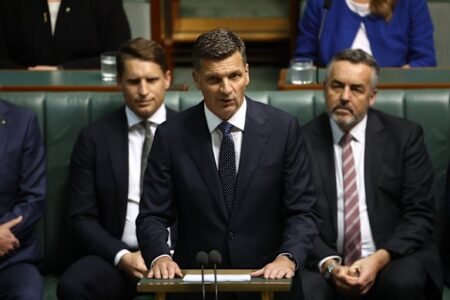
Home Affairs Minister Tony Burke said he made the decision based on advice from domestic spy agency ASIO.
“Today, the organisation that would be colloquially known as the neo-Nazis, but has gone through different names – the European Australian Movement, the National Socialist Network (NSN) and White Australia – has been listed as the second prohibited hate group under the changes that were made to the Criminal Code,” Burke told reporters in Canberra.
“This sends a clear message to those who believe in racial supremacy that their views are not welcome in Australian society.”
The group organised an inflammatory rally outside NSW parliament last November in which participants held up a banner reading: “Abolish the Jewish lobby.”
After the Bondi terror attack on December 14, which led to the deaths of 15 people at a Hanukkah celebration, the government identified Hizb ut-Tahrir and the NSN as the two groups that showed the need for new hate group laws.
They typified behaviour that Burgess had identified as “lawful but awful”, Burke said on Friday.
“None of this will stop bigoted people from having ideas, but it does prevent this group from organising, from meeting, and prevents some of the sorts of horrific, bigoted rallies that we’ve seen around our country,” he said.
Burke said the government would be able to act quickly using regulation if the NSN tried to rebrand itself under another name.
Burgess said in a speech last year that the NSN had not engaged in terrorism but added: “I remain deeply concerned by its hateful, divisive rhetoric and increasingly violent propaganda, and the growing likelihood these things will prompt spontaneous violence, particularly in response to perceived provocation.”
Known neo-Nazis decried the new edict in online forums, railing against Burke, and warning “newbies” to throw out their NSN memorabilia. Some organisers of the March for Australia anti-immigration rallies, which this masthead has previously revealed work in partnership with the neo-Nazis, said they were seeking legal advice on the ruling.
A new Telegram channel set up by the NSN in recent weeks to further their propaganda efforts, called Australian Vanguard, said it would now shut down to escape the proscription laws. “We had a good run with this project,” they said, but “we’re going to have to shut it down.”
March for Australia lead organiser Bec Freedom announced that the group’s main Telegram chat would also be wiped and shut down before the midnight proscribing.
The leaders of the NSN announced in January: “To mitigate the risk of individuals being arrested and charged under these new draconian laws, we are shutting down all operations of the following organisations: the National Socialist Network; the European Australian Movement; White Australia; and the White Australia Party.”
Burke said this did not mean the group’s members no longer posed a threat.
“Effectively, what they did, for want of a better term, is phoenix,” he said, referring to a term in which insolvent companies reappear under a new guise.
Burke said while the group had “changed their name, they did not change the fact they were still an organisation and still engaged in the exact sort of behaviour that met the threshold for this legislation”.
Opposition home affairs spokesman Jonno Duniam praised the move, saying: “Australians do not want to see people avoid justice simply by tearing down a banner and re-emerging under a different name. This recommendation along with that of Hizb ut-Tahrir shows that the laws we backed in January of this year are responsible and effective.”
Executive Council of Australian Jewry co-chief executive Peter Wertheim applauded the decision, saying his organisation had been urging such a move since 2021.
Wertheim said the hate group listing would “send a much-needed message that these groups and their hateful, racist ideology have no place in Australia”.
“It doesn’t matter what they call themselves, or how they structure themselves, these groups use all the well-known techniques of thuggery and menace that Nazis have always used against Jewish communities and other groups they have targeted,” he said.
Cut through the noise of federal politics with news, views and expert analysis. Subscribers can sign up to our weekly Inside Politics newsletter.
 Matthew Knott is the foreign affairs and national security correspondent for The Sydney Morning Herald and The Age.Connect via X, Facebook or email.
 Nick Newling is a federal politics reporter for The Sydney Morning Herald and The Age.Connect via X or email.
 Sherryn Groch is a journalist at The Age covering crime. Email her at s.groch@nine.com.au or contact her securely on Signal @SherrynG.70Connect via X or email.
From our partners
Read the full article here