





 Markets
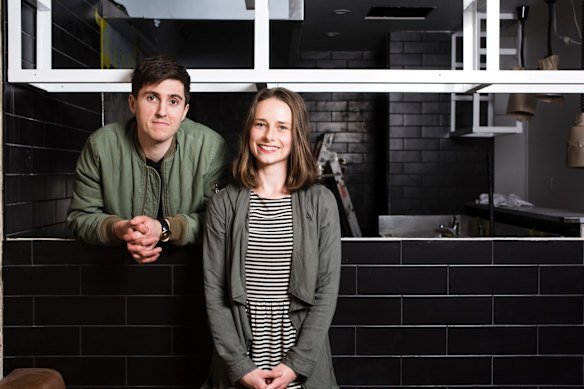
Josh and Julie Niland have a process for working through issues. They talk about them non-stop for weeks until they’ve driven themselves crazy. They then hit on a decision and act on it. It’s been this way since mid-2016, when the then 20-somethings were contemplating opening a fish restaurant on the site of a former sushi train in Oxford Street, Paddington, in Sydney’s east. About 12 months earlier, they’d discussed pursuing just such a dream. “If we ever open anything, I don’t want to own it,” Niland had said firmly.
With this in mind, they’d been planning their Oxford Street restaurant with another chef, who would be their silent backer. The industry wisdom was that fish restaurants don’t work, so the chef was giving them sensible advice on what they’d need to put on the menu to remain busy and, well, stay in business. Some salmon, maybe even a steak. Niland knew the chef had lots of experience. He also knew he didn’t want to compromise his own vision for what the restaurant would be. “Looking around the globe, it was clear the top chefs had a point of view. Mine would be fish.”
It all came to a head the night before the trio were due to sign the lease. “Julie and I were walking around the apartment, looking at each other, going, ‘Argh, I don’t know what we should do,’ ” he tells me. They spoke to Julie’s father, a hand surgeon, who said he could lend them $250,000 to get going on their own.
The couple agreed to write to the chef, saying, essentially, thanks for all your help but we’d like to go it alone. Niland wrote the email, pressed send, then turned and told Julie he’d done it. “She looked at me and was like, ‘WHAT?!’ ”
The would-be chef investor was gracious, wishing them luck. Niland recalls looking at the lease in the lawyer’s office the next day, with the other chef’s name blacked out. When the lawyer went to get him a pen, he vomited into the rubbish bin. “After signing, I sat in my car for about half an hour, heart racing, thinking, ‘What the f— have I done?’ ”
Ten years on, that fish restaurant, Saint Peter, is one of Australia’s most acclaimed, and Josh Niland among our most revered chefs. Saint Peter was one of only eight Australian restaurants to snare three Good Food Guide hats in 2025, a year in which it was also voted Gourmet Traveller’s restaurant of the year. Indeed, it’s been awarded multiple Australian accolades, both in its original, modest 34-seat Oxford Street digs and after its 2024 move around the corner to the Grand National Hotel. Here it’s evolved into a 40-seat dining room offering $395-a-head 10-course dinners, a 15-room hotel, a private dining space and a 30-seat bar where you might pair your tuna burger with an oyster shell martini or an Archie Rose x Saint Peter G&T.
On top of all that, there’s a Fish Butchery across town in Waterloo, which processes fish for Saint Peter and also sells to the public. Also on offer is a range of merchandise, from fish weights, tongs, fish-oil soaps and fish-bone ceramics through to socks and, now, a Niland-designed fish pan. The Nilands also run a hotel restaurant on Hamilton Island, the Catseye Pool Club.
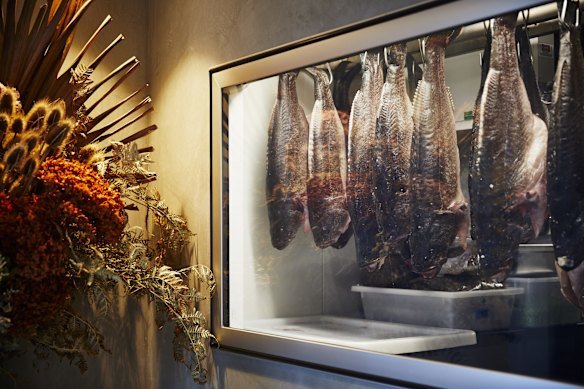
Perhaps more interesting than all this, however, is that, over the same 10-year period, Josh Niland has become something of a superfish in international waters. The Coachella festival, Dan Barber’s Blue Hill restaurants, Ireland’s Food on the Edge conference: these are just a few of the places he’s been invited to appear. He sits on Spain’s Basque Culinary Centre International Council and, in June, began a relationship with New York’s Culinary Institute of America. The interest revolves around Niland’s particular ways of dealing with fish. Gutting and filleting without water (the extra moisture can spoil the fish faster); dry-ageing to keep it for longer; and treating it as butchers do meat, such that much more than two fillets are used. Eyeballs for ice cream, livers for pâté, scales for granola; you get the drift.
It’s a sustainability story wrapped in an economic one, the whole ethos coming about when Niland realised he’d go broke if he didn’t use more than the standard 40-50 per cent of any fish he bought. “I couldn’t get my costs in place,” he says. “All the drama and anxiety of the worst things to ever happen were running through my head: ‘My business is going to go belly-up, my kids will be on the street, my wife is going to leave me, I’m not going to have a home to live in.’ So, back against the wall, that was when I started thinking I needed to use more of the fish, and when I started looking at all my notes from my training and thinking, ‘Maybe I could treat a fish more like an animal.’ ”
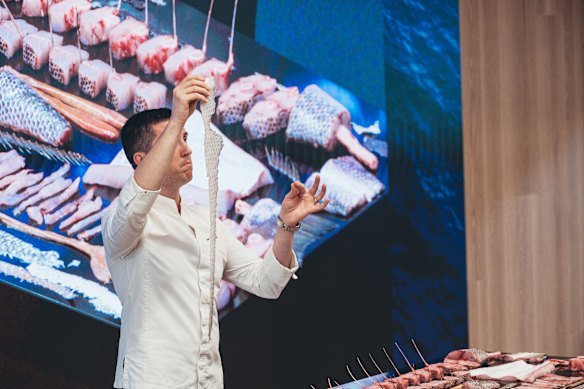
It’s a publishing story wrapped in a culinary one, too. Niland has written three books in which the recipes are more demonstrations of his fish philosophy than home-cooking guides. More than 235,000 copies have gone out into the world, according to publisher Hardie Grant, in 11 languages and across 15 territories, including the US, where they’ve earned four James Beard culinary book awards.
“I travel a lot for work and not infrequently, I’ll be standing in a kitchen in Bangkok or Lima and look on the shelf and there will be a Josh Niland book,” says Pat Nourse, creative director of the Melbourne Food & Wine Festival. “He’s become our best-known chef overseas, certainly in those top-end professional circles.” Nourse agrees the books are less for cooking than learning from: they service Brand Niland and the cooks who want to be like him. “I like his books,” he adds, “but they’re not next to my stove.”
‘I’ll be standing in a kitchen in Bangkok or Lima and look on the shelf and there will be a Josh Niland book.’
Pat Nourse
The global acclaim means that about a third of Saint Peter diners are international visitors, and last year it was the only Australian eatery on the World’s 50 Best Restaurants longlist, where it went from 98th to 66th position. Jamie Oliver, Nigella Lawson, Heston Blumenthal, Yotam Ottolenghi and René Redzepi have long sung Niland’s praises. Now, other top names from global gastronomy are partnering with him for a series of dinners to celebrate Saint Peter’s 10th anniversary. For $1250 a head, diners have enjoyed tasting menus designed by Niland in collaboration with the likes of Joan Roca of Spain’s El Celler de Can Roca, Rasmus Munk from Copenhagen’s Alchemist and Virgilio Martinez of Central in Peru, all of whom have also graced the World’s 50 Best lists. You can count on one hand the Australian-based chefs feted like this by the global food elite: Neil Perry, Tetsuya Wakuda, Peter Gilmore, Ben Shewry. That’s about it.
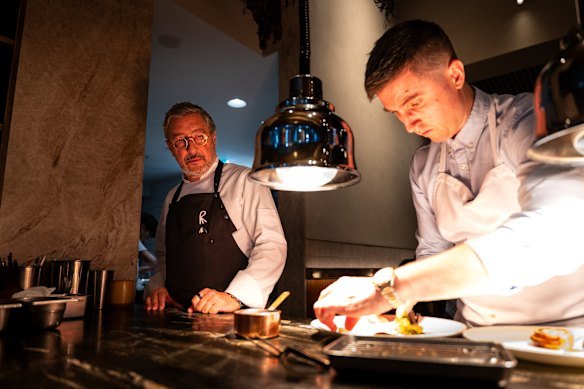
All this makes you wonder what Niland, who is only 37, might do over the next 10 years. Can he keep building his global reputation while ensuring the Sydney mothership, from which everything else flows, stays at its peak, and indeed, afloat, during a cost-of-living crunch? Might he, like Wakuda, capitalise on the offshore interest by moving overseas? Is he chasing further awards or more interested in seeding his fish philosophy into other levels of the food system? And what will he do when the spotlight moves on, as it eventually always does?
‘The ambition was never to create dishes. It was to create methods and systems that could be developed not just for Saint Peter but for the world.’
Josh Niland
There’s a hint as to how he might answer these questions in Saint Peter: Chapter & Verse, a new book to be released on September 1, the restaurant’s actual 10th birthday, detailing the journey from that vomitous lease-signing to today’s global stardom. “The ambition was never to create dishes,” he writes. “It was to create methods and systems that could be developed not just for Saint Peter but for the world.” Niland puts that ambition more succinctly when we speak. “I’ve done it in my 1 per cent, how can I now do that for mass?”
Josh Niland is waiting for me at Paddington’s Grand National, once an English-style corner pub, now the chic centre of his daily life. It’s 9.30am and he’s already had a chat with the hotel manager about bookings and looked in on his kitchen staff. Slim, with brown hair and hazel eyes, Niland is amiable but with a palpable intensity. I feel as if I’ve known him for years although in truth, I barely do. That’s the thing about good hospitality folk: they make it their point to remember you. I was a semi-regular at the original Saint Peter, my dinner-with-friends restaurant of choice in the late 2010s, and while the price point of the current iteration makes it less of a pit stop, when we had American friends in town recently, our treat night out was there.
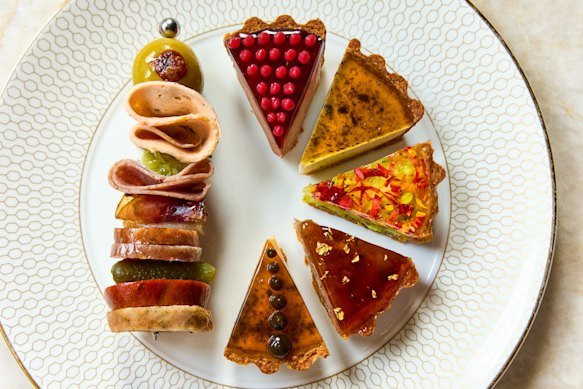
They were duly wowed by the six temperature-controlled oyster drawers, the coral trout noodles, the yellowfin tuna bone-marrow fudge and the fish charcuterie plate that Good Food national restaurant editor Callan Boys calls the “most singular dish of the decade”. You’d be a grump not to be wowed, not least because, for all Niland’s innovation, his priority remains to make something “yummy”. Not yummy? Try again.
We’ve walked to The Bonython cafe, down a fern-strewn lane a few minutes walk from Saint Peter. Niland comes here after the gym most mornings, where he’ll sit with a long black, writing lists on the yellow notepads he favours and talking footy with his barista mate, Jack. It’s soccer he likes, and not the play per se. “I’m engrossed in the management of those teams,” he says. “I find it fascinating that teams can spend millions of dollars, not only on players but on managers, only then to sack them a week later because they didn’t win their game. How is leadership meant to be instant?”
It’s an instructive hobby for someone who spends most of his waking hours at Saint Peter or thinking about Saint Peter, consumed in between by family life with Julie and their four kids, Georgia, Sophie, Lucy and Ted, aged between four and 12. Niland is at the restaurant five or six nights a week – he reckons Julie would say six – and his fascination with leadership is to ensure that the restaurant, hotel and butchery, which between them employ 60-odd staff, can function well whether he’s there or not. “I’m not trying to be a better leader so I can open 32 restaurants, that’s not my goal.”
That said, Niland likes the idea of testing himself against the best in the world by opening a restaurant one day in, say, New York or London. How that would work with four young kids and a Sydney business, he’s not figured out. “Anybody who likes what they do, would they want to go play in the major leagues? Yeah, of course. But how practical it is, I don’t know.”
For a couple of years he ran a restaurant in Singapore’s Edition hotel, Fysh, but by mutual agreement, that deal was not renewed this year. He enjoyed learning to lead a team whose first language was not always English but in the end, despite having taken up the contract “because we couldn’t afford not to”, it was too taxing on family and Saint Peter to be away six times a year.
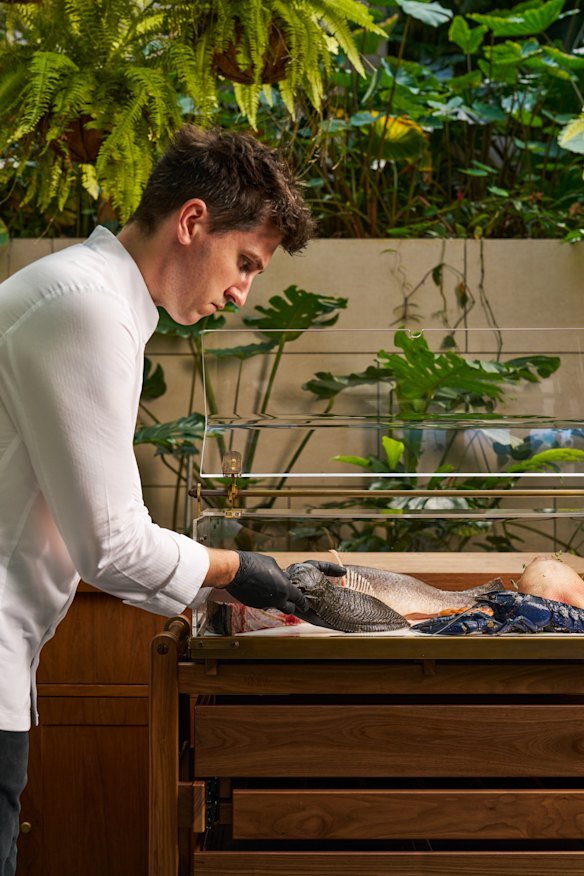
More than opening another restaurant, he wants to work out how to scale up his fish philosophy. So when Robert Jones asked him to present at New York’s Culinary Institute of America (CIA), it was a quick yes. Jones, a former fisherman and fisheries executive, now vice-president of strategic partnerships and industry leadership at the CIA, came across Niland via his first and most popular book, The Whole Fish Cookbook. “That book blew my mind,” he says. Niland spoke in June at the Menus of Change summit, a partnership between the CIA and Harvard University, as well as to CIA students. “He broke down a 100-pound [45-kilogram] yellowfin tuna in front of 120 totally enthralled students,” Jones says. “When he’d finished, he didn’t have a spot on his apron.”
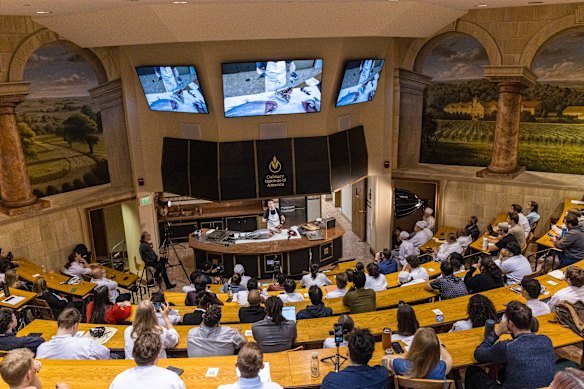
It was the start of a relationship Jones hopes will evolve into an advanced fish curriculum for students, as well as programs for CIA alumni. “We’re known for producing top chefs and haute cuisine, but this conversation is much bigger than Michelin stars,” he says. “A huge number of our graduates create meals for millions of American school children, many others work for companies developing food on college and corporate campuses around the world. We’re talking about a fundamental mind-shift, not just influencing fancy restaurant menus.” On this, he and Niland were simpatico. “One of the things he said early on was that he wanted his legacy to be around seafood education and passing on his knowledge to future generations,” Jones says. “He’s not about protecting his IP, he wants to share his knowledge with as many people as possible. The fact that his goal is education, not Michelin stars, says a lot about him.”
![“He broke down a 100-pound [45-kilogram] yellowfin tuna,” says the CIA’s Robert Jones. “When he’d finished, he didn’t have a spot on his apron.”](https://pureinfonews.com/wp-content/uploads/2026/08/1a07788ad763260be4b71ac6d9b326d0da8d39b6.jpeg)
The story is similar across the Atlantic, where Joxe Mari Aizega runs the Basque Culinary Centre in northern Spain’s San Sebastián. It, too, wants to develop a curriculum around Niland’s ideas, ideally to start next year. “He’s already done some classes in our master program about his philosophy and practice,” Aizega says. “The students admire how he thinks about fish – his ideas but also his practice, he is so technical and rigorous.”
Niland wants to talk to other cooking schools, too. “You can get a PhD in gastronomy, you can get a masters in fermentation, why can’t we put fish butchery into that?” he says. “Why can’t I have that conversation with [France’s] Le Cordon Bleu?”
‘We’re talking about a fundamental mind-shift, not just influencing fancy restaurant menus.’
Robert Jones
Neil Perry was a famous chef before Niland was out of school shorts and runs his own mini-restaurant empire in Sydney’s Double Bay, down the road from Saint Peter’s Paddington. Perry admires what Niland has achieved and also fillets without water, which he’s been doing since his 1980s Blue Water Grill days. “It’s more a case of him agreeing with me on that than me agreeing with him,” he says with a laugh. But dry-ageing is not for him. “I want fish to taste of the sea, to have the unique freshness and verve that can bring.” Perry’s not sure fish should be treated like meat, with primary and secondary cuts and every little bit harvested for use. “Fish has an anatomical variation to land-based animals, which have massive amounts of connective tissue and long muscle holding up a frame that’s moving across the earth,” he says. That combination doesn’t exist “on something that’s moving through the sea”. He doesn’t think he could make up the cost of harvesting everything with the products he’d make, either.
Therein lies one of the big challenges for mainstreaming Niland’s ideas: cost. John Susman, managing director of consultancy Fishtales, agrees with Perry and Niland that fish should never touch water once it’s hauled out of it. He sees Niland’s other practices this way: “Josh’s influence on fish-handling is probably akin to what a Cirque du Soleil performer has on a local Pilates class. He operates at a very exclusive level of high art. That’s pretty hard to translate through to Consumerville.” Susman is glad for the “spotlight Josh has drawn” to fish and says “his craft skills are unmatched” but worries about other cooks trying dry-ageing without Niland’s expertise. Like his mate Perry, Susman prefers fish as fast off the boat as he can get it. “For a crusty old fish bloke like me, it might not be to my taste, but that doesn’t mean it doesn’t have merit.”
‘Josh’s influence on fish-handling is probably akin to what a Cirque du Soleil performer has on a local Pilates class.’
John Susman
Niland stresses his technique is not about pitting dry-ageing against freshness. He serves some fish after one day, others after 15. The practice is all about keeping moisture, and thus the chance for bacteria to grow, off the fish, many of which hang by their tails, not touching, in his cool rooms. The length of stay there depends on variety, size and other factors. “What I’m trying to work out is whether my way of doing things is sustainable on a global scale,” he says. “Can I create a system that’s actually practical, tangible and realistic for everyone to follow?”
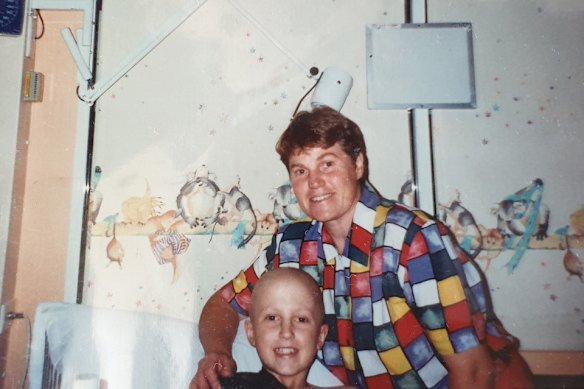
I find myself worrying: with these big goals, and his regular 12-hour days, how does Niland stay upright? I’d worry for anyone working as hard as he does – taking the family to Hamilton Island so he can cook there is his version of a “holiday”, ditto speaking or cooking overseas. He’s no Anthony Bourdain, rarely drinking or partying, but he’s also got only one kidney, thanks to the childhood cancer he suffered from ages eight to 10.
Niland lights up as he starts telling me about the time he got a “tummy parasite” in Japan, for which he got treated by young doctors at a hospital back home. “They said, ‘We’ve never seen anything like this – where your kidney has come out, your liver has taken up real estate.’ ” What’s more, his remaining kidney had grown to be “the equivalent of two kidneys in one”. His body had been “problem-solving” since the age of eight, he tells me with a smile. The upshot: I need not worry. He’s as healthy as the next small-business-owning workaholic.
I wonder at the role his cancer had on his ambition and he says it definitely acted as an “accelerant”. I tell him about the Netflix documentary on tennis great Rafael Nadal, for whom a degenerative foot bone condition made every year potentially the last he might play. Niland understands how this would have turbocharged Nadal. “When you face your own mortality it’s like, ‘Whatever I want to do, I’m going to try to make sure I do it, in any way I can.’ ” If he hadn’t become a cook, he’d like to have been a professional cricketer, he says, though he’s not sure that he had the talent to match his drive to get to the top.
Monica Brown, the business and PR consultant who helped guide Niland’s global trajectory, says he was always in a hurry. “In the first couple of years, I was more holding him back than pushing him forward,” she says. “When he started to vibrate and make a bit of noise, people came to him looking to invest in the business. I said, ‘Do not sell out for $50,000 when you might be able to sell one day for $50 million. Don’t go too fast.’ I’ve had to unpick some chefs’ careers from their backers, and he was still evolving, his menus were still evolving.” Niland was easy to take on the international circuit, she says, for the simple reason that “he was hugely original and talented.”
That ambition was clear to food publisher Jane Willson, too, when she signed Niland up for his first book at Hardie Grant. They met in October 2018 and he said he’d like his book out the following September. That’s impossible, she said: the manuscript would have to be filed by January and, at the time, Julie was pregnant with the couple’s third child and a busy summer was approaching.
He got the manuscript to Willson by January, writing it (and all subsequent books) before and after his restaurant shifts, on the notes app on his phone. He asked Willson how many sales would make a bestseller; she told him that 20,000-25,000 would be excellent. He was incredulous, she remembers: he thought it would be at least 100,000. She and the publishing team laughed. “I was keen to work with him but didn’t want to overpromise,” says Willson, now at Murdoch Books. “I said, ‘Fish books don’t sell.’ He said, ‘That’s what they said about fish restaurants.’ ” That first book is now on its 23rd print run.
Willson admired Niland’s focus. He really wanted a car sponsorship – he now represents Audi. He subsequently secured a watch deal with Zenith, and an annual slot on Network Ten’s MasterChef. “There are so many in the food world with egos that are fragile,” she says. “He has a big ego but it’s not fragile. He also has the great skill of knowing how to stay in his lane.”
Like others I speak to, not least Niland himself, Brown and Willson both mention Julie as a behind-the-scenes force at Brand Niland, an iron fist in a velvet glove on strategy, negotiations and much else besides. She was sealing the lease on Fish Butchery Waterloo from hospital ahead of delivering their fourth child, Georgia, and only just handed over ordering the toilet paper for their venues.
It’s Julie, too, you can blame if a fish-weight ad is stalking you on Instagram. She recently did a course on social media marketing and sees the online merchandise store as her baby. “I have not learnt as much as an adult, ever, as I did in that course.” She’s just taken the lease on a small shopfront for the merch business. “If you’d asked me two years ago if I’d be selling frying pans, I’d have laughed at you, but I’m having fun.” It’s a smart extra revenue stream at a time when high-end dining is facing economic headwinds.
Saint Peter might be a success story today but the Nilands write candidly in their upcoming book, Chapter & Verse, about the hard, hard grind of getting there. From green 20-somethings with no business experience, no equity investors and no bank loan (they’d paid Julie’s dad back within a year), they detail holding on through cashflow crises, the pandemic and the opening and closing various spin-offs, from their first Fish Butchery in Paddington, to a takeaway fish shop, Charcoal Fish, in nearby Rose Bay, and a second, more suburban restaurant, Petermen, on Sydney’s North Shore.
An early lesson came 90 minutes before their 2016 opening, when they realised the second-hand deep-fryer they’d bought had holes, and oil was pouring onto the floor. At the end of that first night came another thudding realisation: they’d hired the wrong person in a key role. After getting home that night, Julie got into the bath and couldn’t stop shaking. “I was in the foetal position for hours, feeling sick,” she writes. It fell to her to let the staffer go; Niland didn’t have the stomach for it.
‘I was in the foetal position for hours, feeling sick.’
Julie Niland
In the early years they earned two Good Food hats, only to lose one of them in 2019. Sitting at the event as the hats were read out, and it dawned on him that they’d lost one, was “the most emotionally crippling moment I have ever experienced”, Niland writes.
This is not the kind of content you usually find in a 448-page, gold-embossed coffee-table book with expensive, full-page photography. But the Nilands want Chapter & Verse to tell the real story of what it’s like, behind the glossy facade of a top-end restaurant, to build such a business.
Other lessons came thick and fast. Their decision during the pandemic to renovate the Oxford Street restaurant, replacing the 34-seat table and chairs for an 18-seat long bar, made it difficult for groups of more than two to easily converse. Opening the takeaway, Charcoal Fish, meant they had to learn on the go how to cook at speed (on day one, some waited 45 minutes for their orders), and manage piles of potatoes because they refused to buy frozen fries. The ceiling at Fish Butchery Paddington buckled because of all the Murray cod dry ageing upstairs. They closed Charcoal Fish and Fish Butchery Paddington on the same day.
The opening and closing of spin-off businesses was able to happen quickly because there were only ever two owners in the business. What becomes clear, reading the book, is how much those spin-offs were about solving immediate problems rather than any kind of expansionist mindset. It was truly adapt or die.
Julie reflects on a period after all that expansion when they were losing “huge amounts” of money and had to rely on the Oxford Street restaurant to prop up the other unprofitable parts of the business. “It would get to the point where I couldn’t bear to think about work other than answer emails, pay bills and do what was strictly necessary, then take the kids to the beach or put on a podcast to try to drown out the stress of it all. I didn’t know how to fix the issues.”
While the early 2020s were a brutal time, you can trace the seeds of the eventual upswing back to the morning in 2018 when George Penklis walked into Saint Peter on Oxford Street. Penklis had made a lot of money in private equity, co-founding Quadrant and Odyssey, and had just bought the dilapidated Grand National Hotel. It was a personal rather than finance-led acquisition, he tells me from his summer sojourn in Greece. His dream was to make it the kind of foodie destination Australia should be creating and marketing to the world. He explained this to Niland and asked if he’d like to make a time to come see the premises, with a view to potentially becoming his tenant. “Josh said, ‘Sure, what about right now?’ ”
It took years and a lot of financial stress for that dream to come to fruition. But when Saint Peter finally opened at the Grand National in August 2024, it was with a stunning fitout funded by Penklis to the Nilands’ exacting specifications. It was in this new venue that Saint Peter got its three Good Food hats. The financier laughs when I ask how much he spent on the fitout, or when it will be paid back in rent. “Let’s just say, as we often say in private equity, that it took twice as long and cost twice as much money [as we initially thought]. It cost a bit more than twice [as much], actually. And I couldn’t be happier.”
Penklis is what might be termed a super-fan. He has the Saint Peter fish weight and tongs, dines there more often than his wife would like, and enjoys poring over the cookbooks. “They work very, very hard, I like to support people like that,” he says. “It’s a passion project that’s going well for both of us.” Private equity guys are not known for taking their eyes off the bottom line, though. They’re known for buying and selling. Does he plan to sell the Grand National anytime soon? No, he says. “I envisage doing more down the track with Josh, actually.”
Get the best of Good Weekend delivered to your inbox every Saturday morning. Sign up for our newsletter.
Read more from Katrina Strickland in Good Weekend:
Read the full article here