

 Markets
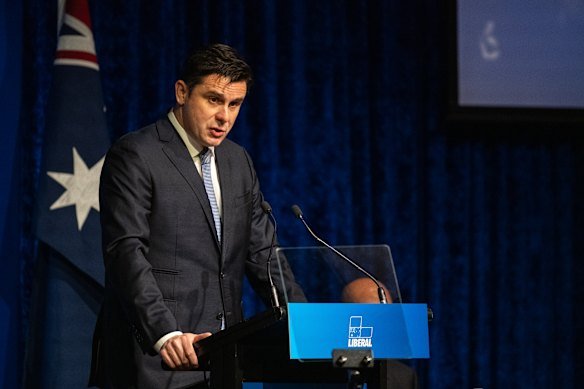
The Liberal Party’s outgoing federal director has delivered a blunt warning to his party’s most senior figures, declaring the organisation faces a demographic crisis among young people and women, and warning that “One Nation are not going away”.
Addressing the second day of the Liberal Party’s federal council meeting in Melbourne on Saturday, Andrew Hirst used his final speech after nine years as director to describe the systemic problems facing the party following its 2025 election defeat.
Hirst, whose departure as federal director coincides with former prime minister Tony Abbott’s appointment as federal president, pointed to persistent institutional failures across consecutive election cycles. He cited figures showing that, since 2010, the number of Australians describing themselves as a lifetime Liberal, National or Labor voter had halved. “More and more voters are making decisions election by election, issue by issue.”
He said that while new party leader Angus Taylor and deputy leader Jane Hume had made a strong start, the Liberals needed to tackle internal membership issues. “More than 55 per cent of Liberal Party members are aged over 60,” Hirst said, with census data showing only 23 per cent of the wider Australian population was in that age bracket. “Less than 10 per cent of our membership is aged between 16 and 30.”
Hirst also noted the party’s remaining younger cohorts were overwhelmingly male. “If you look at that party membership for those aged between 16 and 45, membership skews heavily male,” Hirst said. “Political parties cannot remain strong if they become disconnected from the broader community they seek to represent.”
Hirst said the rapid rise of One Nation was the result both of economic anxiety and the collapse of the Australian idea that if you worked hard, you got a fair go. “One Nation’s rise from single-digit support of around 6 per cent at the last election to now somewhere between 20 and 30 per cent has been rapid, but it is fuelled by frustrations that have built up over time,” he said.
Voters wanted hip-pocket issues addressed, but a deeper drive was also turning the electorate off the major parties: “In Australia, what’s supposed to happen is that if you work hard, play by the rules, and take responsibility, you can get ahead. Many Australians feel this isn’t happening, and the system isn’t working for them.”
A review of the party’s 2025 federal campaign described how Hirst – who spearheaded Scott Morrison’s 2019 election victory – had been frozen out by then-opposition leader Peter Dutton and his office.
Hirst credited Taylor’s federal budget reply as a good start in fighting back against One Nation but urged his party to outline real solutions for Australians, to win that battle. “One Nation are not going away, they’re not our friends, and ignoring them is not an option,” Hirst said.
Hirst pointed to Queensland as the model for how mainstream conservatives could successfully restrict One Nation’s growth. There, at the state level, Coalition support had “held up most strongly, and One Nation support has surged least” because of what Hirst said was an effective state conservative government. “That leaves less of a vacuum for others to fill.”
Kos Samaras, director of political research firm Redbridge and former Labor strategist, agreed the Queensland state government was doing well. “They are a government focused on bread-and-butter issues – they don’t obsess about culture wars, and they don’t get diverted from who is allowed to walk into what bathroom. They get on with the job of running government,” Samaras said.
But he noted this didn’t hold up federally. “At a federal level in Queensland, the Coalition is getting wiped out by One Nation, even if at the state level we have a state LNP government holding the dam wall up.”
Hume did not name One Nation in her speech but did tell the conference “we are not a party of grievance or protest”, adding that the Coalition was “not untried. We are not untested.”
Hume defended Abbott’s capacity to appeal to a broad demographic. Pointing to his electoral record as leader, Hume said more women “voted for the Liberal Party back in 2010 and 2013 than are voting for us now. It’ll be terrific to have Tony at the helm.”
Former federal minister and current Tasmanian treasurer Eric Abetz argued the party’s membership decline was a societal trend rather than an isolated Liberal problem, and he disputed the idea the Liberals should pull back from contentious debates on social values like, he said, “what’s a boy, what’s a girl”. Abetz agreed the threat from One Nation was significant: “Potentially it is existential, and what we need to do is ensure that we don’t give them grounds to solidify their support.”
Western Australia’s Basil Zempilas told the conference that his 15 months leading the state party made him “the longest serving Liberal opposition leader in Australia”. The former football commentator used a sporting analogy to float optimism for the federal Liberal Party under Taylor and Hume’s leadership, saying that on Friday, Carlton, “a team who were down and out just a few weeks ago changed their coach. Change of leadership has produced three consecutive victories, and suddenly they are knocking on the door of the finals when only a month or so ago they were down and out. It’s good to dream.”
Start the day with a summary of the day’s most important and interesting stories, analysis and insights. Sign up for our Morning Edition newsletter.
 Clay Lucas is an investigative reporter at The Age who has covered urban affairs, state and federal politics, industrial relations, transport, health and aged care. Email him at clucas@theage.com.au or claylucas@protonmail.com, or via Signal +61439828128.Connect via X, Facebook or email.
 Brittany Busch is a federal politics reporter for The Age and Sydney Morning Herald.Connect via email.
From our partners
Read the full article here