



 Markets
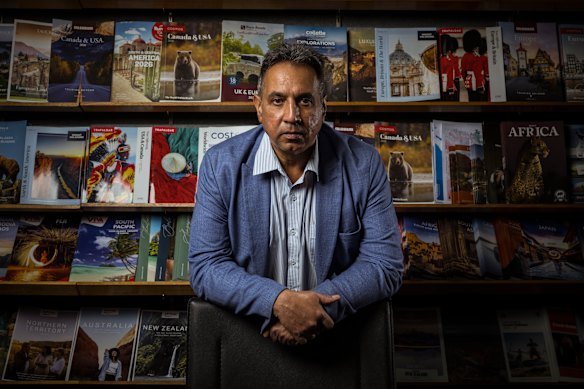
Travel agent Brian Leeson has been waiting for the day when he can take his own bucket-list holiday. The round-the-world journey, to be booked using frequent flyer points he has squirrelled away for years, would start in the United States, where he would reunite with an old friend of five decades.
But Leeson has had to put the dream on hold. The 65-year-old fears increasingly strict controls at the US border mean he could be flagged for criticising President Donald Trump on social media, or for the colour of his skin.
The latest data from the Australian Bureau of Statistics (ABS) show he’s not alone.
Over the years since the COVID-19 pandemic, the US has lost about a third of its annual Australian tourists. In the year to March 2019, 1,090,820 Australian residents returned home from the US. That number was 702,240 in the year to March 2026, according to the latest ABS data.
The Trump administration is proposing even tougher restrictions, including barring international flights into “sanctuary cities” that have refused to fully comply with immigration officials.
Australians have been travelling in increased numbers to the other most popular destinations – including New Zealand, Indonesia, Vietnam and China – over the same period. The number of Australians returning from Japan has more than doubled, from 473,370 to 990,670.
Academics and industry experts say Australians are being turned off the US by a weak exchange rate and high-profile stories of tourists being stopped at the border.
In December, the Trump administration announced a plan that would require Australian travellers to provide their social media details to authorities to enter the country for “enhanced vetting”.
Leeson, an Australian citizen born in India, said that when it came time to book his round-the-world trip, he hesitated after hearing worrying stories. He recalled a man who had been denied entry because he had transited through Hong Kong.
“I don’t hold back in commenting on social media, and I thought that’s one reason why they’ll probably turn me around at the airport,” he said.
“I’m dark-skinned, and I kept hearing of people of Indian origin being pulled aside for additional questioning.”
Leeson said the round-the-world ticket had a strict itinerary, so a disruption would be disastrous.
“You can’t change things at all,” he said. “So if I were to get all the way to Los Angeles, and then be refused entry into the states, that would just upset the whole apple cart.”
He said he was hearing similar concerns from clients through his work as a travel agent.
“We have noticed … sales to Europe and to Japan and parts of Asia have increased tremendously since COVID, but the sales to America has dropped.”
Writer Alistair Kitchen made global headlines last year when he was detained and deported after writing about the pro-Palestinian campus protests that took place while he was a student at Columbia University. US officials said he provided false information about drug use.
Kitchen said he urged caution when people came to him for advice about travelling to the US.
“Don’t assume that just because you have a very small social media presence that you will not be targeted,” said Kitchen, who had scrubbed his own social media days before he left for the US.
“No one wants to have the experience that I did.”
Kitchen said he won’t find out how long he has been banned from the US until he applies for another visa, which he can’t yet bring himself to do.
“It would just be very painful for me to discover how long I’ve been banned from my community. I lived in New York for six years. I have loved ones in New York, and I’m now banned from visiting them … I’d rather not confront that fact,” he said.
Australian travel advisory site Smartraveller says the US is safe to travel to but notes entry requirements are strict.
“US authorities have broad powers to decide if you’re eligible to enter and may determine that you are inadmissible for any reason under US law,” it says.
Earlier this month, Australian musician Adam Hyde, who performs as Keli Holiday, was detained at the border while touring North America and deported, forcing him to cancel the remainder of his tour. Officials cited national security concerns as the reason for his detention.
This week, the Trump administration threatened to halt the processing of international travellers at major airports in “sanctuary cities” that have refused to fully co-operate with an immigration crackdown.
Major gateways for Australian tourists such as Los Angeles and San Francisco would be captured under the proposal.
US Homeland Security chief Markwayne Mullin told Fox News: “We’re currently drawing up plans to say, listen, these sanctuary cities where the local radical-left Democrats aren’t allowing us to do our jobs and enforce federal laws, then we shouldn’t be processing international flights into their cities either.
“They don’t want us to enforce immigration, but they want us to process immigration at their facilities.”
Leeson said he had looked into going through Canada instead of the US, but those seats were much rarer on the round-the-world ticket.
He said the US was a wonderful place to visit, and he had felt safe travelling there in the past.
“I’m still hanging onto the [frequent flyer] points,” Leeson said. “I’m hoping that in a couple of years’ time, if Trump is gone, then policies will change.”
Start the day with a summary of the day’s most important and interesting stories, analysis and insights. Sign up for our Morning Edition newsletter.
 Brittany Busch is a federal politics reporter for The Age and Sydney Morning Herald.Connect via email.
 Shane Wright is a senior economics correspondent for The Sydney Morning Herald and The Age.Connect via X or email.
From our partners
Read the full article here