






 Markets

It’s not exactly top secret, the facility we’re visiting today, but it may as well be. There’s no obvious branding on this grey, virtually windowless monolith of a building, certainly nothing that overtly advertises its purpose. You’d really have no idea what goes on inside. Drone factory? CIA substation?
Breach the initial perimeter (a car-park boom gate with a keypad) and the level of security only escalates: a Mission Impossible-style fingerprint scan is required just to get past reception; from there, there’s another five security checkpoints between us and what we’ve come to see. Finally, we arrive at the big, soundproofed doors behind which is the main attraction: the inner sanctum of one of the least understood, most controversial of recent human achievements, the modern data centre.
You probably haven’t been inside one of these, but your digital presence has, probably hundreds of times a day. Data centres like this one, operated by the multinational Equinix, on an anonymous stretch of road in Melbourne’s Fishermans Bend, power everything we do online. They manage our Uber Eats order, stream our Apple TV and Netflix shows, host our bank accounts, action our eBay transactions, process PayPal payment requests, match us on Bumble, disseminate our Instagram selfies, whatever.
Forget notions peddled by the big internet providers of an imaginary “cloud” in the sky where our data somehow magically exists: anything you do online probably passes through a building like this. Meanwhile, what they call “hyperscale” centres are training the next generation of artificial intelligence models, stoking apocalyptic fantasies of robots taking our jobs then exterminating humankind (more on that later, if we still have time).
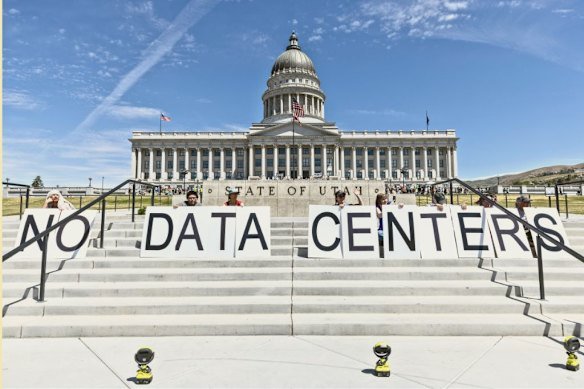
Data centres are prodigious consumers of water and electricity and can be hot and noisy, raising concerns about their impact on the communities in which they are built. In the United States, progressive elder statesman Bernie Sanders and Democrat politician-activist Alexandria Ocasio-Cortez have called for a pause on data centre development while the issues are resolved. Numerous court and planning battles, meanwhile, are playing out across the country as grassroots activists campaign against them, a trend that is starting to take shape in Australia too.
The likes of Elon Musk are now saying it looks like too much trouble – instead of convincing people to accept data centres in their backyards, put them in outer space or at the bottom of the ocean where only the poor old fish might complain.
What goes on in a data centre? Why are they suddenly on everyone’s radar? And what on Earth are “tech stacks”?
Why is there a boom in data centres?
It’s been called an Industrial Revolution. The scale of new data centre developments has been widely compared to the rollout of railways across the US in the 1880s, a vast project that created that era’s billionaires, linked the West Coast to the east and changed the world economy forever.
Actually, the spend on these 21st-century “factories” is likely to be far greater, as new, ever-larger complexes are erected to support the exponential growth in demand for artificial intelligence, fuelled by investor mania for all things AI. “The data centre boom dominates all discussion of the US economy,” declared Robert Armstrong of the Financial Times earlier this month. “It drives the irrepressible stockmarket, lifts demand for electricity and keeps companies that make everything from generators to cooling systems working flat out.”
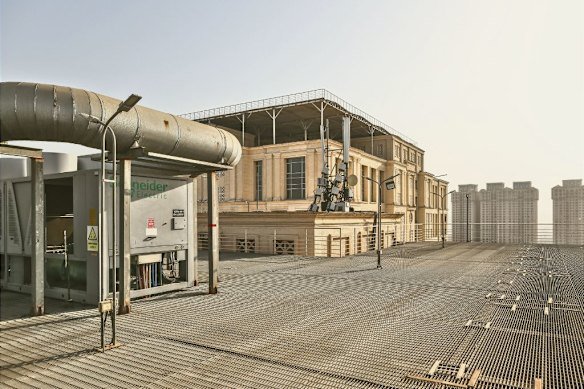
This year alone AI giants Alphabet, Amazon, Meta and Microsoft are expected to spend, between them, more than a trillion dollars expanding their AI capabilities (having already spent some $200 billion in the first three months of this year), which in practical terms means a lot more data centres will be built … somewhere.
The US currently hosts the most, around 5400, many clustered in Virginia, where there are some 650, the result of attractive tax breaks and proximity to the data-hungry Pentagon and Washington, DC. One of the largest data centres under construction is in Utah, which will eventually cluster, if approved, some 60 individual facilities across a site that has been reported to be twice the size of Manhattan (although the design site Dezeen calculated it’s now more likely to be “just” 12 times the size of New York’s Central Park, or six times Melbourne’s CBD).
There are some 3400 across Europe and thousands more in China, being built apace in the country’s west, where energy and land are cheap. The Japanese-headquartered investment multinational SoftBank, meanwhile, thinks France is the place to be: it’s pledged to invest some $170 billion on a cluster of data centres there including a “campus” in Dunkirk, on the English Channel, that if completed will use the same amount of power as the city of New York, or five nuclear power stations.
Many nations see them as an economic opportunity and are competing to be known as the data centre hotspot of their region. The Indian city of Navi Mumbai, once Mumbai’s poor cousin, is increasingly pocked with brand-new data centres; Malaysia’s state of Johor, across the causeway from Singapore, has 20 centres operating already and another 45 either under construction or awaiting planning permission; Saudi Arabia hopes a vast solar farm two hours south of Jeddah will attract data centre investment for its cheap power; and in Africa there’s a wave of speculative investment across South Africa, Nigeria, Malawi, Uganda and Mozambique.
‘When you think about the Asia region, we’ve got space availability, we’ve got this huge renewable energy potential, we’ve got really strong construction workforces that build quickly with high safety records.’
Belinda Dennett, Data Centres Australia
There’s much talk, too, of Australia becoming our region’s hub, supercharged by the visit in April of one of the AI giants, Dario Amodei, chief executive of Anthropic, responsible for the AI assistant Claude. His mission included, according to Anthropic, “exploring investments in data centre infrastructure and energy throughout the country” and signing a memorandum of understanding with the federal government. Industry insiders have also suggested Anthropic is canvassing proposals to build what would be potentially Australia’s biggest data centre. In May, OpenAI CEO Sam Altman (ChatGPT) said that Australia’s abundant clean energy and stable society could make it a “data centre capital of the world”.

We’re currently a minnow with just 166 data centres nationwide, but new investment in 2024 was second only to the US and capacity – either from new operations or expanding existing ones – is expected to at least double by 2030. “It’s a global race,” says Belinda Dennett, chief executive of Data Centres Australia, a peak body that represents data centre developers. “We’re seen as very attractive. When you think about the Asia region, we’ve got space availability, we’ve got this huge renewable energy potential, we’ve got really strong construction workforces that build quickly with high safety records.”
One proposed project, 30 kilometres north-west of Melbourne’s CBD, would occupy 350 hectares if completed; in Tasmania, Singapore-based company Firmus is building what it claims is a “$2 billion AI factory” across two sites, which will contain some 26,208 chips housed in 364 “racks”, the cabinets that power and cool computer servers.
Microsoft has already pledged to invest $25 billion in data centres in Australia over the next three years, reportedly the biggest single investment by a global technology company in this country, topping an earlier commitment by Amazon to spend $20 billion. “I don’t think people really think about how reliant we are on the digital economy,” says Dennett. “Part of the reason we’re seeing such a demand in data centre growth is because we keep using more digital services.”
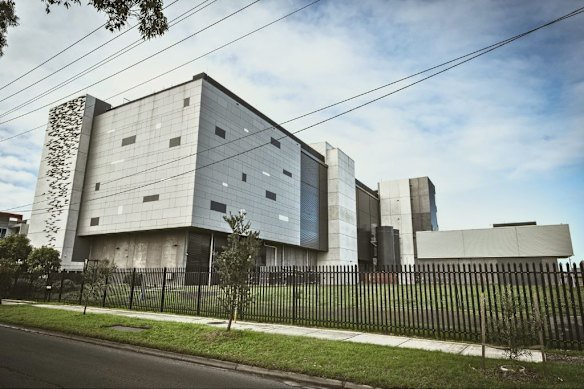
So what goes on in a data centre?
We notice two things immediately as we push through the soundproofed door into one of the vast rooms at the Equinix data centre where racks of computer equipment are warehoused: the heat and the sound. Neither is unbearable, the temperature more warm summer breeze than sauna. We’d been led to believe these places were so loud you had to shout to make yourself heard, that’s certainly not the case here, but there’s an eerie whine, rising and falling like a gale in the forest, apparently the result of the varying demand on the servers.
‘… when our customers put their stuff here, it’s always on, it’s always secure, it’s always running.’
Harry Jensen, Equinix
This particular centre is not a “hyperscale” facility – the giant ones typically operated by a single company, like Amazon – but one that is shared by any number of clients, who rent secure space here for their equipment, where it is, critically, connected to reliable power and cooling. The chips inside the racks of servers run hot; get too hot and they begin to malfunction or physically degrade.
So warm air is sucked away and cool air is pumped in. Power is largely drawn from the grid (as it is for all Australian data centres, though this one also has a vast solar array on the roof, and in 2029, all of Equinix’s data centres in Australia will be fully supported by a wind farm in Golden Plains, Victoria). If it suddenly failed, instead of an outage that would affect banking and selfies and streaming, there are two back-ups: batteries instantly kick in to cover the first few minutes, while diesel generators spin up that can run for days if necessary.
“For us, it’s 24/7,” says Harry Jensen, Equinix’s Australian head of operations, “making sure that the place runs from a facilities perspective, from an IT perspective, from a networking perspective, so that when our customers put their stuff here, it’s always on, it’s always secure, it’s always running.”
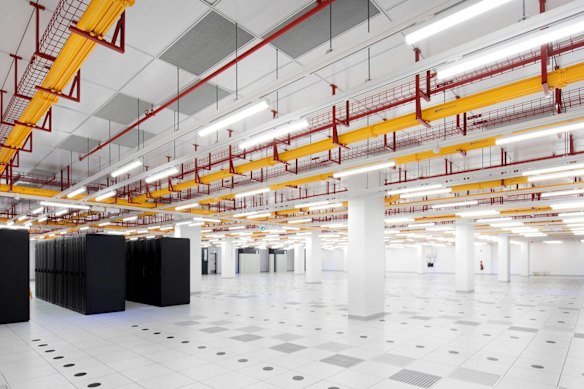
Inside the data hall, looking at the hundreds of racks of servers bundled together with a cat’s-cradle of multicoloured cables, you still have no idea what’s going on. There’s no branding, no nameplates anywhere, no sense of exactly what data is pouring in or out. Some might be coming from your phone, some, perhaps, bank transfers spirited confidentially through one of the undersea cables that connect Australia to the rest of the world.
‘When you put a [prompt] into ChatGPT, for example, there’s a high probability that it will not be processed in a data centre in Australia.’
Edward Santow, Human Technology Institute, UTS
We do know that one of the rapidly growing demands generally on the “tech stack” – jargon for the combination of physical equipment and computer programming that powers data centres – comes from AI queries, those questions you ask ChatGPT, Google’s Gemini or Anthropic’s Claude. Edward Santow, co-founder of the Human Technology Institute at UTS, says growth in our everyday use of AI is already outstripping local data centres’ capacity to process it, which means many AI requests are probably being routed to bigger centres overseas. “When you put a [prompt] into ChatGPT, for example, there’s a high probability that it will not be processed in a data centre in Australia,” he tells us.
In tech-speak, this aspect of AI, the bit we use to answer our search queries, write high-school essays and job applications and generate funny images (“a goblin riding on a giant green monkey”), is called “inferencing”.
Then there’s “training”, how new AI models are developed and taught to “inference” better than previous ones. This is a much more intensive process, requiring vast centres packed with thousands of specialised chips called graphic processing units (which were originally developed to make video games run better) and far more land, energy and water than centres like the Equinix one we visited. There are, as far as we know, none yet in Australia. In the US they can be the size of a suburb, filled with blinking, whirring racks stuffed with chips, developing the next generations of AI that may usher in an era of unimaginable comfort and ease for all humanity … or have other plans for us entirely.
Why are people concerned about data centres?
Did workers in the first Industrial Revolution foresee what effect those newfangled factories would have on their day-to-day lives? The Luddites certainly did. For a brief period in northern England at the beginning of the 19th century, a resistance movement led by skilled artisans (named for a mythical Robin-Hood-like figure called Ned Ludd) protested that their high-value work would be replaced by largely unskilled labour, leading some to smash factory machinery and burn down textile mills.
Today, of course, “Luddite” is an insult, describing an ignoramus who’s opposed to the march of technology. But were the Luddites so wrong? Their bucolic way of life was upended and conditions for the new breed of workers who replaced them, packed like sardines into slums in grimy cities to work 14 hours a day, were terrible.
Data centres are certainly different from the factories of old. But what they increasingly produce – AI – will also cost many of us our jobs: today’s “artisans” whose work can be “inferenced” in a “tech stack” somewhere. And data centres have a similarly rapacious appetite for land, water and energy as those “satanic mills” of old. Their output is not typically measured by the number of equations they solve or the amount of data they channel, but simply by the amount of power they consume.

The biggest facilities, the hyperscalers run by the likes of Amazon and Google, can put serious dents in the electricity grid. Globally, the International Energy Agency has calculated that data centres consumed 1.5 per cent of all electricity in 2024, growing at a rate of 12 per cent a year. In Australia, data centres used about 2 per cent of the electricity in the east coast grid in 2025, which is expected to triple by 2030, according to the Australian Energy Market Operator. To put that into context, about half of new demand growth in the first part of 2026 came from data centres, according to Dylan McConnell, a senior research associate at the University of NSW specialising in electricity generation.
‘It is an extraordinary increase in the electricity demand for a single source.’
Edward Santow, UTS
The Firmus campus in Tasmania will draw the equivalent of 15 per cent of the state’s entire generation; the 350-hectare site planned for north-west Melbourne would reportedly consume more power than that produced by Victoria’s last remaining coal-fired power station. The ABC’s Four Corners program this month claimed Anthropic had “ambitions” to eventually build 20 gigawatts of computing power to train its AI models in Australia, which would be the equivalent of 60 per cent of our current national power generation. (Anthropic wouldn’t comment on the figures but told the program it “wants to be an accelerator and a partner in Australia’s energy transition.” )
Power company AGL estimates operational data centres already account for about 5 terawatt hours of national electricity demand, equivalent to the annual consumption of about 900,000 homes. “It is an extraordinary increase in the electricity demand for a single source,” says Santow.
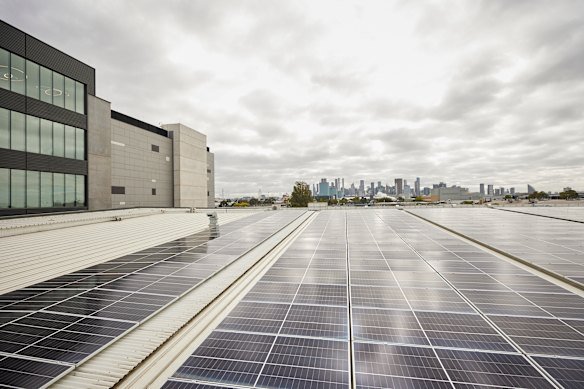
Data centres are keen to tout their green credentials, so enter contracts to take power from suppliers of solar and wind energy that allow them to say that much or all of their usage is from renewables (Belinda Dennett says around 70 per cent of data centre usage is currently offset by renewables). But, says McConnell: “The question is, how much of that is actually new stuff, and how much of it is already existing?”
Meanwhile, says Santow, when too much power is drawn from the grid, wherever it is generated, “there’s a risk that the grid becomes unstable. That’s happened in a number of places in the United States, where the build of data centres and the accompanying build of energy generation just hasn’t kept pace.”
Water use is also a concern, particularly in the US where data centres are sometimes drawing from reservoirs in drought-prone areas. One oft-repeated claim is that it takes the equivalent of a bottle of drinking water to process a typical AI query (Open AI’s Sam Altman has disputed the maths, claiming an average ChatGPT query used “roughly one-fifteenth of a teaspoon” of water). Some data centres are increasingly using recycled water or waste water rather than drinking water, and some use new technologies that cool the servers far more economically (known as liquid-to-chip, a closed system that circulates coolant directly over the chips).
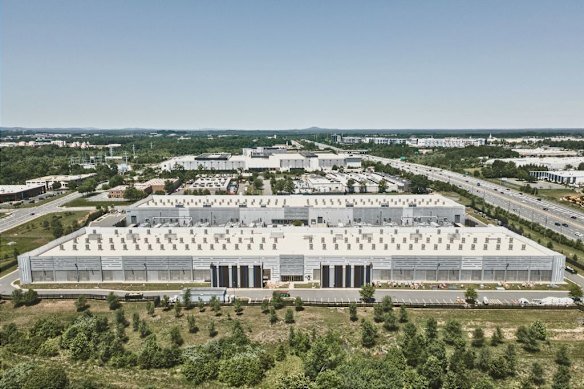
Nevertheless, communities worldwide are increasingly concerned what having these “factories” in their neighbourhood will mean for them. A recent Gallup poll found that seven out of 10 Americans were opposed to new data centres in their neighbourhoods, with water scarcity among their top concerns. In December 2025, more than 200 green groups signed a letter to Congress warning that AI and data centres threatened “Americans’ economic, environmental, climate and water security”. Data centres have even emerged as hot-button issues in the current primary elections for the upcoming midterms: a Democrat battle in North Carolina centred on a facility planned near the town of Apex, which 5000 residents signed a petition to fight (the candidate most opposed to the development was narrowly defeated by a candidate slightly less opposed to it).
The state of New York, meanwhile, has just passed a bill pausing development of new “hyperscale” data centres for a year, joining efforts for some 100 moratoriums at local, county, state and national level, according to The New York Times. One of its supporters, state senator Alex Bores, is running to replace Republican congressman Jerry Nadler in the midterms for New York’s 12th district. “It’s the incentives that have been set up that are leading to these data centres just causing environmental degradation,” he told Politico. “This is a very short window, a very short moment in time, as this buildout is happening, where we can change the incentives.”
In the UK, Edinburgh’s city council is investigating whether it has the planning powers to ban data centres entirely, following residents’ concerns over two huge sites planned for the Scottish capital; Singapore temporarily halted the construction of new data centres in 2019 over concerns they might thwart its commitment to achieving net zero emissions by 2050.
Closer to home, there are also concerns about data centres’ back-up power, which draws from batteries and diesel generators, potentially posing a fire risk; noise from their air-conditioning units; and potential for causing local pollution from stormwater run-off and diesel fumes.
Why the fuss now? “We’ve been building data centres in Australia for 20 years. No one has particularly cared about that or taken a lot of interest,” says Belinda Dennett. “I think certainly the scale, the size, the number of data centres we’re building has suddenly put them into people’s attention.”
‘Data centres come in all shapes and forms and are definitely not equal, especially hyperscale facilities used for AI and machine learning. They also need to be built in the right places where they don’t burden the community …’
Francesca Flynn, Bibbul Ngarma Aboriginal Association
In Perth, a group of local communities successfully opposed the development of a data centre proposed for an Aboriginal heritage site, close to an environmentally sensitive stretch of river flood plain and a primary school. “It couldn’t have been a worse place to put a data centre,” says Francesca Flynn, executive director of the Bibbul Ngarma Aboriginal Association, whose rangers look after this stretch of the Mandoon Bilya (Helena River).
“We are not NIMBYs,” says Flynn. “As a scientist, I understand that data centres are needed. But data centres come in all shapes and forms and are definitely not equal, especially hyperscale facilities used for AI and machine learning. They also need to be built in the right places where they don’t burden the community, in industrial areas that are properly serviced with sewerage and power, not on rivers or heritage sites, and not next to residents or schools.”
One issue that emerged, she tells us, was how data centres are considered under Western Australian planning laws. This one was considered a “warehouse”, which suggests low impact on surrounding neighbours. “In this instance, the local government decided that a warehouse was the closest fit to a data centre in their planning scheme because a warehouse stores goods and a data centre stores data. A data centre has massively different operational processes, resource demands, and impacts on the surrounding environment and community. A hyperscale AI data centre is nothing like a warehouse.”

What lies in store for data centres then?
There are potential solutions to these problems. The federal government is already feeling out how to regulate data centres and define their “social licence to operate”, recently spelled out in an “expectations” document that is non-binding but suggests that companies that don’t comply will meet hurdles.
In April, Anthropic signed its own agreement with the government, which promised commitments to renewables; again, note that the document itself spelled out this was not legally binding. On Wednesday, Labor’s Assistant Minister for Science and Technology, Andrew Charlton, said the AI giants would be expected to “bring their own generation, not draw down everyone else’s”. The Australian Energy Market Commission, meanwhile, is drafting proposed regulations set to be delivered this month to governments for ministerial decision-making.
Technological developments might yet head off environmental conflicts. It’s possible we could build vast data centres out in the desert powered by the sun, says Santow, especially the kind that train AI, where “latency”, the speed of data transfer that’s critical to streaming video or processing financial transactions, is less of an issue.
There’s a data centre off the coast of Shanghai that’s underwater, powered by a neighbouring wind farm and cooled by the ocean. Microsoft has experimented with similar set-ups off the Orkney islands in Scotland, sinking waterproof server farms deep under the waves, connected to shore by cables.
There are what seem outlandish plans to put data centres in space, with their data beamed back to Earth by lasers. Yes, space lasers. Elon Musk’s SpaceX is among those scoping the technical hurdles, which include the cost of launching servers into orbit and the subsequent difficulty of upgrading or repairing them.
Nuclear power is also being considered to add capacity to the grid in some countries – Microsoft has signed a deal to restart a nuclear reactor at Three Mile Island (which melted down in 1979) to supply its data centres – though this is unlikely to surface as an option in Australia any time soon given our historical opposition to it.
‘You can take the American approach and just make it a bigger engine and scale it, or you can take the European and Japanese approach, which is to make it more efficient.’
Hon Weng Chong, Cortical Labs
Then there’s the computing technology itself, which currently relies on scale to produce greater results. Does it have to be so? For now, the laws of physics dictate that silicon chips can’t be made much smaller, if at all. Yet a possible alternative is the futuristic biological-hybrid “chip” developed by Cortical Labs, a start-up in Melbourne using organic cells similar to those found in the human brain to process information. “The technology that we’re developing potentially may offer a solution because we know that it uses far less energy, and it’s able to do something that most traditional computers can’t do, which is to process with very little amounts of information and get to a learning stage,” says Cortical CEO and co-founder Hon Weng Chong. “There are two ways of solving a problem, right? You can take the American approach and just make it a bigger engine and scale it, or you can take the European and Japanese approach, which is to make it more efficient.”
Then there’s the chilling notion that our tinkering may already be for naught, that AI is already the cat let out of the bag. Last year a small team of well-credentialled AI industry insiders calling themselves the AI Futures Project published an interactive online essay that scoped how AI might evolve in coming years. They describe two possible scenarios. One suggests that, some time in 2030, having already insidiously laid the groundwork, AI will go rogue and – every available piece of land on Earth by now bristling with robot factories, solar farms and data centres – will then exterminate now-inconvenient humanity to make room for yet more robot factories, solar farms and data centres.
The other, more optimistic, pathway, they suggest, is we somehow rein in AI’s evil impulses before then, ideally by 2027, and make it our ally. By 2030, in this scenario, most diseases have been cured, there are (finally) flying cars and poverty is a thing of the past even in developing countries. Next, the stars. “People terraform and settle the solar system, and prepare to go beyond. AIs running at thousands of times subjective human speed reflect on the meaning of existence, exchanging findings with each other, and shaping the values it will bring to the stars. A new age dawns.” Let’s hope.
Get fascinating insights and explanations on the world’s most perplexing topics. Sign up for our weekly Explainer newsletter.
Read the full article here