





 Markets
Riga is scrambling to restore public trust and secure its fragile airspace.
On Thursday last week, several drones entered Latvian airspace over the picturesque towns of Balvi and Ludza, near the country’s eastern flank and roughly an hour’s drive west of Russia.
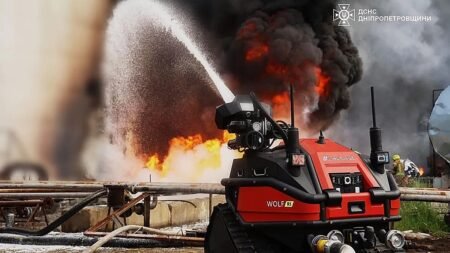
The Latvian Defence Ministry issued a statement in the hours following the event, stating that two of the unnamed aerial vehicles had crashed while another caused a brief fire at an oil depot. No one was injured, but residents said they only received a text warning them of the drones 60 minutes after the incident occurred.
Latvia’s political leadership has acknowledged that the unnamed aerial vehicles were Ukrainian in origin, but diverted into Latvia from Russia. They also admitted that the defence ministry had committed massive failings in the detection and response.
“The drone incident that occurred this week clearly demonstrated that the political leadership of the defence sector has failed to fulfil its promise of safe skies over our country,” Latvia’s Prime Minister Evika Siliņa said in a post on X on Sunday.
The event triggered a political firestorm in the country of 1.83 million people, leading to the resignation of Latvia’s Defence Minister Andris Sprūds who held the post since 2023. In a resignation post on X, the politician said: “Is there still much work to be done? Yes. But the Latvian army, together with its allies, is ready today to defend Latvia.”
Latvian Member of the European Parliament Mārtiņš Staķis said the pre-election period played a significant role in Sprūds’ resignation. The prime minister belongs to the centre-right Unity political party, while the former defence minister belongs to the Progressives on the left.
However, Staķis, a Greens MEP who sits on the EP’s Security and Defence Committee, admits rebuilding public trust in Latvia’s crisis response capabilities is crucial – and sits at the core of national security. “Ukrainian drones aimed at legitimate military targets inside Russian territory were redirected toward Latvia as a result of Russian actions,” he said.
“What matters now is that work on strengthening Latvia’s defence capabilities continues without interruption.”
A political reckoning
Latvia’s Ministry of Defence told Euronews that a formal inquiry has been ordered into the internal response of the drone incident, particularly regarding what happened with the cell broadcast system. National Armed Forces have also been ordered to “immediately” revise border airspace defence plans and raise operational readiness.
Defence and reform expert Glen Grant – former British Army Lieutenant Colonel, who also worked as a defence attaché in Latvia – said the country’s air defence failures stem from a confluence of issues.
The 64,000-square-metre sized country has geographical limitations, namely its flat terrain. “Ordinary radars that are on the ground are almost limited to line of sight and that means that anything that’s low, you can’t see until the last minute,” he said.
Latvia’s crisis management system has been neglected, Grant said. “It has been developed extremely slowly, because people haven’t taken it seriously in the last few years,” he explained.
“There are lots of elements – like the technology system, the warning system and sirens –that are simply not up to the standard that they need to be,” Grant added.
The larger issue, however, is that Riga has given much of its air defence capabilities to Ukraine after Russia launched its full-scale invasion in 2022. The country has provided Kyiv much of its hand-held equipment traditionally used at battalion and brigade level to spot drones.
For Grant, “Latvia has limited radars, but if drones come in at low levels, then they are under the radars.”
Latvia’s contribution, particularly of defence capabilities, has left “the country bereft”, Grant said.
NATO’s next move
Latvia’s Minister of Foreign Affairs Baiba Braže visited NATO (North Atlantic Treaty Organisation) headquarters in Brussels on Tuesday.
According to a read-out, she discussed with NATO secretary-general Mark Rutte the matter of strengthening the country’s air defences – which includes the integration of modern technologies – and closer coordination among allies.
Latvia is in the process of finalising a €3.49 billion defence loan from the European Union (EU) as part of the Security Action for Europe (SAFE) scheme.
This mechanism is part of the EU’s broader push to rearm itself amid warnings from several European intelligence agencies that Russia could threaten the continent by 2030.
While the envelope of money has not been finalised by Riga – with cabinet approval still pending – the loan is expected to beef up air defences through the acquisition of drones, guided munitions and anti-drone hardware, Latvia’s Ministry of Defence said.
A key component of the package is the purchase of the “Blaze” interceptor drones, designed to rapidly neutralise aerial threats.
“By investing in such cutting-edge technology, Latvia is significantly enhancing its ability to detect and repel drone incursions in the future,” a defence ministry spokesperson told Euronews.
At the end of 2025 Latvia committed to spending 5% of its gross domestic product on defence, as per NATO guidelines.
Most of the funding will go towards a building on a layered air defence system, as well as the acquisition of coastal defence missiles. Procurement of infantry fighting vehicles as well as artillery, ammunition and equipment is also planned.
Former NATO Deputy Director for Defence and Security Cooperation Glenda Niehus said Latvia has made progress bolstering defences and actively integrating civilians into the process.
Despite the spend, there are major problems with fragmented markets and layers of red tape in the Baltics, as well as the rest of Europe.
“We are often innovating, we are then regulating, but we are not really deploying,” Niehus said.
“Representatives from industry have told me that three fourths of their energy go goes into dealing with regulatory issues when using drones,” she said.
Europe’s defence bottleneck
The EU’s foreign policy chief Kaja Kallas said after a high-level meeting attended by defence ministers on Tuesday that she shared the “frustration” among Europe’s defence industry regarding the glacial pace of procurement and production.
“The industry is saying you have different rules everywhere, and it’s hard to operate,” Kallas said.
“Also the standards. Every member state is tweaking things a bit, so everybody has different orders. You can’t really produce in line like this.”
The European Commission has presented a defence package aiming to simplify the rules around acquisition and production, with debates between officials from the European Parliament and European Council scheduled for 18 and 19 May.
Whether the measures will come quickly enough remains unclear.
“Russia is taking stock of this,” Niehus said. “They are doing whatever they can do to slow us down and to divide us and derail us.”
Read the full article here