





 Markets
Updated ,first published
Labor will clash with the Coalition over ministers’ power to police harmful online content, unveiling a new crackdown on addictive algorithms that taps global momentum on digital regulation and could draw pushback from the tech-friendly Trump administration.
Communications Minister Anika Wells declared a “reckoning” for US tech titans as the government revealed platforms would be subject to $100 million fines under a proposed digital duty of care. The framework mirrors models in UK and the European Union; Europe has since watered down its laws due to fears of overreach.
The “My Feed, My Way” laws, which Prime Minister Anthony Albanese flagged with this masthead last month, will compel Facebook, Instagram and TikTok to send notifications to new and existing users offering them a feed filled only with accounts they follow, instead of a feed driven by algorithmic recommendations.
The move stopped short of a mandatory opt-in preferred by the Greens and safety advocates yet Albanese boasted about his world-leading approach little more than a week before he visits the United Nations in New York to spruik his latest social media plan.
“We’ve started a global movement,” Albanese said. “It’s about putting choice back into the hands of Australians online … and it will hold the big tech companies responsible for inaction.”
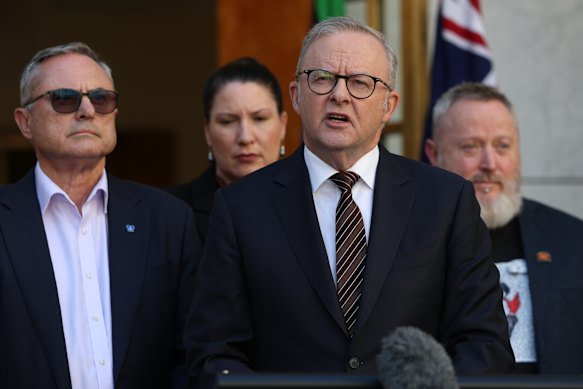
Albanese announced the digital crackdown just after midday Tuesday in his Parliament House courtyard, flanked by parents and activists who have run a public campaign to switch off the algorithm. Albanese’s cabinet colleagues believe he views Australia’s social media teen ban and the upcoming duty of care as a more important feature of his second-term agenda than the universal childcare plan long signalled in his agenda.
After repeated warnings from the Trump administration to lay off the US tech industry, Albanese downplayed the prospect of a rift.
“We’re a sovereign nation. We decide our policies based upon the Australian national interest,” he said.
Labor offered no concessions to the Coalition over the opposition’s core concern: Wells and the eSafety Commission’s powers to designate new categories of harmful content that social platforms would need to police.
Wells said the powers were required to make swift decisions such as the crackdown she ordered in January of the “nudify” feature of Grok, Elon Musk’s controversial AI tool on X. If Wells did not hold the power, she argues that MPs would be required to vote on fresh amendments to the laws every time a new menace was identified.
“I guess it is on the Coalition if they’re going to disagree … [and] consider, is their preference that we recall parliament every time there’s a new Grok?” she said.
Wells’ firm position has stiffened the resolve of the Coalition to campaign against the bill, setting up a clash over government control and political freedom at a time when voters are drifting to anti-establishment parties such as One Nation.
Nationals leader Matt Canavan said Wells could not be trusted. He cited her comments on a Saturday Paper podcast in which she claimed the “power of the algorithm” was making it harder to convince voters that Labor meant what it said when it promised not to enact one policy or another.
“Labor can’t be trusted to regulate the internet because their minister said that no one trusts her any more because of the algorithm,” Canavan said, citing Labor’s broken pledges on property tax concessions.
“News to Labor: people don’t trust you any more because you lied to us about taxes.”
Albanese said: “This is not about censorship; it’s about giving people control.”
The Institute of Public Affairs dubbed Labor’s move the “Albo-rithm” and said attempts to define harm were “necessarily fraught with contested political and moral questions to do with peoples’ diverse ideas and beliefs about what is good for them and others.”
Momentum on making social media safer, particularly for children, has grown after Meta recently agreed to pay $25 billion in a US court case on teenage mental illness and addiction.
The digital duty of care, which Labor will legislate later in the year, will force tech platforms to take reasonable steps to protect under-18s from misogynistic content, targeting the so-called manosphere, posts that encourage eating disorders or terrorism, glorifying crime, or contest that causes mental distress or bullying.
Online games, apps or AI chatbots will be required to protect kids from addictive features that promote endless scrolling or recommenders that may push people down rabbit holes.
If the Coalition votes against the laws, as appears likely, Labor could be forced to adopt tougher measures supported by the Greens in order gain support in the Senate. The Greens want time limits to prevent “doom-scrolling”, banning autoplay functions.
Greens senator Sarah Hanson-Young said an opt-out model was “a recipe for big tech to manipulate and to get around it.”
Wells said Labor had chosen an “optimal” middle-ground position.
“You will have a choice about whether you want the algorithm or whether you want the following feed,” she said.
Australian Chamber of Commerce and Industry chief executive Andrew McKellar said a balance must be struck between online safety and allowing businesses to use social media recommendations to advertise.
The prime minister downplayed the potential for backlash from the Trump administration, which has been critical of other nations curtailing US tech companies.
“Look, we’re a sovereign nation. We decide our policies based upon the Australian national interest,” Albanese said.
The eSafety commissioner would be given the power to issue removal notices over “nudify” apps and big tech companies would face penalties of more than $100 million for flouting the laws.
On separate legislation to bolster Labor’s under-16 ban, the Coalition raised concerns about new interrogation powers for the eSafety Commissioner that the Coalition said would allow the regulator to compel documents from children and their parents.
“These are serious coercive powers and Labor is trying to ram them through without proper scrutiny. We will not support that,” opposition communications spokesman Sarah Henderson said.
“The Coalition’s approach is to protect kids, empower parents, shine a light on Big Tech and protect the freedoms Australians expect,” Senator Henderson said.
Cut through the noise of federal politics with news, views and expert analysis. Subscribers can sign up to our weekly Inside Politics newsletter.
 Paul Sakkal is Chief Political Correspondent. He previously covered Victorian politics and won a Walkley award and the 2025 Press Gallery Journalist of the Year. Contact him securely on Signal @paulsakkal.14.Connect via X or email.
 Brittany Busch is a federal politics reporter for The Age and Sydney Morning Herald.Connect via email.
From our partners
Read the full article here