



 Markets
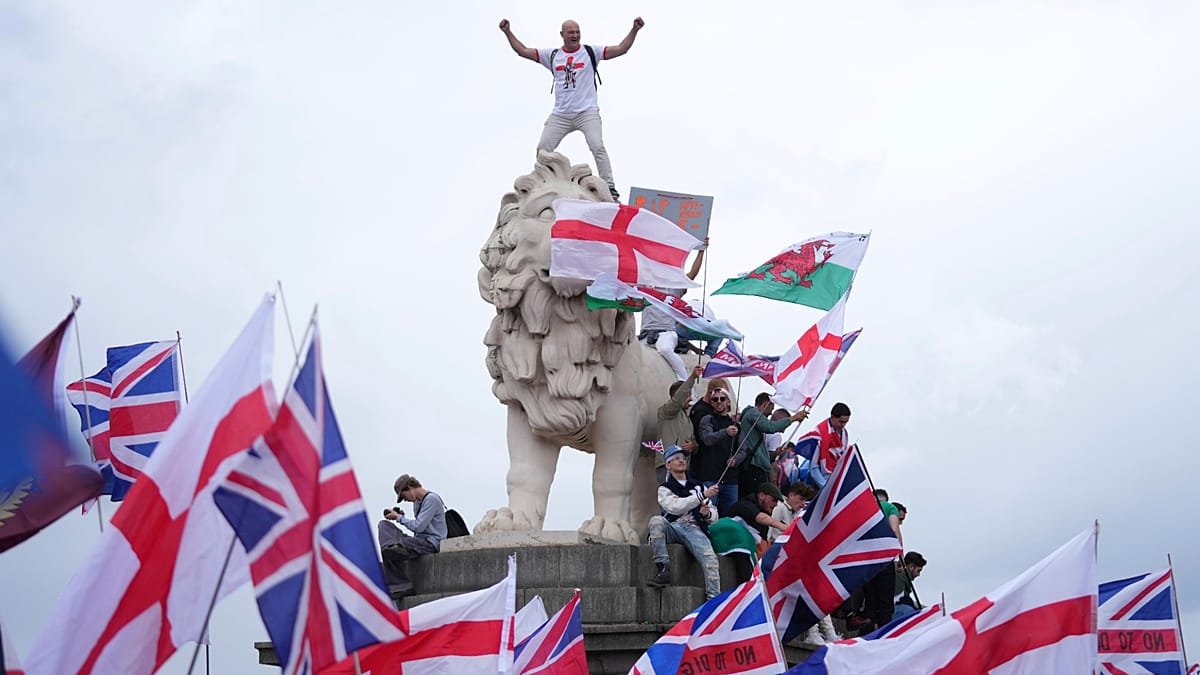
At least seven individuals — including multiple figures with ties to Europe’s far-right — have been barred from attending a rally organised by far-right activist Tommy Robinson in central London on 16 May.
A number of those barred by British authorities were set to address crowds at the “Unite the Kingdom” march, but the Home Office declined their electronic travel authorisation (ETA), a system brought in earlier in 2026 that, once granted, allows visa-exempt foreign nationals to visit the UK multiple times over a period of two years.
Shabana Mahmood, the home secretary, said that they were banned because their presence in the UK is “not conducive to the public good”.
Eva Vlaardingerbroek and Ada Lluch, influencers and commentators from the Netherlands and Spain, respectively, as well as Flemish MP Filip Dewinter and Polish MEP Dominik Tarczyński, shared news of their reported bans on social media, along with screenshots notifying them of the decisions.
The Metropolitan police has warned organisers of the rally that they will be held responsible if speakers spread hate speech during the event, which attracted more than 100,000 attendees last year and led to 25 arrests and two dozen injured officers.
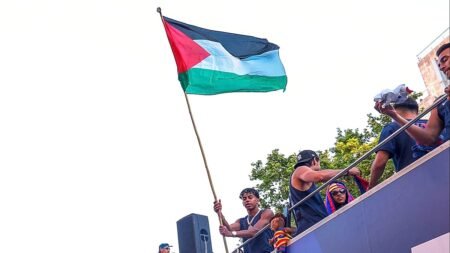
According to the force, the 2026 event is set to mark “one of the busiest days for policing in London in recent years”, coinciding with a demonstration in solidarity with the Palestinian Nakba Day and the FA Cup Final at Wembley Stadium.
A heated response
Several US figures say they have also been denied entry to the UK, including commentator Joey Mannarino and MAGA influencer Valentina Gomez, who spoke at last year’s rally.
While British Prime Minister Keir Starmer did not reveal the identity of the individuals who had been banned, he described them as “far-right agitators.”
In a statement shared on 15 May, he stated that his government would not stand in the way of peaceful protest, but that it would “ban those coming into the UK” to stir up violence.
In another speech made on 11 May, he said, “We will not allow people to come to the UK, threaten our communities, and spread hate on our streets.”
The decision to ban speakers from attending this year’s edition has paved the way to online speculation and debate, with many arguing that the move is an affront to freedom of speech and an individual’s right to criticise migration policies.
Taking to X, Tommy Robinson, whose real name is Stephen Yaxley-Lennon and who has multiple criminal convictions, stated that the UK government was “banning Americans en masse” from entry to the country.
Robinson contrasted the ban with the fact that “thousands” of so-called “invaders” are “chaperoned in every week and put up in hotels!”, making an inflammatory reference to immigrants and asylum seekers.
He has long been a critic of Starmer’s immigration policy and has repeatedly spread false claims and conspiracy theories about migrants and Muslims in the UK.
Who are the banned individuals and what have they said?
Tarczyński, an MEP from the European Conservatives and Reformists Group, has vowed to “sue” Keir Starmer in response to his ban should the prime minister ever leave office.
“Not the government, not the Home Office, but Starmer personally”, he said on X on 12 May.
Tarczyński is known for his staunch anti-immigration stance as well as controversial statements, including that Poland should not take in a single Muslim immigrant.
In 2019, he stated, “We don’t want Poland being taken over by Muslims, Buddhists, or someone else…”
“For me, multicultural society, it’s not a value,” he added. “Christian culture, Roman law, Greek philosophers, these are the virtues for us.”
Ada Lluch is a 26-year-old Catalan activist and influencer, who has attracted controversy for nationalist and anti-immigration views, having previously made controversial statements about Spain being “better off” under Spanish dictator Francisco Franco in posts shared on X in 2024, as reported by El País.
Following the ban, Lluch wrote on X: “One of the reasons Keir Starmer said he banned us from entering the UK is because we don’t bring solutions to the problems. I think the solution is obvious: WE WANT REMIGRATION. AND WE WANT IT NOW!”
“Remigration” is a slogan frequently employed by parts of Europe’s far-right. Proponents say that it’s a form of immigration control in response to rising migration levels, but critics, including human rights groups and legal experts, have described it as discriminatory and racist.
The US-based non-profit Global Project Against Hate and Extremism describes it as a “white supremacist policy concept” that calls for the mass forced removal of immigrants, refugees, and their descendants based on race, ethnicity, culture, being perceived as “non-white,” or a failure to “assimilate”.
The concept has been linked by researchers to the far-right “Great Replacement” theory, which suggests that Western civilisation is threatened with an irreversible decline, due to falling birth rates and an influx of migrants from the Middle East and North Africa.
Dutch political commentator Eva Vlaardingerbroek has previously declared: “They are demanding the sacrifice of our children on the altar of mass migration. Let’s not beat about the bush — this is the rape, replacement and murder of our people … Remigration is possible, and it’s up to us to make it happen.”
Vlaardingerbroek was first notified that her ETA had been withdrawn in January, days after she accused Starmer of allowing “the ongoing rape and killing of British girls by migrant rape gangs”.
Flemish MP Filip Dewinter, who qualified Starmer’s government as “communist”, was embroiled in controversy in 2015, after he shared an X post which stated that the word “racist” was no longer an insult but had become a “title of honour.”
Dewinter included the hashtag #ikbenracistendaarbenikfierop in the post, which translates as “I am a racist and proud of it” — before deleting it.
In her speech made at last year’s event, 26-year-old Colombian-American influencer Valentina Gomez told the crowd that “rapist Muslims” were “taking over” the UK.
“England, they took your guns, they took your swords, and they raped your women,” she said. “You have nothing else to lose, but there’s still hope. You are still the majority. So you either fight for this nation or you let all of these rapist Muslims and corrupt politicians take over.”
Gomez has repeatedly made anti-Muslim statements, sharing an X video depicting her burning a Quran in August 2025, stating, “your daughters will be raped, and your sons beheaded — unless we put an end to Islam once and for all.”
Why have the far-right commentators been banned?
While the Home Office did not confirm why any of the individuals have been banned from the UK, we can look at the country’s existing rules to see what kind of behaviour constitutes a refusal.
The UK government can refuse entry for a wide range of reasons, from past criminal convictions, visa violations or, as in this instance, due to their presence not being “conducive to the public good.” This was the reason cited by Home Secretary Mahmood.
Contrary to online claims, refusing entry on these grounds is not exclusive to Starmer’s current Labour government.
According to a research briefing published by the House of Commons library, past successive Conservative governments have predominantly used visa bans to bar extremists and “hate preachers” from entry, with a focus on Islamist figures accused of supporting terrorism or sectarian violence.
However, other kinds of individuals were also banned under the Conservatives. For instance, in 2013, the UK’s then-home secretary, Theresa May, banned two US bloggers, Pamela Geller and Robert Spencer, from entering the country, citing their stance against Islam.
Between May 2010 and December 2022, successive home secretaries under the Conservatives ordered the exclusion of 369 people from the UK, averaging approximately 30 cases per year, according to annual reports on the use of anti-terrorism powers.
Therefore, claims portraying the policy as unique to Starmer’s Labour government — which came into power in July 2024 — are misleading, as such measures were already in place under previous Conservative prime ministers.
According to the “Counter-terrorism disruptive powers report”, 15 individuals were excluded from the UK in 2024, because their presence in the UK was considered not conducive to the public good.
Across social media, those opposing the visa ban have claimed that freedom of speech is no longer protected in the UK.
However, UK law stipulates that freedom of speech is protected under Article 10 of the Human Rights Act 1998, which incorporates the European Convention on Human Rights. Nevertheless, it also explicitly allows governments to limit free speech to prevent crime or for national security matters.
The 1986 Public Order Act, amended by the Racial and Religious Hatred Act 2006, criminalises rhetoric which incites racial or religious hatred. This includes using “threatening” words or behaviour, or distributing material which intends to stir up religious hatred.
Tommy Robinson, a divisive figure
While Robinson has taken to X to urge participants at the 2026 rally to engage in peaceful protest, he has previously faced repeated criticism for his rhetoric, notably using the term “invaders” to refer to asylum seekers.
Separately, he has spread misinformation about migrant communities, for instance, sharing false claims about the perpetrator of the July 2024 Southport attacks.
He alleged that the attacker who killed three girls in a Taylor Swift-themed dance class was a Muslim asylum seeker who had just arrived in the UK on a small boat.
In reality, the 17-year-old perpetrator was born in Cardiff, Wales, to Rwandan parents and had no known connection to Islam. False claims about the suspect helped fuel mass rioting and marked the largest flare-up in violence in England since the 2011 riots.
At last year’s edition of the rally, a video address by tech billionaire Elon Musk, who has also routinely amplified hardline criticism of Starmer’s stance on immigration, was condemned by Downing Street, after he told the crowd “violence is coming” and “you either fight back or you die”.
Successive British governments have repeatedly struggled to reduce net migration, but the tide appears to be turning: during Labour’s first year in office, migration to the UK fell by more than two-thirds in the year ending June 2025 — the lowest annual figure since 2021, according to the Office for National Statistics (ONS).
The UK’s 204,000 net migration figure sharply contrasts with the recorded peak of 944,000 in the year ending March 2023, under the previous Conservative government. This roughly 80% fall was mainly driven by fewer arrivals for work and study reasons, according to the ONS.
A 2025 study by the Migration Observatory at the University of Oxford states that it’s difficult to compare conviction and incarceration rates among British and non-British citizens because there are no reliable statistics on the size of the population.
However, the available statistics do reveal some trends. For example, young adults are more likely to commit crimes regardless of nationality; when controlled for age or sex, non-UK citizens are underrepresented in the prison population; and non-Brits are overrepresented among offenders for drug offences, but underrepresented for robbery or physical violence, according to the study.
Read the full article here