



 Markets
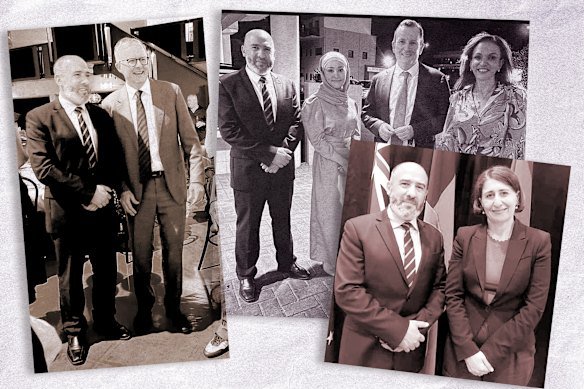
Rateb Jneid is a former bankrupt and builder who is also a lawyer, a religious minister and a marriage celebrant with three master’s degrees, a PhD in education and a professorship at King’s International University in Tonga.
He is also the president of the Australian Federation of Islamic Councils, which has amassed a $56 million property portfolio and generates $4.5 million in revenue each year while lobbying prime ministers and state premiers on behalf of the Muslim community.
Now he is at the centre of a civil war raging inside Australia’s top Muslim organisation, in which members have been expelled; and email campaigns have enveloped foreign embassies amid claims of donations linked to charities run by his family, culminating in a warning from the government regulator that it risks losing its charity status.
Established in the 1960s as a national umbrella body representing Muslim communities through local societies, state councils and a federal executive, AFIC represents more than 120 member organisations across the country. It has long played a central role in mosque building, religious education and advocacy.
Mohammed Berjaoui, who was removed from AFIC’s executive committee last year, says the body has strayed far from its founding purpose.
“It has a long history of being a very good organisation,” the Canberra-based administrator said. “But it’s been hijacked by this person.”
Jneid has accused Berjaoui, his former assistant treasurer, of undermining the organisation by disseminating misleading material.
“The allegation that AFIC has been ‘hijacked’ by one individual is senseless and must be viewed in the above context of Mr Berjaoui’s removal from AFIC,” AFIC’s lawyers, who also represent Jneid, said in a statement.
Jneid is in his ninth year of what, according to AFIC’s constitution, is a maximum of two three-year terms as president. The 55-year-old has delayed the election four times after cementing control of Australia’s peak Muslim representative body despite his family’s colourful history.
Two of Jneid’s brothers, Ziad and Rabih Jneid, were sentenced to up to 15 years in jail in 2016 for trafficking methamphetamine on a “significant scale” from the family home.
Rateb was fined for failing to secure his gun properly during the drug raids, but he was not accused of being involved in his brothers’ trafficking operation.
Two more of Rateb’s brothers, Khaled Jneid and Zakaria Jneid of Kewdale, now appear on Western Australia’s major fine register as owing more than $390,000 combined in fines to the state government.
“All records in relation to those convictions are historical and entirely irrelevant to the operation of AFIC,” Rateb’s lawyers said.
“In any case, people make mistakes and are capable of rehabilitation, particularly when they have been reprimanded for their misjudgments through the appropriate legal processes.”
Zakaria is also the president of International Humanitarian Aid Inc., based at the family home in Kewdale, south-east Perth. Rateb’s elderly mother, Mona Sukari, is the vice president.
The modest suburban home disguises the charity’s grand mission: to provide food, clothing, shelter and medical aid to those suffering from war, famine and natural disasters.
But despite receiving $400,000 in donations since 2020 and passing on $280,000 as donations to other charities, there is little public record of any aid it has directly delivered.
International Humanitarian Aid Inc lawyer Tarek Kheir said the charity had provided aid to communities, including during Ramadan, and that it had assisted university students during COVID-19.
Kheir also provided a photo of coupons, sacks of food and boxes, as well as a video with the charity’s logo on a piece of paper in a warehouse.
“No donation was said to have been received or spent for an improper purpose,” Kheir said.
According to a complaint submitted to AFIC by former chief executive Hicham Zraika, International Humanitarian Aid Inc has received $102,500 in donations from AFIC. Until March 2020, the charity also received funding through AFIC’s Eftpos terminals. The organisation’s website is now down.
International Humanitarian Aid Inc is supported in soliciting donations by the Muslim Youth Support Centre Western Australia. The charity was founded by Rateb’s son, who was its president until late 2019. His relatives, Abdullah Jneid, Amir Jneid, and Mohammed Jneid are listed as the charity’s treasurer, secretary and chairperson with the Australian Charities and Not-for-Profits Commission. The charity has received at least $50,000 in donations from AFIC, plus a loan that was subsequently waived.
Again, there is little public record of where funds have been distributed after calls for donations for natural disasters, including the 2023 Turkey earthquake, and for goat meat supplies to combat hunger in Kenya, Somalia and Lebanon.
When its Facebook page was active until 2024, it largely focused on Rateb’s activities, including delivering speeches in India, lobbying against voluntary assisted dying legislation in NSW and presenting local football awards. Its website has also since disappeared.
Kheir said the charity had delivered sporting programs and counselling services for young people. The lawyer also supplied photos of a dinner, a lunch and a football game run by the charity.
Last year, AFIC’s executive committee waived the debt owed by the Muslim Youth Support Centre Western Australia. “There was full disclosure of the conflict of interest with respect to the loan,” Rateb’s lawyers said.
Minutes of meetings by the AFIC’s executive committee show that donations or grants were routinely awarded to other charities and relevant associations. They also show that executives would declare when they had conflicts of interest and would excuse themselves from the meeting for the duration of that specific discussion. Rateb’s lawyers said he “withdrew from the meeting when the decision was made to waive the debt, although his son is no longer the president of [Muslim Youth Support Centre Western Australia].”
“The executive committee acted pursuant to inquiries made by the treasurer regarding MYSCWA’s liquidity as well as legal advice obtained by AFIC, which disclosed that enforcement was not an option,” his lawyers said.
But the charities and their links to the AFIC president were not the only connections that have raised concerns among AFIC executives.
Another former AFIC chief executive, Kamalle Dabboussy, said in 2024 that, when he raised concerns about a bank account being “run off the books” for Al-Ameen Mosque being built by AFIC in Perth, Rateb allegedly told him not to declare that it was related to AFIC. The dispute was first reported by The Australian.
“We will avoid scrutiny this way. There is too much chatter,” Rateb allegedly told Dabboussy.
“We set the bank account up that way on purpose. I want to avoid people barking at us. We don’t want to get all these questions and answers from people about the bank account. The public doesn’t understand. That is why we don’t include it. I don’t care what other people think.”
After raising concerns about a conflict of interest involving Rateb, Dabboussy was accused of inappropriately complimenting a female employee’s appearance. Dabboussy’s employment was wrongly terminated. Then a court ordered him to be reinstated. Dabboussy later reached a confidential $300,000 settlement with AFIC. He did not respond to requests for comment.
Rateb’s lawyers said the “real story here” is that Al-Ameen Mosque, which was purchased during the dispute, was purchased for $730,000 and is now worth more than $3 million.
“A significant windfall for the Muslim community that AFIC is proud of,” they said.
The lawyers said Dabboussy’s allegations were “subject to an exhaustive audit by the ACNC and were found to be unsubstantiated”.
Rateb has spent a decade building relationships at the top of Australian politics, meeting with Prime Minister Anthony Albanese, former NSW premier Gladys Berejiklian and former WA premier Mark McGowan.
From his base in Perth, the 55-year-old has wielded control over AFIC’s branches in the eastern states, earning the ire of rivals as well as growing scrutiny from the charity regulator.
After demanding more financial transparency from Rateb about the donations to his family’s charities and about travel expenses, credit card spending and a series of secretive decisions, Berjaoui said he became the target of a series of anonymous emails, including threats and accusations of disloyalty.
Rateb, in return, accused Berjaoui of engaging in “fitna” against the organisation – an Arabic term that means sedition or rebellion.
In September 2025, Berjaoui says the Lebanese embassy and the Palestinian embassy were copied in on an email smear campaign accusing him of having no understanding of Islam, “stabbing Rateb in the back”, urging members to kick him out of AFIC and warning him that “you do not know when Allah will take your soul”.
In November, the tension exploded in public when Berjaoui allegedly assaulted Rateb’s ally, former president Keysar Trad, by slapping him at AFIC’s Zetland headquarters. He has pleaded not guilty to common assault. He will face trial later in the year. It is the second time Berjaoui has had a physical altercation with another AFIC executive: he was hit with a good behaviour bond for throwing papers in the face of another former president in 2015.
The internal dispute escalated further at a December 3 executive meeting at which Berjaoui was expelled, a decision AFIC said was made in accordance with its governance responsibilities.
Rateb’s lawyers said AFIC had undergone substantial reform under his presidency, including strengthening its internal governance, restoring external stakeholder relationships and resolving longstanding legal matters.
But Berjaoui is increasingly concerned by the politicisation of the organisation under Rateb’s leadership. He has transformed the charity from one focused on logistics such as building schools and mosques to a political player in its own right – a fraught undertaking for a body designed to accommodate a wide variety of Islamic divisions from dozens of countries.
Rateb has been prolific in recent months, publishing statements almost every day in March, ranging from peace plans for Palestine to the legacy of 12th-century Muslim leader Salahuddin al-Ayyubi (known in the West as Saladin) and a 12-page research paper on the treatment of Uighurs in Xinjiang.
Artificial intelligence detection tool GPTZero reveals that between 66 and 100 per cent of the statements distributed by Rateb are AI-generated.
“AFIC is a representative of the Muslim Community and feels the Muslim voice is not being adequately heard,” Rateb’s lawyers said. “Accordingly, AFIC will continue to unashamedly amplify issues that are important to the Muslim community.”
Rateb has also criticised the Australian government’s response to attacks on Iran, hate speech legislation, and he has also defended Hizb ut-Tahrir, a radical Islamist organisation.
“We shouldn’t be involved in any politics at all,” Berjaoui said. He said public statements on conflicts in the Middle East and South Asia could jeopardise grants relied upon by member organisations.
Few people understand the visceral internal warfare of AFIC like Haset Sali, a retired lawyer now based on the Sunshine Coast. A founding father of the peak body four decades ago and its former legal counsel, he was purged along with his Shepparton Albanian Association in 2006 by what he describes as a “cabal” that has since steered the organisation into a nosedive.
Sali doesn’t mince words, branding the current culture as “toxic” and the state of AFIC-managed schools as “tragic”. He said the 2006 coup wasn’t about policy — it was about a multimillion-dollar goldmine.
“We had the assets valued at roughly $100 million,” Sali says. “By the time they carried out their … practices … the organisation just lost its way. They decided we were running it too healthily. They wanted the initiative so they could milk the resources.”
Sali said the organisation needed a drastic intervention but he feared no politician has the appetite, and too many good people had been turned off by the bitter infighting.
“I took my responsibilities very, very seriously over more than 20 years. I’d like to help in some way if I could,” he said.
AFIC now faces an existential threat. Rateb has delayed the most recent election four times since November because of changes to accountants and auditors, and a scheduling clash with the AFL’s Gather Round in Adelaide, which booked out hotel rooms in the city where the election was due to be held. The election is now set for July 26.
“Dr Rateb Jneid will not be standing for re-election,” his lawyers said, stating his presidency had been extended in the circumstances of the COVID-19 pandemic.
“Dr Jneid’s service involved significant personal sacrifice, including extensive unpaid work and extended periods away from his family during the early months of organisational stabilisation.”
But Rateb’s critics within the organisation fear his replacement will be one of his many proxies, and that his influence within AFIC’s governance will remain.
The election delays have left AFIC in limbo as it continues to tear itself apart on multiple fronts, including a bitter legal feud with its NSW affiliate, United Muslims NSW, which AFIC suspended over claims of membership stacking and financial irregularities, which United Muslims denies. AFIC also threatened the Islamic Museum of Canberra Inc and the Arab Australian Friendship Society with expulsion last month.
In a 2022 Supreme Court ruling on the dispute with United Muslims NSW, Justice Jeremy Kirk said Rateb “does not appreciate receiving criticism”.
“He has sometimes taken steps to avoid being held accountable, which reflects poorly on him,“ he said, adding that his evidence “should be approached with caution”.
The charity regulator also has AFIC in its sights. The ACNC warned AFIC that it risks losing its charity status and Commonwealth tax concessions if it fails to manage its conflicts of interest and accountability obligations. Stripping it of both could make the peak body responsible for representing more than 800,000 Muslim Australians financially unviable.
“It was a final warning,” said Berjaoui. “Rateb is treating it as a family business. AFIC should be treated as a company, not as a small grocery shop in a village in Lebanon.”
 Rob Harris is the national correspondent for The Sydney Morning Herald and The Age based in Canberra. He is a former Europe correspondent.Connect via email.
 Eryk Bagshaw is an investigative reporter for The Sydney Morning Herald and The Age.
He was previously North Asia correspondent. Reach him securely on Signal @bagshawe.01Connect via X or email.
From our partners
Read the full article here