






 Markets
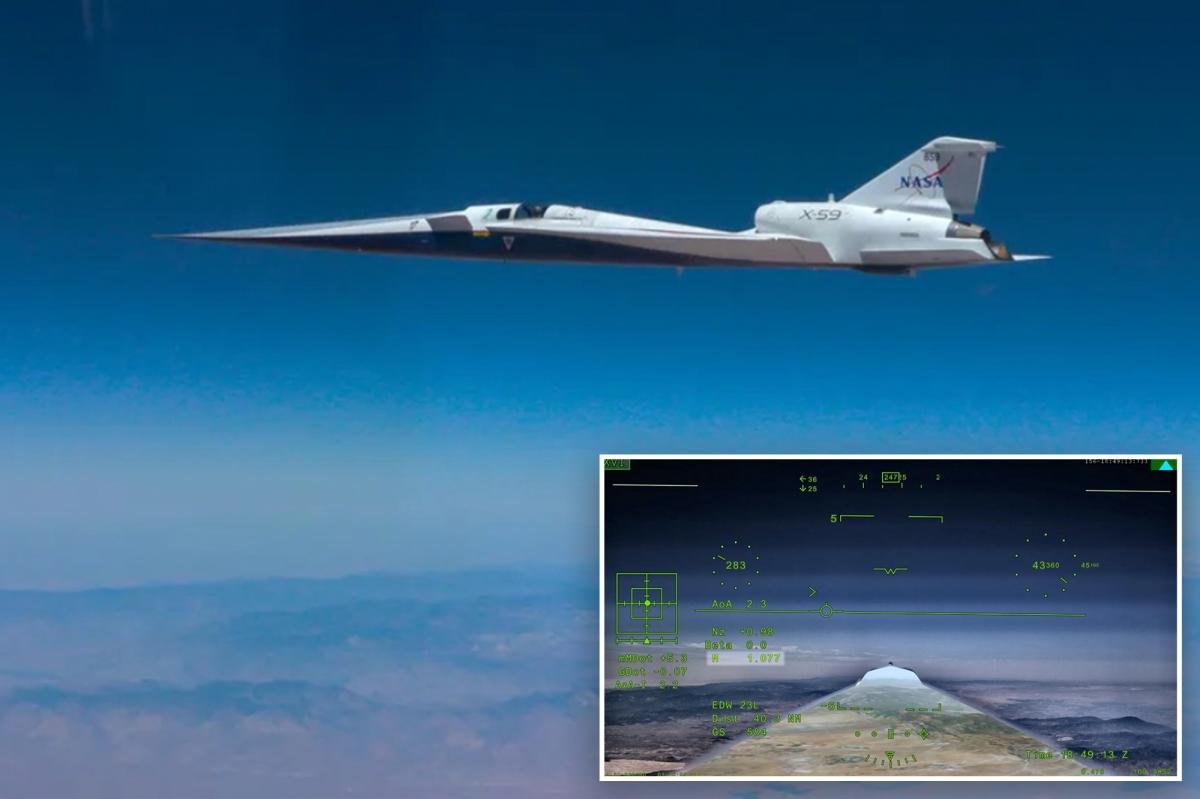
Traveling at the speed of sound may actually be on the horizon.
NASA’s supersonic aircraft, dubbed “son of Concorde” after its predecessor, successfully broke the sound barrier for the first time. The experimental X-59 aircraft completed an 81-minute test flight on Friday, 5 June, reaching a speed of nearly 713mph while flying at an altitude of 43,400ft, according to the space agency.
The jet completed an 81-minute test flight earlier this month over California’s Edwards Air Force Base, reaching Mach 1.1 — nearly 713 mph — at an altitude of 43,400 feet.
The successful flight brings NASA one step closer to making faster-than-sound passenger travel a reality once again, potentially slashing flight times between cities like New York and London to under four hours. But unlike its famous predecessor, the X-59 isn’t just designed for speed; it’s also designed for stealth.
For decades, one of the biggest obstacles facing supersonic travel has been the thunderous sonic boom produced when an aircraft breaks the sound barrier. The explosive noise can top 110 decibels, rattle homes and even crack windows, prompting US regulators to ban civilian supersonic flights over land in 1973.
NASA hopes the X-59 can change that.
The aircraft’s unusually long nose and carefully sculpted body are designed to spread out the shock waves generated during supersonic flight, transforming the traditional sonic boom into little more than a soft “thump” heard from the ground.
The futuristic design comes with one unusual drawback: there are no forward-facing cockpit windows. Instead, the pilot relies on a network of high-definition cameras and augmented reality displays known as the eXternal Vision System to see ahead.
“You know you are supersonic when gauges say you are supersonic. I didn’t feel anything,” said test pilot Jim ‘Clue’ LessLess. ‘It went smoothly, and we easily got to Mach 1.1.’
The “Son of Concorde” is an aircraft with an unusually long nose and a sculpted body, designed to help spread the shock waves generated during supersonic flight. Instead of a deafening boom, people on the ground should hear little more than a soft “thump.”
Since its maiden flight in October 2025, the X-59 has completed dozens of increasingly challenging tests as engineers gradually expanded the aircraft’s flight envelope.
“Flying at supersonic speeds is a major milestone for the X-59 team,” said Cathy Bahm, project manager for NASA’s Low Boom Flight Demonstrator. “Completing the first mission-conditions flight is especially meaningful — it’s the moment where we begin validating the aircraft in the environment it was designed for.”
But just because the aircraft can go that fast doesn’t mean it will always fly supersonic. According to NASA, testing will continue, including a mix of subsonic and lower-altitude flights, so the team can continue monitoring it in varied conditions.
The aircraft has inevitably drawn comparisons with Concorde, the iconic Anglo-French supersonic jet that carried passengers across the Atlantic in less than 3.5 hours.
Concorde entered commercial service in 1976 and became synonymous with luxury air travel, but its loud sonic boom restricted routes to mostly ocean crossings. A crash outside Paris in 2000, combined with soaring operating costs and a downturn in air travel after the Sept. 11 attacks, ultimately doomed the program.
The final Concorde flight took place in November 2003, seemingly ending the era of commercial supersonic travel.
More than two decades later, NASA hopes the X-59 can bring it back — only this time, without the boom.
NASA’s isn’t the only aircraft touting the “son of Concorde” honorific, as last year Boom Supersonic’s single-seat XB-1 jet hit 844 mph in just 12 minutes —
Read the full article here