


 Markets

Spending on local missile manufacturing and systems to protect Australia from drone and missile attacks will surge over the next decade as the Albanese government rejects accusations it is using accounting trickery to inflate defence spending figures in a bid to placate the Trump administration.
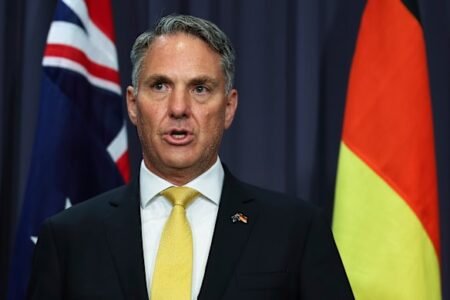
Defence Minister Richard Marles broke with Canadian Prime Minister Mark Carney and other commentators who have declared the global rules-based order is dead, arguing that Australia needed to defend the system of norms and laws that has helped it prosper in recent decades.
He warned Australia stands “at the foothills of a new nuclear arms race” in the Indo-Pacific and needed to spend more to defend itself as major powers such as the US and Russia abandon previous arms control efforts.
The national defence strategy and 10-year spending plan revealed on Thursday showed the government would spend an extra $53 billion on defence over the next decade and $14 billion extra over the next four years.
Reflecting frustration within the government at claims it has not spent enough on defence, Marles said military spending did not rise “as a result of think tanks, or former generals, or washed-up bureaucrats” but because of vigorous debates around the cabinet table.
The government revealed it would cut $5 billion from existing defence programs over the next four years, and $10 billion over a decade, to free up money for drones, nuclear-powered submarines and other advanced technologies.
Senior sources, speaking on condition of anonymity, said the capabilities being scrapped included the air force’s fleet of 10 C-27J Spartan aircraft, considered overly expensive to maintain and capable of being replaced by cheaper aircraft.
The new spending plan showed that the government would spend up to $36 billion on local missile manufacturing over the next decade, up from an estimate of $21 billion two years ago.
Spending on missile defence would grow to as much as $30 billion over the next decade, a major increase on the $18 billion estimate in 2014.
“We will accelerate the introduction of air and missile defence capabilities, including new investment in a medium‑range, ground‑based air defence system, recognising the increasingly contested air and missile environment,” Marles said in his speech to the press club.
“This program will commence as a priority from 2026 to enhance protection against advanced aircraft as well as cruise and ballistic missiles.”
Marles said Australia would be spending 3 per cent of gross domestic product on defence by 2033 by using a North Atlantic Treaty Organisation (NATO) definition that includes areas of spending – such as on military pensions – that have not previously been used in Australian defence spending calculations.
The Trump administration has urged allies, including Australia, to spend at least 3.5 per cent of GDP on defence.
Opposition defence spokesman James Paterson accused the government of “using an entirely new measure of Australia’s defence spending as a proportion of GDP”.
“Accounting tricks do not make our country safer, and changing the rules about how we measure defence spending is pulling the wool over the eyes of the Australian people, not being upfront and honest with them about exactly how much we are spending,” he said.
Marles said the government was seeking to “compare apples with apples” by assessing Australia’s defence spending alongside like-minded nations in Europe and North America.
Marcus Hellyer, regarded as the nation’s leading defence economist, said he estimated Australia would be spending 2.47 per cent of GDP on defence by 2033 using the traditional method of calculation.
Greens defence spokesman David Shoebridge said: “At its core this new strategy is doubling down on the US alliance, while still pretending it is based on a ‘shared commitment to rules, sovereignty and self-respect’. You can only deliver this message if you actively ignore all the evidence of the US actively trashing international law and peaceful norms.
“For all the trumpeting of increased spending, it’s worth noting it’s primarily delivered by an accounting trick where defence pensions get rebadged as defence spending and most of the actual budget increases are being sunk straight into the AUKUS submarine black hole.”
The government’s spending plan reveals the vast scale of spending on the nuclear-powered submarine program over the next decade: $71 to $96 billion, dwarfing investments in all other military capabilities.
Over the next decade, 41 per cent of defence spending will be allocated to the navy, largely because of the investment in AUKUS, compared to 17 per cent for the army and 14 per cent for the air force.
This compares to a 2020 estimate of 28 per cent of spending for maritime defence, 24 per cent for the RAAF and 20 per cent for the army.
The spending surge reflects the growing importance of the navy, alongside the promotion last week of navy chief Mark Hammond to lead the Australian Defence Force.
Marles said the global rules-based order was “under extreme pressure” as he singled out China for massively increasing military spending without transparency and enforcing contested territorial and maritime claims in the South and East China seas.
However, he said he strongly disagreed with the “the idea of the global rules‑based order – an order where nations can pursue their security and economic interests, consistent with international law and free from coercion – is now extinct”.
“The global rules‑based order provides a middle power like Australia with agency,” he said.
“A world defined purely by power and might does not. And it is most definitely against Australia’s national interest to rush – as some Australians have – to the conclusion that this order no longer has any role.”
Australian Strategic Policy Institute executive director Justin Bassi praised Marles for rejecting the “cynical claim that rules are dead and we need to rely on interests over values”.
Ian Langford, a retired senior army officer who served in top Defence roles, accused the government of using “accounting tricks” to inflate the level of defence spending as a percentage of GDP.
Cut through the noise of federal politics with news, views and expert analysis. Subscribers can sign up to our weekly Inside Politics newsletter.
 Matthew Knott is the foreign affairs and national security correspondent for The Sydney Morning Herald and The Age.Connect via X, Facebook or email.
From our partners
Read the full article here