




 Markets

The City of Albany, in Western Australia’s Great Southern, holds a special place in the Anzac legend.
For many of the soldiers departing Australian shores on their way to face combat in the nation’s first major overseas conflict, one of the last sights they saw of their homeland was Mt Clarence standing above King George Sound.
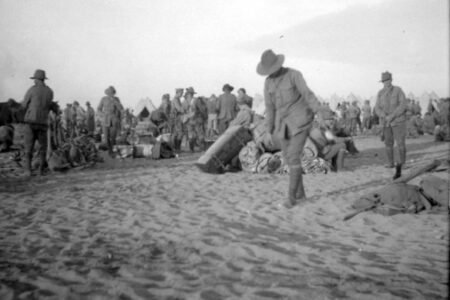
In late 1914, more than 41,000 Australian and New Zealand soldiers left the then-port town as they set off to fight in World War I.
Albany was picked as a rendezvous as it was an important coaling and watering port. It was also chosen as King George Sound could safely shelter the 38 troopships and three escorting warships.
It is widely understood that the nation’s first-ever dawn service took place in Albany back in 1923, which has now become synonymous with the Anzac Day commemorations.
Mt Clarence is now the site of the National Anzac Centre, an award-winning facility built to commemorate the 100th anniversary of the departure of the Anzacs from what is now a busy regional city.
Albany Returned and Services League services director Michael Tugwell said the port city held a unique significance to the story of the Anzacs.
“Not just in WA, it is actually worldwide,” he said.
“I’ve served in the Middle East with the armed forces and I recently holidayed in Europe with my wife, and quite simply, people over there all know Albany is the departure point for the Anzacs.
“Therefore the title ‘Australia’s home of the Anzacs’ sits very proudly and attracts a huge amount of people.”
In addition to his official role, Tugwell also serves as the master of ceremonies for the dawn service and said the number of people attending the ceremony had grown over the years.
“With the current situation in the Middle East there is a heightened awareness of the fragility of peace.”
Albany RSL services director Michael Tugwell
“We now get 5000 people standing on that hill, and we get a secondary live stream down at the Albany Entertainment Centre and from there over to the Anzac Peace Park,” he said.
“So there are three options for people to attend, but it’s an incredible experience standing on top of that hill that was one of the last sights that so many young Australians and Kiwis saw in 1914, and it’s very special.”
Albany is the home to a host of historic sites dedicated to the service of AUstralia’s military personnel, including Princess Royal Fortress, The Desert Mounted Corps Memorial, Anzac Peace Park and, of course, the National Anzac Centre.
However, Tugwell said Anzac Day brought out the pride in the city.
“We have the standard program that we run each Anzac Day, and that consists of the dawn service at 530 followed by the gunfire breakfast at the Albany Entertainment Centre,” Tugwell said.
“The troops march down York Street from the town hall, stepping off at 10 o’clock, And the commemorative service down at the Anzac Peace Park that starts at 10.30am and finishes at about 11.30am.
“Finally, we have a public function at the Albany RSL/Stirling Club in Stirling Terrace starting at 12 o’clock.”
“It’s a major logistical exercise to get 5000 people up there in two hours at one skinny, narrow road. But it runs very smoothly. I’m very pleased with the bus company and the State Emergency Services staff who run that for us.”
Tugwell said the ongoing conflict in the Middle East had heightened awareness of the importance of Australia’s service men and women.
“With the current situation in the Middle East there is a heightened awareness of the fragility of peace,” he said.
“And the fact that we are the lucky people in the lucky country – and one would hope we stay that way.
“But I think it is always on people’s minds, certainly in a year such as this.”
Start the day with a summary of the day’s most important and interesting stories, analysis and insights. Sign up for our Morning Edition newsletter.
From our partners
Read the full article here