





 Markets
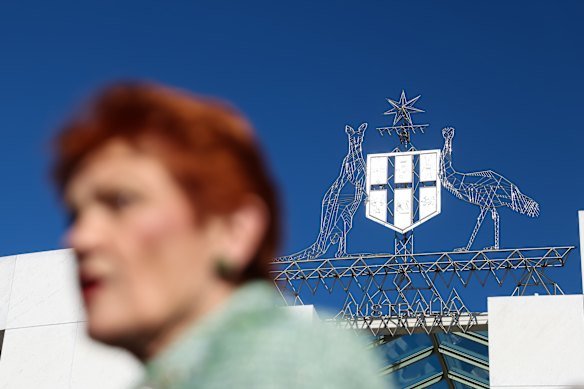
Last Sunday night, Channel 7’s Spotlight underscored the Pauline Hanson paradox. She draws attention to legitimate concerns over immigration and integration, but makes constructive discussion nearly impossible. Her clumsy attack on multiculturalism has had the effect of turning an imprecise term into a motherhood statement which unites opposition to her without clarifying the topic she raises. She channels some people’s deep-seated fear without being able to articulate it clearly enough for the root cause to be treated.
There are two ways of responding to a Pauline paradox. One is to ignore the confusion and embrace the opportunity to ventilate the issues. The other is to take advantage of the muddle to ignore them. Naturally, the Albanese government prefers the latter.
To be entirely historical, Hanson has not single-handedly injected the discussion over immigration and integration into the public debate. Rising rents and housing shortages have played a significant role in concerns over the rate of immigration. Australians have expressed increasing concern over community cohesion since the Hamas attack on Israel on October 7, 2023, revealed that the unwritten immigration decree – that old wars should not be brought to our shores – had been breached.
Polls, including Demos, have found that Australians are uncomfortable that the Israel-Hamas war has become a major, or at least persistent, issue in Australian politics. A decade earlier, polling found that Australians were in favour of banning the burqa which, through its visibility, can function as a proxy for concerns over integration. Hanson is not responsible for putting these things on the agenda; she was just there, ready and available to channel concerns when the Bondi terrorist attack took place.
She now has carriage of those concerns politically: 30 per cent of voters have indicated they would elect One Nation. More than a third of voters regard it as the party best placed to handle immigration.
The current attention on immigration and social cohesion is an opportunity for Australia to consider how integration processes might be strengthened and to address the separatism that has emerged in pockets of the community. Unlike the UK and many European nations, we do not yet have a big problem with parallel societies. But their various challenges are a warning that we should not be complacent.
Skilled immigration (which Australia can be more strict about than countries with land borders) is rarely recognised as the powerful tool of integration other nations lack. The right to come and the right to stay are levers at our disposal. And Australian citizenship is a genuine prize. The returning “ISIS brides” have, ironically, demonstrated its value. An Australian citizen has a powerful claim on Australia, which our nation honours. Citizenship should be commensurately difficult to obtain.
Instead, Hanson’s instinct has been to run down its meaning, first proposing that the women should not be permitted to return, then writing to Coalition leader Angus Taylor offering support to keep out a cohort of men linked to Islamic State, including a Perth-born doctor. Many Australians would share the concern she has expressed that people who have committed crimes of the nature this cohort is accused of will now be a burden on the taxpayer. Hanson could have sought assurances for us that they would not be eligible, or only on strict terms. But she can’t help herself, it seems. Instead, a careless interview in which she claimed Australia went wrong after it abolished the White Australia policy drowned the necessary policy discussion in a generic fury.
The ungainly idea of “monoculturalism” – which Hanson introduced at her first National Press Club address – had a similar effect of raising an important topic and simultaneously shutting it down. Since she coined the mono word, the term multiculturalism has been elevated into an untouchable pillar of the Australian character by politicians worried about getting voters offside.
There was a time, in the ’80s and ’90s, when the idea of multiculturalism was hotly debated. Some older conservatives, former prime minister John Howard and current Liberal Party president Tony Abbott among them, still hark back to that debate in their speeches.
The concern then was that celebrating a multiplicity of cultures implied people coming to Australia would or should continue to live according to the values and practices of their home countries, rather than embracing the liberal democratic values and egalitarian practices of the new country. It’s a fair point, now lost in the many words that have been spilt over multiculturalism versus monoculturalism. We’re now unclearer than ever what either term actually means. Both, apparently, can mean harmonious coexistence to some people while absolving others from considering whether we’re upholding something precious.
The worst effect of the Pauline paradox is that it diminishes the ability to name and deal with an underlying anxiety which has, alongside social cohesion, been a key driver of support for One Nation. Economic insecurity heightens concerns over immigration. But not so much in times of growth and prosperity. And there’s a good reason for that. When the economy is growing, opportunity is plentiful; the social safety net remains a contingency and there’s a reasonable expectation there will be enough for all.
As the UK and Europe have discovered, the dynamics shift dramatically when economic growth stalls, creating an understandable anxiety that sharing the available pie with more people will result in less for all. Social supports become less sustainable with more participants.
Immigration policy is made in the budget, not just at the border. The most important backdrop of the Spotlight episode wasn’t the number of burqas in the London borough of Tower Hamlets but the sluggish UK economy, supported by rising taxes (including an increase to capital gains tax). That economy now spends more on welfare than it earns in income tax. Yet One Nation has little to say on that front.
In this, as in other ways, it is the worst enemy of its own agenda. Until or unless it can solve the Pauline paradox, One Nation won’t leave much of a policy legacy.
Parnell Palme McGuinness is an insights and advocacy strategist. She has done work for the Liberal Party and the German Greens and is a senior fellow at the Centre for Independent Studies.
Get a weekly wrap of views that will challenge, champion and inform your own. Sign up for our Opinion newsletter.
 Parnell Palme McGuinness is an insights and advocacy strategist. She has done work for the Liberal Party and the German Greens and is a senior fellow at the Centre for Independent Studies. She is also an advisory board member of Australians For Prosperity, which is part-funded by the coal industry.
From our partners
Read the full article here