




 Markets
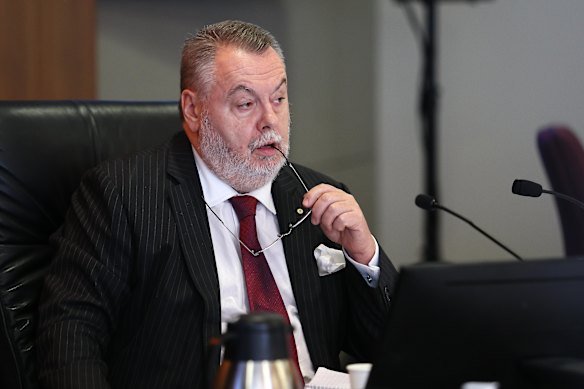
A union delegate threw a microwave in the break room and balaclava-clad men appeared outside building sites with weapons as the CFMEU used safety complaints about plastic chairs and rain puddles to get at contractors, a Queensland inquiry has heard.
Managers from the companies contracted to build Brisbane’s Cross River Rail appeared as witnesses at the state’s commission of inquiry into the CFMEU on Thursday, where they were questioned about a “safety reset” on the tunnel project that began in 2023.
Richie Atutolu, the man accused of throwing the microwave, was hired by contractor CPB as a workplace health and safety representative in August that year, according to Nicole Watson, a senior human resources adviser at global civil construction firm Ghella.
She told the inquiry there were two other concerns involving Atutolu beyond outside the break room incident that were raised with her during an investigation into his conduct in the workplace.
One involved him threatening to fight a worker on site, saying words to the effect of, “Righto, you want to mouth off? Get out the front and let’s go,” before storming out and eventually cooling down. Another also involved verbal threats and swearing.
He was one of 14 health and safety representatives, hand-picked by the CFMEU’s Jade Ingham, who were brought onto the Cross River Rail sites as part of a safety reset that began in 2023, after a worker fell from scaffolding and was seriously injured. Some had criminal convictions.
CPB project director Andrew Large told the inquiry it was a “pragmatic decision” to agree to the union’s demands to hire the safety representatives, but the group took advantage of their access.
“The activities they were doing were more about trying to influence and potentially disrupt non-CFMEU subcontractors in delivering their works on a day-to-day basis,” he said.
Ghella’s HR advisor Watson investigated another safety representative, Adam Langford, who stopped a crane company from coming onto the Boggo Road site in November 2024.
Watson said when she called Langford, she was surprised at his reply: “Ah, Nicole, I’m surprised they’re getting me on this. I’ve done heaps worse than this.”
Both Atutulo and Langford were let go from the project on Watson’s recommendation.
Watson said she heard complaints about union behaviour at the northern portal of the Boggo Road site, where the scaffolding injury had happened, including workers who said they had been threatened by union organisers.
“I was advised by one CFMEU organiser, [Matthew] Vonhoff, who was standing about a foot away from my face, that he knows who I am, he knows my bike, he knows my registration bumper, and that he was coming after me,” a worker said of an incident in August 2024.
Another said the union threatened them with violence if they refused to sign a new pay deal.
“Some CFMEU guys [sic] basically threatened if he doesn’t sign onto the CFMEU EBA they were going to bash him, and that’s when they showed him the weapons they were carrying, which were knives, guns and bats,” they told Watson.
Another email detailed men in balaclavas armed with knives and a handgun at the project gate around that time.
Safety notices ‘weaponised’ against CPB
The inquiry also heard evidence from Graeme Silvester, CPB’s general manager for health and safety, who accused the union of using trumped-up safety notices to block them out of future work.
He said the contractor would often deny union representatives who did not have entry permits access to the site. They would then return with workers from the regulator, Workplace Health and Safety Queensland, who would let them on site.
“They’d walk around site, sometimes for seven or eight hours a day, until they could find something wrong, and then we’d get a notice,” he said.
Silvester cited one month when a Cross River Rail project was given 56 notices – a number unheard of on Australian worksites, he said – adding they were not illegal, but often pedantic.
“We got a prohibition notice for plastic barbecue chairs in lunchrooms because they were domestic quality and not industrial standard. We got notices for puddles in walkways … because it was raining at the time,” Silvester said.
Silvester said when union organisers were turned away, WHSQ boss Helen Burgess would ring and give him a “fair rant”.
“It would hurt, I believe were her words,” he said he was told around the time of the 56 safety notices.
He described the union as “an organised crime gang” that was using WHSQ to achieve their goals.
Silvester believed the uptick in safety notices was directly linked to drafts of BPIC legislation that meant companies with repeat notices could not get state work in the future.
“We were getting notices to stop us getting work,” he said.
Start the day with a summary of the day’s most important and interesting stories, analysis and insights. Sign up for our Morning Edition newsletter.
From our partners
Read the full article here