






 Markets
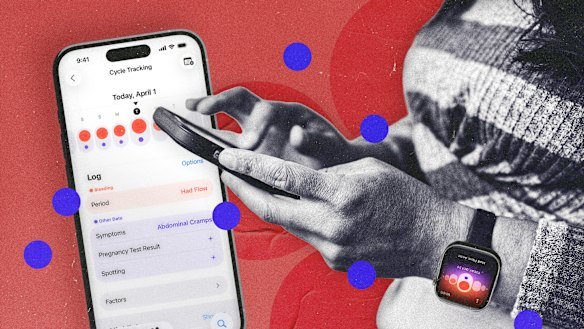
Apple, get the hell out of my uterus. If I wanted this level of exploration into my innermost privacies, I’d endeavour to bring back my mother from the dead, give her an inviting nod, and let her rip. Now I won’t need to.
Because as part of its 2027 software update, Apple’s Health app will be able to notify users when menstrual cycle patterns are suggestive of perimenopause.
But wait, I hear you ask: Isn’t it enough that our iPhone Health App already prompts us to log in our pregnancy test results? And tick whether we’ve had sex, and if we’ve used protection or not? (I’ll spare you the various types of “cervical mucus quality” you’re asked to share; you might be about to swallow your Weet-Bix.)
The answer is no, silly! Apple is here to help.
So those with uteruses can “understand more about what’s going on with your body and be better prepared to talk to your doctor”, said Apple spokesman Craig Federighi at the company’s announcement in California last week.
Now, let’s say I did have a hankering to share with Apple chief executive Tim Cook the sinewy details of my sexual and gynaecological life that I am unlikely to offer up to my closest friends. (Like you, I contain multitudes.) I still might not like where this could take me.
History gives us a peep into what happens when women’s gynaecological states are catalogued by those in power. There is the centuries-old tradition of women being subjected to the so-called “wedding night virginity test” – when a bridegroom brought out the white bedsheet, after he’d consummated his marriage, to prove to his community that his wife walked into the marriage a virgin. If the sheet had a red bloodstain on it, the bride was safe; this was seen as proof that her hymen, a thin membrane at the vaginal opening, had been in place before they had sex.
No bloodstain, and she could be subjected to beatings, and even divorce.
In the modern era, women undergo surgery out of fear of such reprisals.
“They are hiding something they don’t want to reveal,” Dr Chaitali Mahajan, from Mumbai, told Dateline in 2024 of her patients who ask her to perform hymenoplasty surgery to reconstruct their hymen before they marry. “There’s peer pressure. They want to hide that they’ve had intercourse before, or they haven’t shared it with their partner.”
It’s not always been men scrutinising and judging women’s worth by their genitals. Queen Victoria closely monitored the menstrual cycle of her daughter-in-law, Princess Alexandra of Denmark, secretly asking the princess’ doctor to let her know when Alexandra was menstruating, reportedly to find out if she was pregnant.
Alexandra’s first two children were born prematurely; historians think this is because she told Queen Victoria the wrong due dates, to thwart the Queen from being present at the births.
Because Alexandra knew then what we know now.
At best, it’s creepy when others want to document the state of our cervixes for their own private desires and agendas. At worst, it can lead to our death.
This is what happened to 28-year-old mother Amber Thurman in 2022. Unable to get a legal abortion in her home state of Georgia, she travelled to North Carolina for abortion pills. She developed a rare infection as a result, stumbling into a Georgia emergency department. A dilation and curettage procedure would probably have cured her. Except this, too, was outlawed there except in cases of managing a “spontaneous” or “naturally occurring” miscarriage. She died of sepsis.
And she’s not alone in that fatality list.
Abortion bans in the US are probably associated with increases in deaths during or within a year of pregnancy, according to a study published in the American Journal of Public Health in April.
Which brings us to Apple’s helpful tracking. Because tracking women’s journey into perimenopause is just Apple’s latest effort at stockpiling information about when we’re fertile, if we’re having sex, and therefore – presumably – if we’ve had a miscarriage or abortion.
That cervical mucus quality that Apple’s app asks us to track on our phones? It’s a metric that can alert a person as to how close they are to ovulation, and therefore an optimal time to become pregnant. So, too, is our basal body temperature. (Our phone asks for that, too.)
It’s possible that Tim Cook just needs a lesson in manners. (Remember, he’s the guy who oversaw aggressive practices that meant Apple users were locked out from fixing their own hardware.)
We all have what’s called an inside voice, Tim. It’s what saves us from wanting to wring each other’s necks. Your mother-in-law doesn’t need to hear, for instance, that when you clap eyes on her tortellini, hairballs immediately spring to mind.
Same goes with women’s uteruses.
We don’t want to hear your thoughts on them. Let alone share the state of them with you, or your tech bro mates. Although, from one intimate to another, I am curious. When will our iPhones start asking men about their erectile dysfunction?
Samantha Selinger-Morris is host of The Morning Edition for The Sydney Morning Herald and The Age.
From our partners
Read the full article here