




 Markets
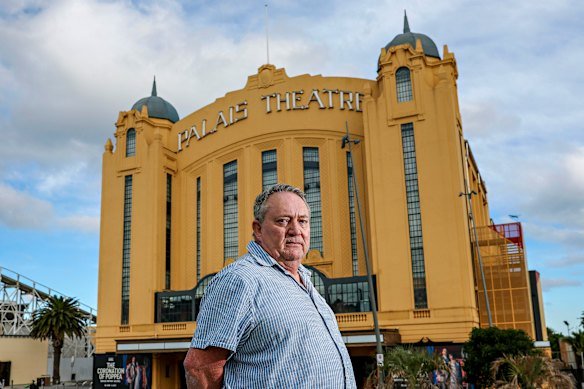
Murray Wight plucks another cigarette out of a green plastic case, his back turned to Melbourne’s Palais Theatre.
“I understand where you’re coming from,” he says, curtly.
“It helps that people out there realise, if this old fart can do this on his own, then maybe I can fill out the petition, and something will get done.” He clears his throat, puts the cigarette to his lips.
“I just don’t find it particularly interesting.”
Well, what is the interesting part, then?
Wight gestures emphatically with his free hand to the theatre behind him. “Common sense,” he says. “It’s just stupid.”
Eddie Jim
The last time Wight was here, he was straining to stand in a cramped dress circle seat inside the theatre, bellowing down at the stage, hands cupped around his mouth: “Stop the show, there’s a man dying.”
The laughter in the crowd dwindled to a murmur, and the comedian performing – until then, completely unaware – was shocked into silence. Finally, the house lights shuddered to life, revealing a man sprawled on the theatre steps.
Two nurses and an off-duty paramedic had tried desperately to revive him in the dark on March 26, 2025, but it was some 15 minutes before paramedics arrived and Wight heard the first beeps of a defibrillator.
More than a year later, Wight – irrevocably changed by that night – has his own grassroots campaign to mandate defibrillators in public venues and buildings in Victoria.
Wight plays out the scene on the footpath; running his hands over invisible red chairs, which he and his son leaned over to prop up the man after he slumped into the aisle.
With every minute a defibrillator is not used during cardiopulmonary resuscitation (CPR), a person’s cardiac arrest survival rate decreases by 10 per cent.
Ambulance Victoria’s median response time for cardiac arrest patients is eight minutes.
“It should be the people who run the country, this state, who are in charge of our health, saying, ‘this needs to happen because it will save lives’,” Wight says. “The advice that I was given was, when you write a letter to a politician, you have to allow six weeks for them to reply. After six weeks, they’ve had plenty of opportunity. They can’t say they didn’t get a fair go.”
Wight – a gruff but kind-hearted 66-year-old retiree living in Reservoir in Melbourne’s north – has done precisely that: given 128 Victorian MPs, including Health Minister Harriet Shing, and all Australian health departments ample time to express their support for legislative change. There is no legal requirement for public venues and buildings to have defibrillators on-site in any state or territory, except South Australia.
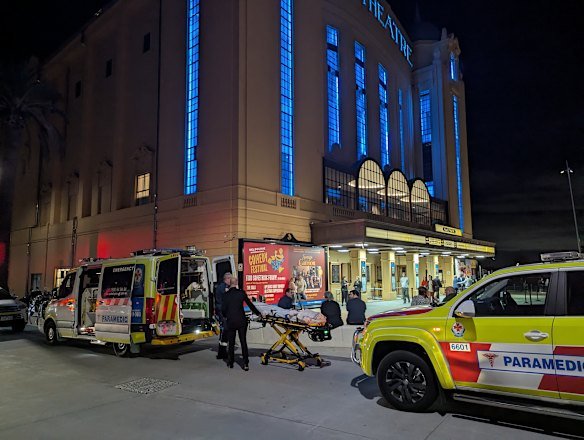
Since March, Wight has received no response from Shing, and just three personalised responses from MPs’ offices – among them, Sarah Mansfield, a general practitioner who weeks ago urged the state government to commit to a public defibrillator mandate. “I don’t even know what party she belongs to,” says Wight.
I tell him she’s the Victorian Greens’ deputy leader. “OK, well, good on her,” he says, with a wave of the hand. “To me, it’s never been a political thing – it’s about public health.”
Mansfield agrees. Without CPR and defibrillation from a bystander, the survival rate for people who go into cardiac arrest outside of hospital is about 5 per cent. That can increase to more than 60 per cent with quick access to a defibrillator.
“This is something where there’s just such clear evidence that having access to an AED makes a difference, that I’m not quite sure why you wouldn’t at least ensure that they’re available in public spaces,” Mansfield says.
“We know there’s real disparity across Victoria as well. If you look at the western suburbs of Melbourne, we know that there’s quite high rates of cardiac arrest relative to other parts of Melbourne and the state, but there’s very few AEDs that are publicly accessible.”
Shing doesn’t suggest her government is considering a mandate, but instead reiterates Victoria has 10,000 registered defibrillators – more than any other state or territory. She acknowledges that, “when combined with CPR and used before paramedics arrive, public access defibrillators dramatically increase the chance of a person surviving a cardiac arrest”.
“Knowing CPR, downloading the GoodSAM app [for cardiac arrest first-responders], and keeping our AEDs accessible and well-maintained will give more people the best chance of survival in an emergency,” Shing says.
The Victorian Liberals don’t have a policy on whether they’d support a public defibrillator mandate.
The Palais said the theatre has defibrillators in both front- and back-of-house areas, and they were made available to people working on the man that night. However, when The Age visited later, there were no clearly marked public defibrillators in the foyer, mezzanine level outside the theatre, or the dress circle. When Triple Zero operators checked the defibrillator registry – one of the first things they do when they take a call – there was none registered. This remains the case.
“We extend our sincere condolences to the family and loved ones,” says a spokeswoman for Live Nation, which operates the Palais.
“Out of respect to the family, we do not consider it appropriate for us to comment further.
“The Palais Theatre continues to maintain defibrillators at the venue, with relevant staff trained in their use.”
When I ask Wight what he wants out of his campaign, he gestures back to the theatre. “Next time I come to this place, it’ll have an AED on every floor,” he says. “My focus is, let’s get these things in these places. Let’s embarrass the politicians. Let’s get their asses kicked, because it is possible to do.”
Minutes before our meeting – the culmination of months’ of emailed updates and musings – Wight received an alert from the Victorian parliament, confirming his online petition to mandate public defibrillators was approved. Pulling his ute into a car park near the Palais and looking down at his phone, he was triumphant.
Start the day with a summary of the day’s most important and interesting stories, analysis and insights. Sign up for our Morning Edition newsletter.
Read the full article here