




 Markets
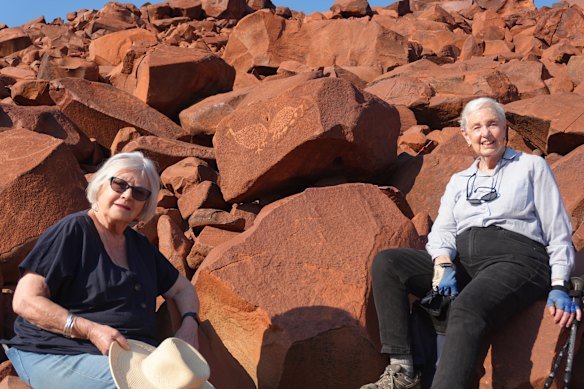
Judith Hugo and Susan Swain
We have just spent several days at Murujuga, guided by traditional custodians around a deeply sacred place that contains the largest, oldest collection of Aboriginal rock art in the world.
Since 2006, our organisation Friends of Australian Rock Art has been campaigning alongside Murujuga’s traditional custodians to protect this priceless cultural treasure, and we have visited many times.
Since our last visit, Murujuga has been designated as Australia’s latest World Heritage site by UNESCO, but industrial expansion has also continued right on top of this extraordinary ancient place, also known as the Burrup Peninsula in WA’s Pilbara.
With our guides, we spent days exploring the sacred songlines and stories contained in these carvings, up to two million in total, according to archaeological experts who accompanied us.
However, while appreciating the serene beauty of the landscape, it was impossible to avoid the sights and sounds of emissions from the massive gas plants on the site, including Woodside’s North West Shelf.
Last month, the government suddenly released the third annual Murujuga Rock Art Monitoring Report. Every year this report has been released later, and with greater secrecy. When you look at what it contains, that’s not surprising.
The WA government had previously tried to blame damage to the rock art on industrial emissions from a small power station that was decommissioned more than two decades ago and had been located more than 10 kilometres from the rock art sites which show greatest impacts.
Conversely, Woodside’s North West Shelf gas plant is situated within the area that the MRAMP report shows greatest rock art damage occurring.
UWA Professor of World Rock Art Benjamin Smith has previously stated that levels of current industrial emissions are “five times higher” than historic emissions. The lead statistician on the MRAMP study, Professor Adrian Baddeley, resigned after publicly criticising “unacceptable government interference” in the presentation of scientific findings in last year’s research.
So what does the long-awaited 2025 Murujuga Rock Art Monitoring Report (released a year late) tell us?
The previous MRAMP report found clear evidence that rock art close to industry had been damaged due to industrial pollution. The latest report has found that damage has affected more petroglyphs over a larger area than previously thought.
It also found that the report’s scientists from Curtin University could not rule out further and ongoing damage to the petroglyphs from industrial pollution.
These revelations are deeply alarming.
The latest results demonstrate exactly what independent scientists have been saying – and government and industry have been denying – for many years.
The MRAMP results also confirm that government regulators have been failing at their job of protecting the rock art at Murujuga. By denying these impacts for too long, the very agencies that are supposed to protect our heritage have actively enabled its destruction.
Other concerns with the MRAMP program include that the MRAMP program is funded by the industry who are causing the pollution at Murujuga – it is not independent.
The WA government also withheld the release of the MRAMP results until after key decisions were made to approve Woodside’s North West Shelf Extension, the largest source of industrial emissions at Murujuga.
Both industry and government regulators must be held to account for this ongoing damage to priceless World Heritage.
The situation remains that every single day, over 20 tonnes of industrial acid-forming pollution is released over Murujuga by Woodside’s LNG processing facilities.
That is why Friends of Australian Rock Art is challenging approvals for this facility in the state and Federal courts.
FARA was established to promote and protect ancient and unique rock art, especially the petroglyphs at Murujuga, and we were delighted to be joined by our legal team this week to introduce them to this extraordinary place that they are helping us fight to protect.
We are challenging the federal government approvals which allow ongoing operation of Woodside’s giant LNG export facility until 2070. The legal trigger for assessment of the project at the Commonwealth level under the EPBC Act was the National Heritage listing of the area secured in 2007. If it were not for FARA’s efforts to secure this listing there would be no federal assessment of the project.
FARA also has a separate WA Supreme Court challenge to the WA government’s approval for the project which is ongoing.
Murujuga is a World Heritage-listed cultural landscape of Outstanding Universal Value. It is not the right place for some of the most damaging and polluting industries.
The latest MRAMP results are a clear demonstration of why we must continue to fight for the protection of this global treasure, including from the impacts of industrial pollution.
We won’t stop fighting for Murujuga until governments and industry do the right thing.
Judith Hugo OAM and Susan Swain are the co-convenors of Friends of Australian Rock Art, which for two decades has advocated to protect, preserve and promote Australian rock art, particularly the petroglyphs found at Murujuga (the Burrup Peninsula) in Western Australia. In 2007, FARA successfully campaigned along with traditional custodians for Murujuga’s National Heritage Listing.
From our partners
Read the full article here